
Rare Book Monthly
Articles - August - 2009 Issue
USF: Collecting Dust

Civil Unrest
By Bruce McKinney
Ten years ago the changing functionality of libraries was, to many, already clear. Libraries would become electronic information gatherers and redistributors and their relationship to the printed word atrophy and decline. Libraries, the repository of books, would become the repository of information. The book, as storage and redistribution element, would be replaced by the database and, in time, the full text search. Libraries, the stodgy backwater of the intellectual revolution, would soon become its Omaha Beach. Five years ago sixty percent of librarians we surveyed, when asked whether the primary focus of the library was to provide information or provide books, stipulated information over books. This past year, in answer to the same question, information now held a 70 - 30 edge. A few years hence it will be 80%, then 90%.
Fast forward to The University of San Francisco in the spring of 2009 where change, reality and economic imperative recently converged on the Fulton Street campus of this Jesuit University. In May, for the second time in less than 3 years, material housed in the Donohue Rare Book Room was sold to raise cash. The first sale was of a painting removed from the rare book room walls that Bonhams & Butterfields sold at auction in December 2006 for $900,000. In returning to the auction rooms recently to again raise funds, this time to sell Durer prints, the university stepped into a minefield of anger and anxiety that has been building for some time. For those who predicted the decline of the traditional library a decade ago and long since decamped to the once-thought-to-be-safe confines of the rare book room, in the recent sale of printed material they see siege engines in the University's approach.
The reaction of three of the five communities intertwined with the rare book room has been one of almost absolute disgust and opprobrium. Staff and faculty, donors and volunteer support, and rare book dealers all feel betrayed because they believe such material is to be appreciated, treasured and absolutely retained. The other communities, the students and public, do not seem to much care.
What are the arguments?
Bill Reese, the distinguished American bookdealer, frames the issue for traditionalists this way.
"The sale of material from the Gleeson Library is a tragedy of the first order and a perfect example of what can happen when bottom-line philistines in administration find ways to squeeze money out of collections built up by the devoted effort of many people over a long period of time."
He then goes on to add,
"When an institution takes a collection in trust, there is a moral obligation involved. Just because donors were too trusting to think that their trust would be violated doesn't make it morally right, even if it is legally so."
Rare Book Monthly
-
![<b>Forum, Mar. 25:</b> Botany.- [Robin (Jean)]. <i>Histoire des Plantes, nouv...](https://ae-files.s3.amazonaws.com/AdvertisementPhotos/9a2a2dbe-8edf-4091-9a08-800f7aba747e.jpg "<b>Forum, Mar. 25:</b> Botany.- [Robin (Jean)]. <i>Histoire des Plantes, nouvellement trouvées en l'Isle Virgine…,</i>, 1620; with Geoffrey Linocier <i>L'Histoire des plantes,</i> second edition, 1619-20. £3,000 - £4,000.")
Forum Auctions
Natural History: The remaining stock of Antiquariaat Junk, 1899-2026
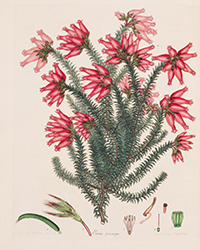
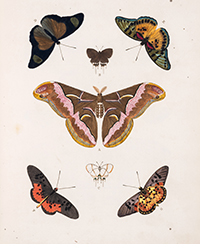
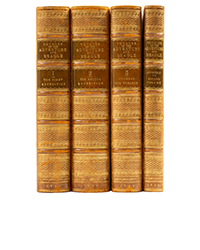
25 March 2026Forum, Mar. 25: Botany.- Andrews (H.C.) Coloured Engravings of Heaths, 4 vol. in 2, first edition, [1710,--94]-1802-1809-[1830]. £10,000 - £15,000.Forum, Mar. 25: Butterflies.- Cramer (Pierre) and Caspar Stoll. De Uitlandsche Kapellen voorkomende in de drie Waereld-Deelen…,, 5 vol., Amsterdam & Utrecht, 1779-91. £8,000 - £12,000.Forum, Mar. 25: Voyages.- Darwin (Charles) and others. Narrative of the Surveying Voyages of His Majesty's Ships Adventure and Beagle, 3 vol. in 4, including Appendix to vol.2, first edition, 1839. £8,000 - £12,000.Forum, Mar. 25: Butterflies.- de Graaf (Willem Diederik Vincent). [Inlandsche Kapellen in beeld], 170 fine original watercolours, [Enkhuizen], [1800-40]. £8,000 - £12,000.Forum Auctions
Natural History: The remaining stock of Antiquariaat Junk, 1899-2026
25 March 2026Forum, Mar. 25: Birds.- Dresser (Henry Eeles). A History of the Birds of Europe, 9 vol., including supplement, first edition, by the author, 1871-96. £6,000 - £8,000.Forum, Mar. 25: Zoology.- Felines.- Elliot (Daniel Giraud). A Monograph of the Felidæ or Family of the Cats, first edition, for the Subscribers, by the Author, [1878]-1883. £25,000 - £30,000.Forum, Mar. 25: Birds.- Frisch (Johann Leonard). Vorstellung der Vögel Deutschlandes, 2 vol., first edition, Berlin, Friedr. Wilhelm Birnsteil, [1736]-1763. £40,000 - £60,000.Forum, Mar. 25: Birds.- Gould (John). The Birds of Great Britain, 5 vol., first edition, by the author, 1862-1873. £30,000 - £40,000.Forum Auctions
Natural History: The remaining stock of Antiquariaat Junk, 1899-2026
25 March 2026Forum, Mar. 25: Pomology.- France.- Poiteau (A.) Pomologie Française. Recueil des Plus Beaux Fruits cultivés en France, 4 vol., Paris, 1846. £30,000 - £40,000.Forum, Mar. 25: Botany.- [Robin (Jean)]. Histoire des Plantes, nouvellement trouvées en l'Isle Virgine…,, 1620; with Geoffrey Linocier L'Histoire des plantes, second edition, 1619-20. £3,000 - £4,000.Forum, Mar. 25: Asia.- Japan.- Siebold (P.F. von). Nippon. Archiv zur Beschreibung von Japan, 7 parts in 6 vol., first edition, Leyden, [1832]-1852. £35,000 - £45,000.Forum, Mar. 25: Asia.- Valentijn (Francois). Oud en Nieuw Oost-Indiën..., 5 vol. in 8, first edition, Dordrecht [&] Amsterdam, 1724-26. £8,000 - £12,000.Forum, Mar. 25: Botany.- Australia.- Redouté (P.J.).- Ventenat (Étienne Pierre). Jardin de la Malmaison, 2 vol.,, Paris, 1803-04[-05]. £30,000 - £40,000. -


-
Books & Autographs
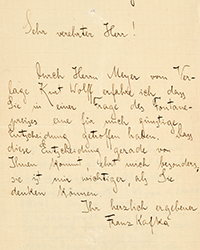
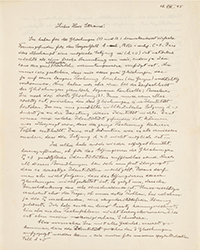
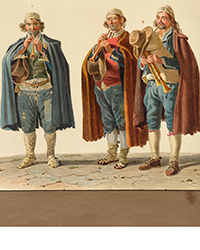
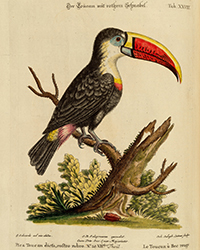
Wednesday 25 MarchKoller, Mar. 25: KAFKA, FRANZ, SCHRIFTSTELLER. Eigenh. Brief mit Unterschrift. Prag, 20. Oktober [19]15. CHF 30,000-40,000.Koller, Mar. 25: EINSTEIN, ALBERT. Zwei eigenhändige Briefe an Ernst Gabor Straus, unterschrieben "A.E" bzw. "A. Einstein". [Princeton], [19]45. und [1950]. CHF 30,000-40,000.Koller, Mar. 25: HORTENSE DE BEAUHARNAIS, MUTTER VON NAPOLEON III. Album aus ihrem Besitz mit 69 Aquarellen und Pinselzeichnungen in Sepia oder Grau… CHF 14,000-18,000.Koller, Mar. 25: ZOOLOGIE - ORNITHOLOGIE - Seligmann, Johann Michael. Verzameling van uitlandsche en zeldzaame Vogelen. Teile 1-8 (von 9) in 2 Bänden. Mit 421 prächtig altkolorierten Kupfertafeln. CHF 14,000-20,000Koller, Mar. 25: BOTANIK - Berlèse, Lorenzo und Johann Jakob Jung. Iconographie du genre camellia... 3 Bände. Mit 300 Farbstichtafeln "a la poupée.” Paris, [1839-]1841-1843. CHF 12,000-18,000.