Rare Book Monthly
Articles - October - 2007 Issue
<i>A Farewell to Alms</i> -- a book considered

The rapid increase in human efficiency is very recent.
Beginning about 1760 there is evidence of the beginnings of sustained economic development in England. What he sees is 1% growth. It wasn't much but, after 129,750 years of no growth, it was positively exhilarating. The "gathering storm" stage would last the next 100 years. Only at around 1860 did the modern economy as we know it today take shape.
For Englishmen and women these were breathtaking events. The economic transformation, first unleashed in England, quickly spread to other European countries and in time to other continents. What is surprising is his data suggesting that for many countries and their economies, the Industrial Revolution has not yet arrived and he completes his book with an examination of why this is so. This leads him to be critical of the way the World Bank and IMF approach development in underdeveloped countries. He suggests that development is the natural out-growth of pre-conditions such as social stability, a rising middle class, a stable government and appropriate economic institutions such as a functioning bank system, a stable currency and infrastructure. He believes, when the environment is right, human instinct simply propels advance. I believe he is correct. Africans flee Africa and Mexicans flee Mexico to become full fledged economic players in the developed world. At home the same people do not generally fare as well. It's tough to play monopoly in a swamp.
That said, it is a mystery to me why the author, a man of the 21st century, looks only backward. The implications of this book for the present and future are worth exploring and as he is reticent to do so I'll look ahead.
The implication of the 130,000 year perspective and the only recent development of the modern economy suggest economic development as we know it is very new. As things go, the new car smell is still in the air. Dr. Clark points out that a significant portion of the world is not yet developing -- still caught in the Malthusian Trap. He further suggests that several features are always present in emerging economies: reduced dependence on agriculture and a concomitant shift to manufacturing coupled with increasing education [and or training] and population. This suggests that the future role of international economic aid agencies could be to make 10 to 25 year commitments in diverse parts of the world to evaluate his concepts for development. I believe his emphasis would be on the creation of the pre-conditions for development coupled with an expectation that human nature will adjust positively to opportunity. One of the first places to try this will be in northern Mexico. America grows anxious as tens of thousands of illegal immigrants cross the border in pursuit of work. Armed patrols and fences are an absurd response. Create a thriving economic environment in Mexico and perhaps, in time, it will be Americans that are climbing the fences. Such an approach will not only cost less. It will also pay dividends. His analysis creates the hopeful prospect of bringing an increasing percentage of the world's population out of the Malthusian Trap and into the 21st century economy. His model is akin to a fire first lit by rubbing sticks together. His ideas deserve serious consideration.
Rare Book Monthly
-

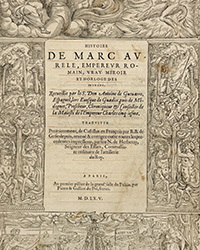
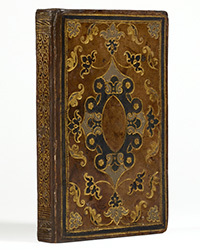
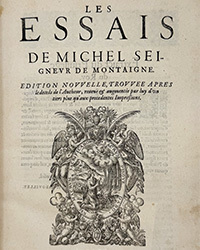

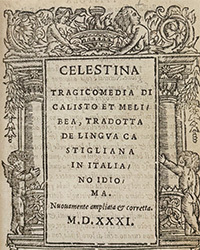
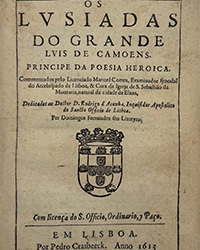
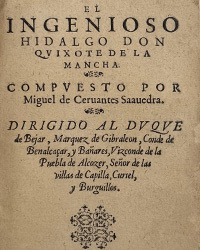

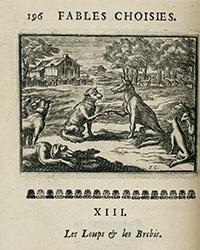
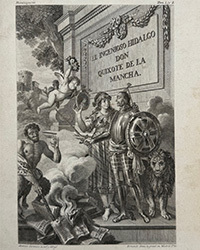
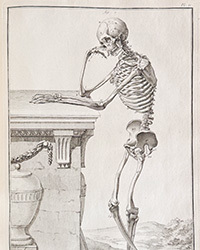

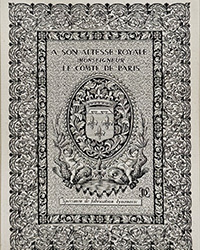
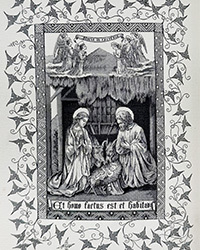 ALDE, Apr. 8: GUEVARA (ANTONIO DE). Histoire de Marc-Aurèle, Empereur Romain, vray miroir et horloge des Princes. Paris, Pierre et Galliot du Pré, frères, 1565. €3,000 to €4,000.ALDE, Apr. 8: HEURES DE LA VIERGE. Horæ in laudem beatissimæ virginis Mariæ ad usum Romanum. Paris, Charles L'Angelier, 1556. €4,000 to €5,000.ALDE, Apr. 8: MONTAIGNE (MICHEL DE). Les Essais. Édition nouvelle, trouvée après le deceds de l'autheur… Paris, Abel L'Angelier, 1595. €6,000 to €8,000.ALDE, Apr. 8: [ROJAS (FERNANDO DE)]. Celestina, tragicomedia di Calisto et Melibea, tradotta de lingua castigliana in italiano idioma… Venise, 1531. €2,000 to €3,000.ALDE, Apr. 8: CAMÕES (LUÍS DE). Os Lusiadas. Lisbonne, Pedro Crasbeeck, 1613. €2,000 to €3,000.ALDE, Apr. 8: CERVANTES (MIGUEL DE). El Ingenioso hidalgo Don Quixote de la Mancha. Bruxelles, Roger Velpius & Huberto Antonio, 1611. €6,000 to €8,000.ALDE, Apr. 8: LA FONTAINE (JEAN DE). Fables choisies, mises en vers. Paris, Denys Thierry et Claude Barbin, 1678-1694. €6,000 to €8,000.ALDE, Apr. 8: CERVANTES (MIGUEL DE). El Ingenioso hidalgo Don Quixote de la Mancha. Madrid, Joaquin Ibarra, 1780. €3,000 to €4,000.ALDE, Apr. 8: DIDEROT (DENIS) ET JEAN LE ROND D'ALEMBERT. Encyclopédie, ou dictionnaire raisonné des sciences, des arts et des métiers. Paris, 1751-1765. €15,000 to €20,000.ALDE, Apr. 8: [LIVRE TISSÉ]. LAMARTINE (Alphonse de). Les Laboureurs. Poème tiré de Jocelyn… Lyon, J. A. Henry, 1883. €8,000 to €10,000.ALDE, Apr. 8: [LIVRE TISSÉ]. Livre de prières tissé d'après les enluminures des manuscrits du XIVe au XVIe siècle. Lyon, [A. Roux], 1886. €5,000 to €6,000.
 -