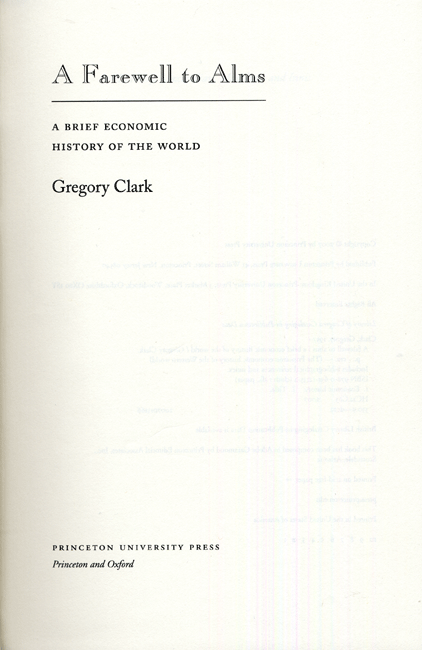
This is a brief economic history of the world with a focus on the
Industrial Revolution. It is written by Dr. Gregory Clark. In it he
offers a fresh perspective on recent economic developments that have
intriguing implications for the world economy over the next one hundred
years.
The difference between mathematics and economics is the difference between
certainty and informed speculation. Mathematics looks at numbers and sees
fixed if sometimes obscure relationships. Economics is the imposition of
explicative theory on those things we do for money and reward. It's the
difference between What are you paid and why do you work? Dr.
Clark who teaches at the University of California at Davis, has written a
thought-provoking book about Industrial Revolution, its causes and uneven
spread around the planet. Using historical data available for England for
the pre-industrial period [1200 to 1760] he creates a statistical baseline
that, when compared to England from 1761 to the present, shows distinctive
economic differences in the later period which he describes, as other
economists have, as the first Industrial Revolution. In creating a
clearer statistical picture of pre-industrial England he has created a
unique pre-post comparison. He then interprets the causes for the
Industrial Revolution through an examination of what changed. It is not
an entirely certain process but original and highly worthwhile.
Modern economic theory credits institutions for creating the amalgam of
factors that have enabled economic development. He credits the individual
or more accurately, the sum of them, who acted from self-interest in an
environment that was uniquely pliant to individual initiative. The
development of the British Empire with a unifying language, sound laws,
low taxes, minimal barriers to technology transfer, and relative peace
were the apparent preconditions for the economic development achieved
within the British Empire between 1860 and the eve of World War I. His
book, A Farewell to Alms, by clarifying the past glimpses the future. And
at 377 pages plus reference material, it's a rarity in economic theory,
the easily understood book. No doubt, other economists will hold this
against him.
He sees the world before the Industrial Revolution as stasis or as
Dictionary.com defines it: the state of equilibrium or inactivity caused
by opposing equal forces. He defines the modern era as beginning about
130,000 BC and being in stasis until 250 years ago. Then, in England, the
Industrial Revolution began to take hold. It was, in his view, a thousand
years in the making. His perspective is economic so the birth, death and
revival of religions, the coming and going of dinosaurs, even the major
shifts of humans as hunter-gathers to farmers are simply scenes observed
from the window of trucks flying across Kansas on Route 40. They simply confirm his view of pre-industrial life as an
equation:
P = F
where the number of people possible was equal to the amount of food
available. When food was more plentiful population expanded. When the
food supply diminished population fell. He allows that technology,
perhaps more aptly labeled invention, increased food supply in some areas
and mentions the production of rice in Japan and China as examples. But
he believes that advances in food production, in the pre-Industrial
Revolution period, always ultimately were reflected in increasing
population that in time ate its way back to starvation and falling
population. This is called the Malthusian Trap.
Sotheby’s, Dec. 11: Darwin and Wallace. On the Tendency of Species to form Varieties..., [in:] Journal of the Proceedings of the Linnean Society, Vol. III, No. 9., 1858, Darwin announces the theory of natural selection. £100,000 to £150,000.
Sotheby’s, Dec. 11: J.K. Rowling. Harry Potter and the Philosopher's Stone, 1997, first edition, hardback issue, inscribed by the author pre-publication. £100,000 to £150,000.
Sotheby’s, Dec. 11: Wolfgang Amadeus Mozart. Autograph sketchleaf including a probable draft for the E flat Piano Quartet, K.493, 1786. £150,000 to £200,000.
Sotheby’s, Dec. 12: Hooke, Robert. Micrographia: or some Physiological Descriptions of Minute Bodies made by Magnifying Glasses. London: James Allestry for the Royal Society, 1667. $12,000 to $15,000.
Sotheby’s, Dec. 12: Chappuzeau, Samuel. The history of jewels, first edition in English. London: T.N. for Hobart Kemp, 1671. $12,000 to $18,000.
Sotheby’s, Dec. 12: Sowerby, James. Exotic Mineralogy, containing his most realistic mineral depictions, London: Benjamin Meredith, 1811, Arding and Merrett, 1817. $5,000 to $7,000.
Rare Book Hub is now mobile-friendly!
Swann Maps & Atlases, Natural History & Color Plate Books December 9, 2025
Swann, Dec. 9: Lot 156: Cornelis de Jode, Americae pars Borealis, double-page engraved map of North America, Antwerp, 1593.
Swann, Dec. 9: Lot 206: John and Alexander Walker, Map of the United States, London and Liverpool, 1827.
Swann, Dec. 9: Lot 223: Abraham Ortelius, Typus Orbis Terrarum, hand-colored double-page engraved world map, Antwerp, 1575.
Swann Maps & Atlases, Natural History & Color Plate Books December 9, 2025
Swann, Dec. 9: Lot 233: Aaron Arrowsmith, Chart of the World, oversize engraved map on 8 sheets, London, 1790 (circa 1800).
Swann, Dec. 9: Lot 239: Fielding Lucas, A General Atlas, 81 engraved maps and diagrams, Baltimore, 1823.
Swann, Dec. 9: Lot 240: Anthony Finley, A New American Atlas, 15 maps engraved by james hamilton young on 14 double-page sheets, Philadelphia, 1826.
Swann Maps & Atlases, Natural History & Color Plate Books December 9, 2025
Swann, Dec. 9: Lot 263: John Bachmann, Panorama of the Seat of War, portfolio of 4 double-page chromolithographed panoramic maps, New York, 1861.
Swann, Dec. 9: Lot 265: Sebastian Münster, Cosmographei, Basel: Sebastian Henricpetri, 1558.
Swann, Dec. 9: Lot 271: Abraham Ortelius, Epitome Theatri Orteliani, Antwerp: Johann Baptist Vrients, 1601.
Swann Maps & Atlases, Natural History & Color Plate Books December 9, 2025
Swann, Dec. 9: Lot 283: Joris van Spilbergen, Speculum Orientalis Occidentalisque Indiae, Leiden: Nicolaus van Geelkercken for Jodocus Hondius, 1619.
Swann, Dec. 9: Lot 285: Levinus Hulsius, Achtzehender Theil der Newen Welt, 14 engraved folding maps, Frankfurt: Johann Frederick Weiss, 1623.
Swann, Dec. 9: Lot 341: John James Audubon, Carolina Parrot, Plate 26, London, 1827.