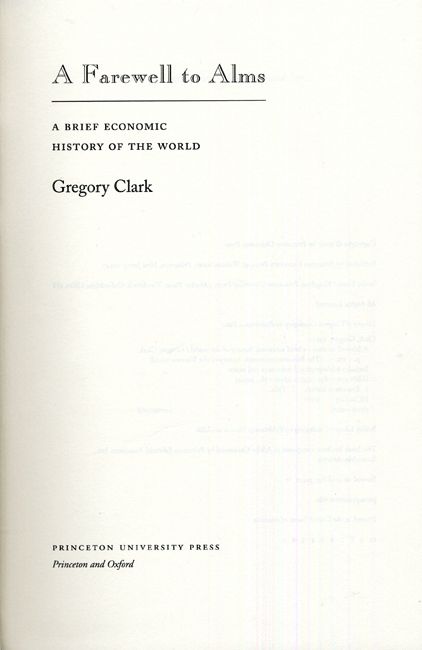
This is a brief economic history of the world with a focus on the
Industrial Revolution. It is written by Dr. Gregory Clark. In it he
offers a fresh perspective on recent economic developments that have
intriguing implications for the world economy over the next one hundred
years.
The difference between mathematics and economics is the difference between
certainty and informed speculation. Mathematics looks at numbers and sees
fixed if sometimes obscure relationships. Economics is the imposition of
explicative theory on those things we do for money and reward. It's the
difference between What are you paid and why do you work? Dr.
Clark who teaches at the University of California at Davis, has written a
thought-provoking book about Industrial Revolution, its causes and uneven
spread around the planet. Using historical data available for England for
the pre-industrial period [1200 to 1760] he creates a statistical baseline
that, when compared to England from 1761 to the present, shows distinctive
economic differences in the later period which he describes, as other
economists have, as the first Industrial Revolution. In creating a
clearer statistical picture of pre-industrial England he has created a
unique pre-post comparison. He then interprets the causes for the
Industrial Revolution through an examination of what changed. It is not
an entirely certain process but original and highly worthwhile.
Modern economic theory credits institutions for creating the amalgam of
factors that have enabled economic development. He credits the individual
or more accurately, the sum of them, who acted from self-interest in an
environment that was uniquely pliant to individual initiative. The
development of the British Empire with a unifying language, sound laws,
low taxes, minimal barriers to technology transfer, and relative peace
were the apparent preconditions for the economic development achieved
within the British Empire between 1860 and the eve of World War I. His
book, A Farewell to Alms, by clarifying the past glimpses the future. And
at 377 pages plus reference material, it's a rarity in economic theory,
the easily understood book. No doubt, other economists will hold this
against him.
He sees the world before the Industrial Revolution as stasis or as
Dictionary.com defines it: the state of equilibrium or inactivity caused
by opposing equal forces. He defines the modern era as beginning about
130,000 BC and being in stasis until 250 years ago. Then, in England, the
Industrial Revolution began to take hold. It was, in his view, a thousand
years in the making. His perspective is economic so the birth, death and
revival of religions, the coming and going of dinosaurs, even the major
shifts of humans as hunter-gathers to farmers are simply scenes observed
from the window of trucks flying across Kansas on Route 40. They simply confirm his view of pre-industrial life as an
equation:

P = F
where the number of people possible was equal to the amount of food
available. When food was more plentiful population expanded. When the
food supply diminished population fell. He allows that technology,
perhaps more aptly labeled invention, increased food supply in some areas
and mentions the production of rice in Japan and China as examples. But
he believes that advances in food production, in the pre-Industrial
Revolution period, always ultimately were reflected in increasing
population that in time ate its way back to starvation and falling
population. This is called the Malthusian Trap.
Heritage, Dec. 15: Jerry Thomas. How to Mix Drinks, or the Bon-Vivant's Companion, Containing Clear and Reliable Directions for Mixing All the Beverages Used in the United States…
Rare Book Hub is now mobile-friendly!
Bonhams, Dec. 8-18: Autograph Letter Signed ("Martinus Luther") to His Friend the Theologian Gerhard Wiskamp ("Gerardo Xantho Lampadario"). $100,000 - $150,000.
Bonhams, Dec. 8-18: An Exceptionally Fine Copy of Austenís Emma: A Novel in Three Volumes. $40,000 - $60,000.
Bonhams, Dec. 8-18: Presentation Copy of Ernest Hemmingwayís A Farewell to Arms for Edward Titus of the Black Mankin Press. $30,000 - $50,000.
Bonhams, Dec. 8-18: Autograph Manuscript Signed Integrally for "The Songs of Pooh," by Alan Alexander. $30,000 - $50,000.
Bonhams, Dec. 8-18: Autograph Manuscript of "Three Fragments from Gˆtterd‰mmerung" by Richard Wagner. $30,000 - $50,000.
Bonhams, Dec. 8-18: Original Preliminary Artwork, for the First Edition of Snow Crash. $20,000 - $30,000.
Bonhams, Dec. 8-18: Autograph Letter Signed ("T.R. Malthus") to Economist Nassau Senior on Wealth, Labor and Adam Smith. $20,000 - $30,000.
Bonhams, Dec. 8-18: History of the Peloponnesian War by Thucydides Finely Bound by Michael Wilcox. $20,000 - $30,000.
Bonhams, Dec. 8-18: First Edition of Lewis and Clark: Travels to the Source of the Missouri River and Across the American Continent to the Pacific Ocean. $8,000 - $12,000.
Bonhams, Dec. 8-18: Original Artwork for the First Edition of Neal Stephenson's Groundbreaking Novel Snow Crash. $100,000 - $150,000.
Bonhams, Dec. 8-18: A Complete Set Signed Deluxe Editions of King's The Dark Tower Series by Stephen King. $8,000 - $12,000.
Bonhams, Dec. 8-18: Autograph Letter Signed ("John Adams") to James Le Ray de Chaumont During the Crucial Years of the Revolutionary War. $8,000 - $12,000.
Sotheby’s Book Week December 9-17, 2025
Sotheby’s, Dec. 17: Francesco Colonna. Hypnerotomachie, Paris, 1546, Parisian calf by Wotton Binder C for Marcus Fugger. €200,000 to €300,000.
Sotheby’s, Dec. 17: Nausea. De principiis dialectices Gorgias, and other works, Venice, 1523, morocco gilt for Cardinal Campeggio. €3,000 to €4,000.
Sotheby’s, Dec. 17: Billon. Le fort inexpugnable de l'honneur, Paris, 1555, Parisian calf gilt for Peter Ernst, Graf von Mansfeld. €120,000 to €180,000.
Sotheby’s Book Week December 9-17, 2025
Sotheby’s, Dec. 16: Salinger, J.D. The Graham Family archive, including autographed letters, an inscribed Catcher, a rare studio photograph of the author, and more. $120,000 to $180,000.
Sotheby’s, Dec. 16: [Austen, Jane]. A handsome first edition of Sense and Sensibility, the author's first novel. $60,000 to $80,000.
Sotheby’s, Dec. 16: Massachusetts General Court. A powerful precursor to the Declaration of Independence: "every Act of Government … without the Consent of the People, is … Tyranny." $40,000 to $60,000.