Alexander Hamilton: On Exhibit in New York and Online
- by Michael Stillman
Alexander Hamilton
By Michael Stillman
If you are anywhere near New York City this month, you still have a chance to take in what is an absolutely wonderful exhibition. The location is the New-York Historical Society at 170 Central Park West, and the subject is Alexander Hamilton. The exhibition runs through the 28th of February 2005. For those unable to attend in person, you may find a glimpse of this exhibit online at www.alexanderhamiltonexhibition.org/virtualtour/good.html. Be sure to check out the virtual tour.
Hamilton was one of the most important of America's founders, but he never received quite the glowing press of some his fellow leaders, at least not until recently. The result is he never made it into the hearts of generations of schoolchildren the way his rival Thomas Jefferson did. Jefferson also had the good sense not to get himself killed in a duel while still relatively young, so he had more time to work on his legacy. Perhaps Hamilton himself is much at fault for the lack of recognition he received. Somehow he managed to get himself into battles with just about every other founding father. He could turn a molehill into a mountain, which explains why his life ended as it did. Still, despite his managing to anger just about every other founding father, he did retain the enormous respect of one. If you were to have one devoted believer in the first years of America, who better could you choose than George Washington?
Hamilton's primary contributions were to America's financial and economic systems. He served President Washington as Secretary of the Treasury, and his programs saved the new nation from impending bankruptcy. He was the one who fought for the federal government's assuming the war debt of the states. He was behind the nation's first taxes. He promoted industrialization, which enabled the nation to develop into the powerhouse it became. He also supported a strong navy. Hamilton was a supporter of a strong federal government, and with James Madison and John Jay, wrote the Federalist Papers, which urged adoption of the Constitution. In fact, Hamilton was a prolific writer who could write about anything under the sun.
Hamilton was perhaps not as dedicated to electoral democracy as some of his fellow founders, and this may be the major reason he did not become the icon Jefferson did. Too often he has been painted as the aristocratic foil to Jefferson's image as defender of freedom and democracy. He supposedly had some monarchist tendencies, and favored the election for life of senators. However, Hamilton's concerns were that too much democracy could lead to too little liberty, not too much.
Swann Maps & Atlases, Natural History & Color Plate Books December 9, 2025
Swann, Dec. 9: Lot 156: Cornelis de Jode, Americae pars Borealis, double-page engraved map of North America, Antwerp, 1593.
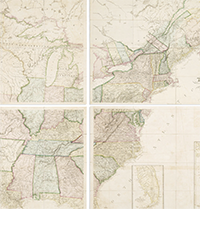
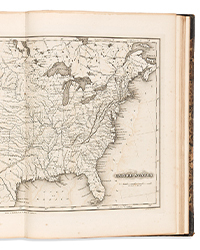
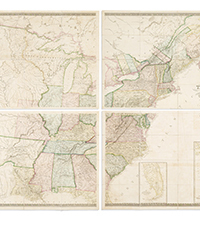
Swann, Dec. 9: Lot 206: John and Alexander Walker, Map of the United States, London and Liverpool, 1827.
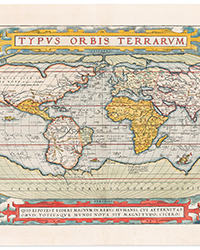
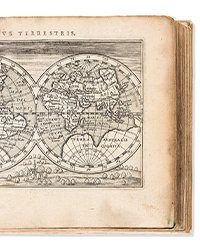
Swann, Dec. 9: Lot 223: Abraham Ortelius, Typus Orbis Terrarum, hand-colored double-page engraved world map, Antwerp, 1575.
Swann Maps & Atlases, Natural History & Color Plate Books December 9, 2025
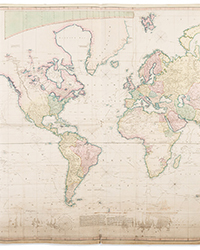
Swann, Dec. 9: Lot 233: Aaron Arrowsmith, Chart of the World, oversize engraved map on 8 sheets, London, 1790 (circa 1800).
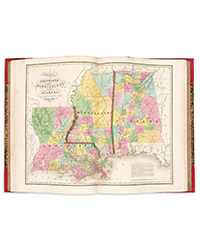
Swann, Dec. 9: Lot 239: Fielding Lucas, A General Atlas, 81 engraved maps and diagrams, Baltimore, 1823.
Swann, Dec. 9: Lot 240: Anthony Finley, A New American Atlas, 15 maps engraved by james hamilton young on 14 double-page sheets, Philadelphia, 1826.
Swann Maps & Atlases, Natural History & Color Plate Books December 9, 2025
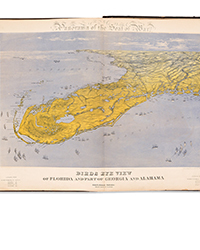
Swann, Dec. 9: Lot 263: John Bachmann, Panorama of the Seat of War, portfolio of 4 double-page chromolithographed panoramic maps, New York, 1861.
Swann, Dec. 9: Lot 265: Sebastian Münster, Cosmographei, Basel: Sebastian Henricpetri, 1558.
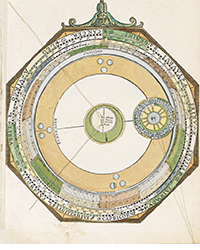
Swann, Dec. 9: Lot 271: Abraham Ortelius, Epitome Theatri Orteliani, Antwerp: Johann Baptist Vrients, 1601.
Swann Maps & Atlases, Natural History & Color Plate Books December 9, 2025
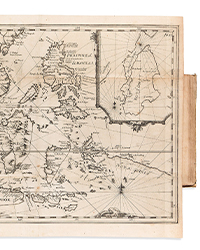
Swann, Dec. 9: Lot 283: Joris van Spilbergen, Speculum Orientalis Occidentalisque Indiae, Leiden: Nicolaus van Geelkercken for Jodocus Hondius, 1619.
Swann, Dec. 9: Lot 285: Levinus Hulsius, Achtzehender Theil der Newen Welt, 14 engraved folding maps, Frankfurt: Johann Frederick Weiss, 1623.
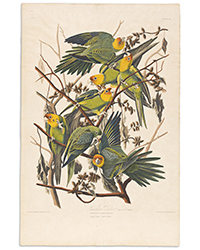
Swann, Dec. 9: Lot 341: John James Audubon, Carolina Parrot, Plate 26, London, 1827.
Sotheby’s Book Week December 9-17, 2025
Sotheby’s, Dec. 11: Darwin and Wallace. On the Tendency of Species to form Varieties..., [in:] Journal of the Proceedings of the Linnean Society, Vol. III, No. 9., 1858, Darwin announces the theory of natural selection. £100,000 to £150,000.
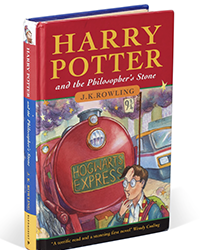
Sotheby’s, Dec. 11: J.K. Rowling. Harry Potter and the Philosopher's Stone, 1997, first edition, hardback issue, inscribed by the author pre-publication. £100,000 to £150,000.
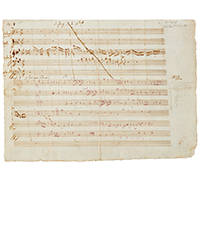
Sotheby’s, Dec. 11: Wolfgang Amadeus Mozart. Autograph sketchleaf including a probable draft for the E flat Piano Quartet, K.493, 1786. £150,000 to £200,000.
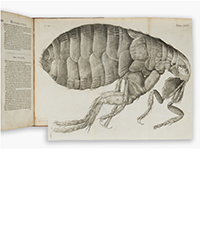
Sotheby’s, Dec. 12: Hooke, Robert. Micrographia: or some Physiological Descriptions of Minute Bodies made by Magnifying Glasses. London: James Allestry for the Royal Society, 1667. $12,000 to $15,000.
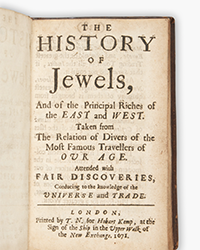
Sotheby’s, Dec. 12: Chappuzeau, Samuel. The history of jewels, first edition in English. London: T.N. for Hobart Kemp, 1671. $12,000 to $18,000.
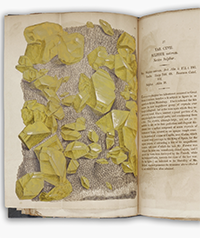
Sotheby’s, Dec. 12: Sowerby, James. Exotic Mineralogy, containing his most realistic mineral depictions, London: Benjamin Meredith, 1811, Arding and Merrett, 1817. $5,000 to $7,000.



![<b>Sotheby’s, Dec. 11:</b> Darwin and Wallace. On the Tendency of Species to form Varieties..., [in:] <i>Journal of the Proceedings of the Linnean Society,</i> Vol. III, No. 9., 1858, Darwin announces the theory of natural selection. £100,000 to £150,000.](https://ae-files.s3.amazonaws.com/AdvertisementPhotos/00d5fd41-2542-4a80-b119-4886d4b9925f.png "<b>Sotheby’s, Dec. 11:</b> Darwin and Wallace. On the Tendency of Species to form Varieties..., [in:] <i>Journal of the Proceedings of the Linnean Society,</i> Vol. III, No. 9., 1858, Darwin announces the theory of natural selection. £100,000 to £150,000.")