
Reviewed by Bruce McKinney
I recently read a remarkable book, The Future of Freedom by Fareed Zakaria. It is a small book of very large ideas. It speaks not from ideology but from openness and it offers explanations for the changing political environment both in the world and in America. In newspapers and on television we hear about events. This is a book of interpretation.
This is a book that expresses the idea that, at least with respect to economic development, the past predicts the future. All readers of history and members of AE take note. Our perspective is confirmed here. As George Santayana wrote, "Those who cannot remember the past are condemned to repeat it." For those who believe this Mr. Zakaria's book is cautionary. The paperback edition is $14.95 and if President Bush had read it he could have saved $129 billion and countless lives. Mr. Zakaria makes the point that democracy requires a broad middle class. Education and per capita income are two measures he employs to establish the probability that democracy will take hold. Iraq today meets neither standard and will not for many years to come. It's a matter of numbers.
Mr. Zakaria simply has looked at those countries that adopted democracy, established who has succeeded [survived as a democracy] and who has failed and then looked at both literacy as percentage of the population along with gross per capita income. He found that where about two thirds of the population was effectively middle class and the per capita income at least $6,000 there was a high probability that democracy, if introduced, would succeed. Iraq's GDP, gross domestic product, per person was estimated at $1,600 in 2003 and oil, a substantially undistributed form of national income, a material part of it. So if you are wondering why democracy seems foreign there it's because it is. Democracy is a political development stage based on economic development and wide citizen participation. Iraq will get there someday as will most countries in the world but to try to impose democracy now, before the basic underpinnings are established, is going to be expensive, tenuous and dangerous. The test in Iraq isn't going to be whether elections can be held in January but whether in 5 years, democracy survives without foreign occupation. Americans are high minded but they also grow impatient. Mr. Zakaria's analysis suggests that the United States has not done its homework. To me it looks like another Vietnam.
Recently Mr. Zakaria was interviewed on Jon Stewarts's The Daily Show and seemed to distance himself from the factual conclusions that can be drawn from his book. In the interview he expressed hope that US intervention in Iraq might work. His own research suggests it's unlikely.
Rare Book Monthly
Articles - December - 2004 Issue
The Future of Freedom by Fareed Zakaria

A straightforward and illuminating analysis of the world we live in.
Rare Book Monthly
-
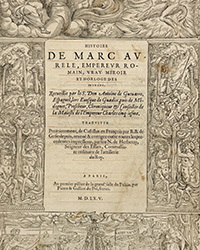
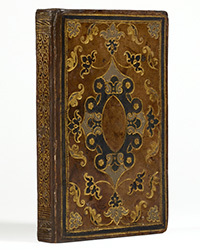
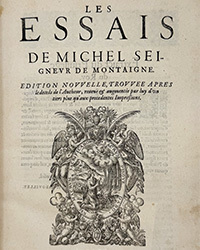
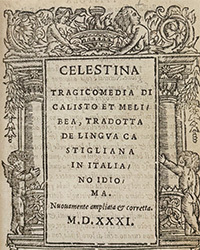
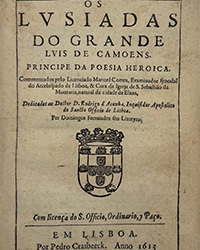
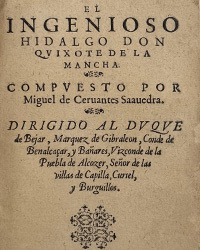
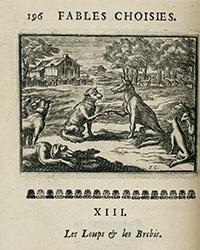
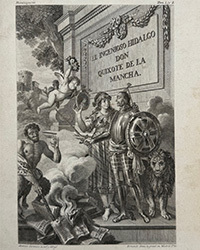
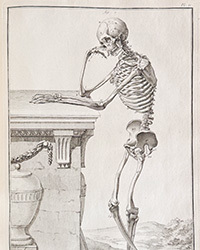
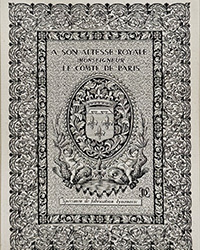
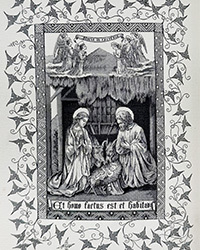 ALDE, Apr. 8: GUEVARA (ANTONIO DE). Histoire de Marc-Aurèle, Empereur Romain, vray miroir et horloge des Princes. Paris, Pierre et Galliot du Pré, frères, 1565. €3,000 to €4,000.ALDE, Apr. 8: HEURES DE LA VIERGE. Horæ in laudem beatissimæ virginis Mariæ ad usum Romanum. Paris, Charles L'Angelier, 1556. €4,000 to €5,000.ALDE, Apr. 8: MONTAIGNE (MICHEL DE). Les Essais. Édition nouvelle, trouvée après le deceds de l'autheur… Paris, Abel L'Angelier, 1595. €6,000 to €8,000.ALDE, Apr. 8: [ROJAS (FERNANDO DE)]. Celestina, tragicomedia di Calisto et Melibea, tradotta de lingua castigliana in italiano idioma… Venise, 1531. €2,000 to €3,000.ALDE, Apr. 8: CAMÕES (LUÍS DE). Os Lusiadas. Lisbonne, Pedro Crasbeeck, 1613. €2,000 to €3,000.ALDE, Apr. 8: CERVANTES (MIGUEL DE). El Ingenioso hidalgo Don Quixote de la Mancha. Bruxelles, Roger Velpius & Huberto Antonio, 1611. €6,000 to €8,000.ALDE, Apr. 8: LA FONTAINE (JEAN DE). Fables choisies, mises en vers. Paris, Denys Thierry et Claude Barbin, 1678-1694. €6,000 to €8,000.ALDE, Apr. 8: CERVANTES (MIGUEL DE). El Ingenioso hidalgo Don Quixote de la Mancha. Madrid, Joaquin Ibarra, 1780. €3,000 to €4,000.ALDE, Apr. 8: DIDEROT (DENIS) ET JEAN LE ROND D'ALEMBERT. Encyclopédie, ou dictionnaire raisonné des sciences, des arts et des métiers. Paris, 1751-1765. €15,000 to €20,000.ALDE, Apr. 8: [LIVRE TISSÉ]. LAMARTINE (Alphonse de). Les Laboureurs. Poème tiré de Jocelyn… Lyon, J. A. Henry, 1883. €8,000 to €10,000.ALDE, Apr. 8: [LIVRE TISSÉ]. Livre de prières tissé d'après les enluminures des manuscrits du XIVe au XVIe siècle. Lyon, [A. Roux], 1886. €5,000 to €6,000.
 -
Sotheby’s
Books, Manuscripts & Objects from Three Important Collections
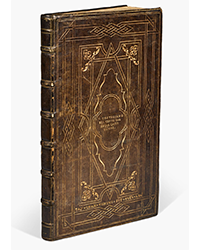
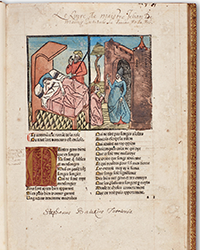
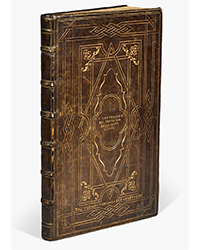
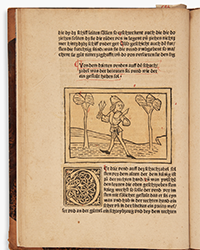
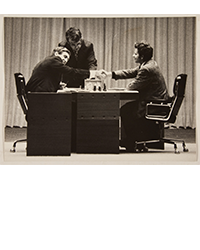
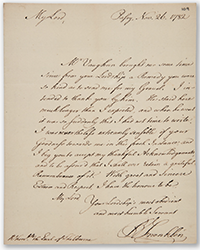
Open for Bidding 2-17 AprilSotheby’s, Apr. 2-17: [Guillaume de Lorris and Jean de Meun]. Le Roman de la Rose, [Geneva or Lyons, c.1481], first printed edition of the most important medieval French vernacular poem. £200,000 to £300,000.Sotheby’s, Apr. 2-17: Castiglione. Il libro del cortegiano. [Venice], April 1528, first edition, in a magnificent binding by Jean Picard for Jean Grolier. £100,000 to £150,000.Sotheby’s, Apr. 2-17: Jacobus de Cessolis. Schachzabelbuch, Strasbourg, 1483, von der Lasa copy. £50,000 to £70,000.Sotheby’s, Apr. 2-17: World Championship, 1972. A collection of 84 press photographs of the famed match between Spassky and Fischer. £2,000 to £3,000.Sotheby’s, Apr. 2-17: Ben Franklin. Autograph letter signed, to Lord Shelburne, British Prime Minister, during peace negotiations, November 1782. £15,000 to £20,000.