These days change is a constant in the world of books.
By Bruce McKinney
When I was in high school in upstate New York the conservative and stable choice for a career was IBM. These were the 1960s and the valley was full of IBM success stories. Big money, prestige and stability were all possible then right down into the middle ranks. And it was a case study of the dictum that past is not prologue. We were looking at the stars and did not see the valley below. The rare book business is looking the same way today.
You could set your proverbial watch by the rhythmic and consistent machinations of the book business all the way from the turn of the 20th century to the home stretch. Dealers were attracted to the field for their interest in the material, the stability of the business model and the evident surplus of buyer demand to supply. One could spend a lifetime investigating interesting material and sell it to a ready market of appreciative collectors.
Several trends were at work though that would lead to fundamental change. Supply was not predictable. The years 1960 to 1980 were, for the auction houses, an exceptional period. Large book auctions of important, valuable and interesting material took place consistently. True, there were fewer houses than there are today, but they were very busy. Large collections, such as Thomas Streeter’s needed seven auctions to complete. Seen from the vantage of 2003, this looks to have been a golden age.
The eighties saw higher prices and the emergence of collectors less interested in the material than its rarity. This field, always a delicate balance of books and buyers, began to skew to the upside as a certain rapaciousness began to take hold, egged on by mindless dealer posturing. “Only copy known, the only copy not in the holdings of the Royal Family” and the like became the hot breath to fill the inflationary balloon that the rare book business became by the beginning of the 21st century.
With the downturn in equities a gear change became inevitable for the book trade. But of
course it hasn’t been just the standard off-the-shelf pull-back because since the mid 1990s
new marketing alternatives have developed to bring an interesting complexity to the field.
The emergence of www.abe.com has clearly been the signal event for it has made it
possible for more than 10,000 sellers today to directly post their offerings to a world
market that has only just begun to understand that virtually every book extant can
and will in time be found online. The sellers are setting up shop. The collectors have yet, in proportionate numbers, to be buying. Cars were built before the paved roads were constructed and the electronic book selling system is being created before book buyers are fully embracing it.
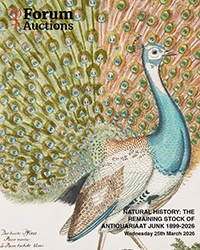
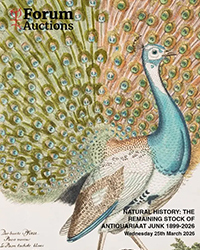
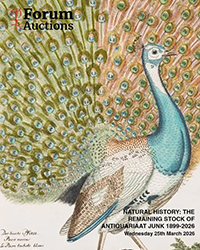
Forum Auctions Natural History: The remaining stock of Antiquariaat Junk, 1899-2026 25 March 2026
Forum, Mar. 25: Botany.- Andrews (H.C.) Coloured Engravings of Heaths, 4 vol. in 2, first edition, [1710,--94]-1802-1809-[1830]. £10,000 - £15,000.
Forum, Mar. 25: Butterflies.- Cramer (Pierre) and Caspar Stoll. De Uitlandsche Kapellen voorkomende in de drie Waereld-Deelen…,, 5 vol., Amsterdam & Utrecht, 1779-91. £8,000 - £12,000.
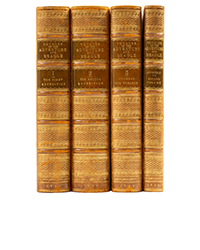
Forum, Mar. 25: Voyages.- Darwin (Charles) and others. Narrative of the Surveying Voyages of His Majesty's Ships Adventure and Beagle, 3 vol. in 4, including Appendix to vol.2, first edition, 1839. £8,000 - £12,000.
Forum, Mar. 25: Butterflies.- de Graaf (Willem Diederik Vincent). [Inlandsche Kapellen in beeld], 170 fine original watercolours, [Enkhuizen], [1800-40]. £8,000 - £12,000.
Forum Auctions Natural History: The remaining stock of Antiquariaat Junk, 1899-2026 25 March 2026
Forum, Mar. 25: Birds.- Dresser (Henry Eeles). A History of the Birds of Europe, 9 vol., including supplement, first edition, by the author, 1871-96. £6,000 - £8,000.
Forum, Mar. 25: Zoology.- Felines.- Elliot (Daniel Giraud). A Monograph of the Felidæ or Family of the Cats, first edition, for the Subscribers, by the Author, [1878]-1883. £25,000 - £30,000.
Forum, Mar. 25: Birds.- Frisch (Johann Leonard). Vorstellung der Vögel Deutschlandes, 2 vol., first edition, Berlin, Friedr. Wilhelm Birnsteil, [1736]-1763. £40,000 - £60,000.
Forum, Mar. 25: Birds.- Gould (John). The Birds of Great Britain, 5 vol., first edition, by the author, 1862-1873. £30,000 - £40,000.
Forum Auctions Natural History: The remaining stock of Antiquariaat Junk, 1899-2026 25 March 2026
Forum, Mar. 25: Pomology.- France.- Poiteau (A.) Pomologie Française. Recueil des Plus Beaux Fruits cultivés en France, 4 vol., Paris, 1846. £30,000 - £40,000.
Forum, Mar. 25: Botany.- [Robin (Jean)]. Histoire des Plantes, nouvellement trouvées en l'Isle Virgine…,, 1620; with Geoffrey Linocier L'Histoire des plantes, second edition, 1619-20. £3,000 - £4,000.
Forum, Mar. 25: Asia.- Japan.- Siebold (P.F. von). Nippon. Archiv zur Beschreibung von Japan, 7 parts in 6 vol., first edition, Leyden, [1832]-1852. £35,000 - £45,000.
Forum, Mar. 25: Asia.- Valentijn (Francois). Oud en Nieuw Oost-Indiën..., 5 vol. in 8, first edition, Dordrecht [&] Amsterdam, 1724-26. £8,000 - £12,000.
Forum, Mar. 25: Botany.- Australia.- Redouté (P.J.).- Ventenat (Étienne Pierre). Jardin de la Malmaison, 2 vol.,, Paris, 1803-04[-05]. £30,000 - £40,000.
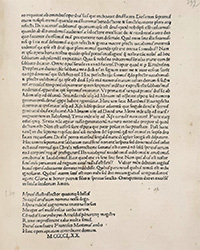
ALDE, Mar. 11: AUGUSTIN (Saint). De civitate Dei. Rome, Konrad Sweynheym et Arnold Pannartz, 1470. €20,000 - €30,000.
ALDE, Mar. 11: [REGNART (LE LIVRE DE)]. [Le] Docteur en malice, maistre Regnard, demonstrant les ruzes et cautelles qu'il use envers les personnes… Rouen, 1550. €20,000 - €30,000.
ALDE, Mar. 11: TRITHÈME (JEAN). Polygraphie et universelle escriture cabalistique. Paris, [Benoît Prévost pour] Jacques Kerver, 1561. €8,000 - €10,000.
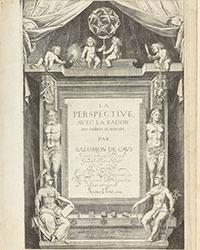
ALDE, Mar. 11: CAUS (SALOMON DE). La Perspective, avec la raison des ombres et des miroirs. Londres, John Norton, 1612.
ALDE, Mar. 11: NICERON (JEAN-FRANÇOIS). La Perspective curieuse ou magie artificielle des effets merveilleux de l'optique. Paris, Pierre Billaine, 1638. €6,000 - €8,000.
ALDE, Mar. 11: VONTET (JACQUES). L’Art de trancher la viande et toute sorte de fruits… S.l.n.d. [probablement Lyon, vers 1647]. €20,000 - €30,000.
ALDE, Mar. 11: HUGO (VICTOR). [Paysage spectral avec une église], [vers 1837]. €20,000 - €30,000.
ALDE, Mar. 11: [HERVEY DE SAINT-DENYS (LÉON D')]. Les Rêves et les Moyens de les diriger. Observations pratiques. Paris, Amyot, 1867. €3,000 - €4,000.
ALDE, Mar. 11: GACHET (PAUL-FERDINAND). Les Chats de Gachet (Manuscrit). S.d. [avant mai 1873]. €6,000 - €8,000.
ALDE, Mar. 11: [REDON (ODILON)]. PICARD (EDMOND). Le Juré. Monodrame en cinq actes… Bruxelles, Mme veuve Monnom, 1887. €7,000 - €9,000.
ALDE, Mar. 11: [TOULOUSE-LAUTREC (HENRI DE) ET HENRI-GABRIEL IBELS]. MONTORGUEIL (GEORGES). Le Café-concert. Paris, [1893]. €4,000 - €5,000.
ALDE, Mar. 11: [TERRY (EMILIO)]. Projet de fontaine. Dessin original au stylo et à l'encre noire. 1938. €2,000 - €3,000.




![<b>Forum, Mar. 25:</b> Botany.- Andrews (H.C.) <i>Coloured Engravings of Heaths,</i> 4 vol. in 2, first edition, [1710,--94]-1802-1809-[1830]. £10,000 - £15,000.](https://ae-files.s3.amazonaws.com/AdvertisementPhotos/c8ea395f-160f-48d0-8c6f-eb14b9c7bdf5.jpg "<b>Forum, Mar. 25:</b> Botany.- Andrews (H.C.) <i>Coloured Engravings of Heaths,</i> 4 vol. in 2, first edition, [1710,--94]-1802-1809-[1830]. £10,000 - £15,000.")
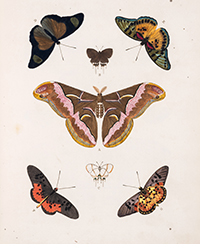
![<b>Forum, Mar. 25:</b> Butterflies.- de Graaf (Willem Diederik Vincent). <i>[Inlandsche Kapellen in beeld],</i> 170 fine original watercolours, [Enkhuizen], [1800-40]. £8,000 - £12,000.](https://ae-files.s3.amazonaws.com/AdvertisementPhotos/28c2fdc6-b72e-497e-9838-b2418859500f.jpg "<b>Forum, Mar. 25:</b> Butterflies.- de Graaf (Willem Diederik Vincent). <i>[Inlandsche Kapellen in beeld],</i> 170 fine original watercolours, [Enkhuizen], [1800-40]. £8,000 - £12,000.")
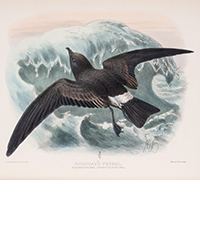
![<b>Forum, Mar. 25:</b> Zoology.- Felines.- Elliot (Daniel Giraud). <i>A Monograph of the Felidæ or Family of the Cats,</i> first edition, for the Subscribers, by the Author, [1878]-1883. £25,000 - £30,000.](https://ae-files.s3.amazonaws.com/AdvertisementPhotos/74388261-9139-43c1-bb56-f1801a1d2175.jpg "<b>Forum, Mar. 25:</b> Zoology.- Felines.- Elliot (Daniel Giraud). <i>A Monograph of the Felidæ or Family of the Cats,</i> first edition, for the Subscribers, by the Author, [1878]-1883. £25,000 - £30,000.")
![<b>Forum, Mar. 25:</b> Birds.- Frisch (Johann Leonard). <i>Vorstellung der Vögel Deutschlandes,</i> 2 vol., first edition, Berlin, Friedr. Wilhelm Birnsteil, [1736]-1763. £40,000 - £60,000.](https://ae-files.s3.amazonaws.com/AdvertisementPhotos/7b144b2a-cde0-4b1f-be06-fa9568cf4aea.jpg "<b>Forum, Mar. 25:</b> Birds.- Frisch (Johann Leonard). <i>Vorstellung der Vögel Deutschlandes,</i> 2 vol., first edition, Berlin, Friedr. Wilhelm Birnsteil, [1736]-1763. £40,000 - £60,000.")
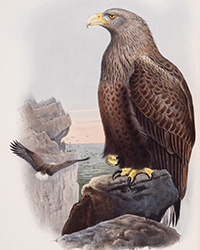
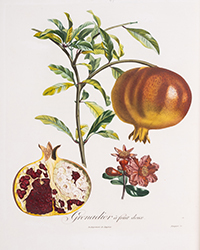
![<b>Forum, Mar. 25:</b> Botany.- [Robin (Jean)]. <i>Histoire des Plantes, nouvellement trouvées en l'Isle Virgine…,</i>, 1620; with Geoffrey Linocier <i>L'Histoire des plantes,</i> second edition, 1619-20. £3,000 - £4,000.](https://ae-files.s3.amazonaws.com/AdvertisementPhotos/9a2a2dbe-8edf-4091-9a08-800f7aba747e.jpg "<b>Forum, Mar. 25:</b> Botany.- [Robin (Jean)]. <i>Histoire des Plantes, nouvellement trouvées en l'Isle Virgine…,</i>, 1620; with Geoffrey Linocier <i>L'Histoire des plantes,</i> second edition, 1619-20. £3,000 - £4,000.")
![<b>Forum, Mar. 25:</b> Asia.- Japan.- Siebold (P.F. von). <i>Nippon. Archiv zur Beschreibung von Japan,</i> 7 parts in 6 vol., first edition, Leyden, [1832]-1852. £35,000 - £45,000.](https://ae-files.s3.amazonaws.com/AdvertisementPhotos/9b1bf9d0-4e40-41d0-9957-d89a37e1313c.jpg "<b>Forum, Mar. 25:</b> Asia.- Japan.- Siebold (P.F. von). <i>Nippon. Archiv zur Beschreibung von Japan,</i> 7 parts in 6 vol., first edition, Leyden, [1832]-1852. £35,000 - £45,000.")
![<b>Forum, Mar. 25:</b> Asia.- Valentijn (Francois). <i>Oud en Nieuw Oost-Indiën...,</i> 5 vol. in 8, first edition, Dordrecht [&] Amsterdam, 1724-26. £8,000 - £12,000.](https://ae-files.s3.amazonaws.com/AdvertisementPhotos/7ade0e81-f47b-45b3-bd2c-123a0469d82f.jpg "<b>Forum, Mar. 25:</b> Asia.- Valentijn (Francois). <i>Oud en Nieuw Oost-Indiën...,</i> 5 vol. in 8, first edition, Dordrecht [&] Amsterdam, 1724-26. £8,000 - £12,000.")
![<b>Forum, Mar. 25:</b> Botany.- Australia.- Redouté (P.J.).- Ventenat (Étienne Pierre). <i>Jardin de la Malmaison,</i> 2 vol.,, Paris, 1803-04[-05]. £30,000 - £40,000.](https://ae-files.s3.amazonaws.com/AdvertisementPhotos/0bc6575a-a6e5-44f6-8664-66fbad19c190.jpg "<b>Forum, Mar. 25:</b> Botany.- Australia.- Redouté (P.J.).- Ventenat (Étienne Pierre). <i>Jardin de la Malmaison,</i> 2 vol.,, Paris, 1803-04[-05]. £30,000 - £40,000.")
![<b>ALDE, Mar. 11:</b> [REGNART (LE LIVRE DE)]. <i>[Le] Docteur en malice, maistre Regnard, demonstrant les ruzes et cautelles qu'il use envers les personnes…</i> Rouen, 1550. €20,000 - €30,000.](https://ae-files.s3.amazonaws.com/AdvertisementPhotos/ddd3b34c-8abc-4eae-8474-6ea05406ccd0.jpg "<b>ALDE, Mar. 11:</b> [REGNART (LE LIVRE DE)]. <i>[Le] Docteur en malice, maistre Regnard, demonstrant les ruzes et cautelles qu'il use envers les personnes…</i> Rouen, 1550. €20,000 - €30,000.")
![<b>ALDE, Mar. 11:</b> TRITHÈME (JEAN). <i>Polygraphie et universelle escriture cabalistique.</i> Paris, [Benoît Prévost pour] Jacques Kerver, 1561. €8,000 - €10,000.](https://ae-files.s3.amazonaws.com/AdvertisementPhotos/cbc8d1a4-d991-48c7-b788-7554a6774b0e.jpg "<b>ALDE, Mar. 11:</b> TRITHÈME (JEAN). <i>Polygraphie et universelle escriture cabalistique.</i> Paris, [Benoît Prévost pour] Jacques Kerver, 1561. €8,000 - €10,000.")
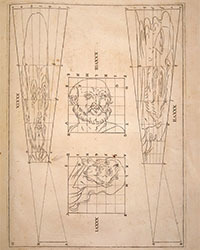
![<b>ALDE, Mar. 11:</b> VONTET (JACQUES). <i>L’Art de trancher la viande et toute sorte de fruits…</i> S.l.n.d. [probablement Lyon, vers 1647]. €20,000 - €30,000.](https://ae-files.s3.amazonaws.com/AdvertisementPhotos/21ad2e05-5544-44aa-887d-76df423e17af.jpg "<b>ALDE, Mar. 11:</b> VONTET (JACQUES). <i>L’Art de trancher la viande et toute sorte de fruits…</i> S.l.n.d. [probablement Lyon, vers 1647]. €20,000 - €30,000.")
![<b>ALDE, Mar. 11:</b> HUGO (VICTOR). [Paysage spectral avec une église], [vers 1837]. €20,000 - €30,000.](https://ae-files.s3.amazonaws.com/AdvertisementPhotos/dc734df9-0811-477f-919a-2563b8452855.jpg "<b>ALDE, Mar. 11:</b> HUGO (VICTOR). [Paysage spectral avec une église], [vers 1837]. €20,000 - €30,000.")
![<b>ALDE, Mar. 11:</b> [HERVEY DE SAINT-DENYS (LÉON D')]. <i>Les Rêves et les Moyens de les diriger. Observations pratiques.</i> Paris, Amyot, 1867. €3,000 - €4,000.](https://ae-files.s3.amazonaws.com/AdvertisementPhotos/7e769889-43a5-495e-a931-c511da576c2b.jpg "<b>ALDE, Mar. 11:</b> [HERVEY DE SAINT-DENYS (LÉON D')]. <i>Les Rêves et les Moyens de les diriger. Observations pratiques.</i> Paris, Amyot, 1867. €3,000 - €4,000.")
![<b>ALDE, Mar. 11:</b> GACHET (PAUL-FERDINAND). <i>Les Chats de Gachet</i> (Manuscrit). S.d. [avant mai 1873]. €6,000 - €8,000.](https://ae-files.s3.amazonaws.com/AdvertisementPhotos/855dc2c0-17e3-4562-a1cc-2e7265c3769c.jpg "<b>ALDE, Mar. 11:</b> GACHET (PAUL-FERDINAND). <i>Les Chats de Gachet</i> (Manuscrit). S.d. [avant mai 1873]. €6,000 - €8,000.")
![<b>ALDE, Mar. 11:</b> [REDON (ODILON)]. PICARD (EDMOND). <i>Le Juré. Monodrame en cinq actes…</i> Bruxelles, Mme veuve Monnom, 1887. €7,000 - €9,000.](https://ae-files.s3.amazonaws.com/AdvertisementPhotos/b325eb41-450b-4bd6-851c-4125e04dfbe7.jpg "<b>ALDE, Mar. 11:</b> [REDON (ODILON)]. PICARD (EDMOND). <i>Le Juré. Monodrame en cinq actes…</i> Bruxelles, Mme veuve Monnom, 1887. €7,000 - €9,000.")
![<b>ALDE, Mar. 11:</b> [TOULOUSE-LAUTREC (HENRI DE) ET HENRI-GABRIEL IBELS]. MONTORGUEIL (GEORGES). <i>Le Café-concert.</i> Paris, [1893]. €4,000 - €5,000.](https://ae-files.s3.amazonaws.com/AdvertisementPhotos/6588f3a0-90f2-464c-8125-a76866eabe85.jpg "<b>ALDE, Mar. 11:</b> [TOULOUSE-LAUTREC (HENRI DE) ET HENRI-GABRIEL IBELS]. MONTORGUEIL (GEORGES). <i>Le Café-concert.</i> Paris, [1893]. €4,000 - €5,000.")
![<b>ALDE, Mar. 11:</b> [TERRY (EMILIO)]. <i>Projet de fontaine.</i> Dessin original au stylo et à l'encre noire. 1938. €2,000 - €3,000.](https://ae-files.s3.amazonaws.com/AdvertisementPhotos/0840c8e4-4f35-4c95-b2d3-3d5addd6fd51.jpg "<b>ALDE, Mar. 11:</b> [TERRY (EMILIO)]. <i>Projet de fontaine.</i> Dessin original au stylo et à l'encre noire. 1938. €2,000 - €3,000.")