
• Old World Auctions (April 22): Lot 16. Blaeu's world map on a polar projection in contemporary color (1695) Est. $5,500 - $7,000
    Old World Auctions (April 22): Lot 55. Illuminated lunar globe produced in East Germany (1977) Est. $750 - $900
    Old World Auctions (April 22): Lot 594. Rare and decorative De Jode map of Africa (1593) Est. $7,500 - $9,000
    Old World Auctions (April 22): Lot 127. The first printed map to focus on New England and New France (1565) Est. $4,500 - $5,500
    Old World Auctions (April 22): Lot 298. Rare Texas oilfield map (1920) Est. $3,000 - $3,750
    Old World Auctions (April 22): Lot 656. Bible leaf with hand-colored image of Adoration of the Magi (1450) Est. $1,800 - $2,100
    Old World Auctions (April 22): Lot 9. Blaeu's magnificent carte-a-figures world map (1641) Est. $12,000 - $15,000
    Old World Auctions (April 22): Lot 214. Rare edition of view of the world from Silicon Valley (1984) Est. $600 - $750
    Old World Auctions (April 22): Lot 34. Fascinating Japanese satirical map published just prior to WWII (1938) Est. $1,400 - $1,700
    Old World Auctions (April 22): Lot 181. German edition of Catesby's scarce and important map of the Southeastern US (1755) Est. $3,750 - $4,500
    Old World Auctions (April 22): Lot 625. Complete set of Covarrubias's "Pageant of the Pacific" (1940-39) Est. $1,200 - $1,500
  • Jeschke Jádi
    Rare Book Auction 159
    Saturday April 25
    Jeschke Jádi, Apr. 25: Lot 1153 Gerhard Mercator u. Jodocus Hondius. Atlas sive cosmographicae. Amsterdam, Hondius, 1606.
    Jeschke Jádi, Apr. 25: Lot 1378 Martin Höhlig, Collection of 100 photographs Berlin im Licht, 1928.
    Jeschke Jádi, Apr. 25: Lot 192. Fragment of a late medieval liturgical music manuscript. 14th century
    Jeschke Jádi
    Rare Book Auction 159
    Saturday April 25
    Jeschke Jádi, Apr. 25: Lot 1394 Auguste Salzmann. Jérusalem. 40 salt paper prints. Paris, Baudry, 1856.
    Jeschke Jádi, Apr. 25: Lot 1143 Deluxe edition of Prince Waldemar of Prussia's travelogue about Sri Lanka, India and Nepal. Berlin, 1853.
    Jeschke Jádi, Apr. 25: Lot 1225. Koch-Gruenberg. Indianertypen (Indiantypesin the Amazon). Berlin 1906.
    Jeschke Jádi
    Rare Book Auction 159
    Saturday April 25
    Jeschke Jádi, Apr. 25: Lot 862. Cornelis Ploos van Amstel. Viro Amplissimo Nobilissimo. Amsterdam 1765.
    Jeschke Jádi, Apr. 25: Lot 549. Francisco de Goya. Los desastres de la guerra. 80 Etchings. Madrid, 1923.
    Jeschke Jádi, Apr. 25: Lot 1033. Rösel von Rosenhof. Natural History of Frogs. Nuremberg, 1815.
    Jeschke Jádi
    Rare Book Auction 159
    Saturday April 25
    Jeschke Jádi, Apr. 25: Lot 13 Pomponius Mela. Cosmographi. Venice, Renner 1478.
    Jeschke Jádi, Apr. 25: Lot 526 William Shakespeare. Hamlet. Cranach Press, 1928.
    Jeschke Jádi, Apr. 25: Lot 1022. Eugen Johann Christoph Esper. Butterflies Leipzig, 1829-1839.
  • Doyle
    Rare Books, Autographs & Maps
    April 16, 2026
    Doyle, Apr. 16: Twelve miscellaneous volumes on Italian history and literature. $100 to $200.
    Doyle, Apr. 16: A fine collection of Company school paintings of Mughal monuments. $4,000 to $6,000.
    Doyle, Apr. 16: A Book of Hours of Rouen with eight miniatures. $30,000 to $45,000.
    Doyle, Apr. 16: Einstein discusses General Relativity and the Unified Field Theory. $20,000 to $30,000.
    Doyle, Apr. 16: An extraordinary letter from Thomas Jefferson to Charles Willson Peale. $12,000 to $18,000.
    Doyle, Apr. 16: Extraordinary color plates of the geology of St. Helena. $800 to $1,200.
    Doyle, Apr. 16: The deluxe issue of Rorer's Mimpish Squinnies. $800 to $1,200.
  • Swann
    Fine Books Featuring Focus on Women
    April 23, 2026
    Swann, Apr. 23: Thomas Heywood. An Apology for Actors. London: Printed by Nicholas Okes, 1612. $3,000 to $5,000.
    Swann, Apr. 23: Illuminated Islamic Devotional Manuscript. 19th century. Approx. 90 leaves with gilt-decorated title and 2 full page miniatures of Mecca and Medina. $800 to $1,200.
    Swann, Apr. 23: Antiphonal in Latin. Manuscript on Parchment. Cologne, early 16th century. $7,000 to $9,000.
    Swann
    Fine Books Featuring Focus on Women
    April 23, 2026
    Swann, Apr. 23: Mohammed ibn Jafir Albategnius. De Scientia Stellarum Liber. Bologna: Victor Benati, 1645. $8,000 to $12,000.
    Swann, Apr. 23: Frank Herbert. Dune. Fine First Edition. Philadelphia: Chilton Books, 1965. $5,000 to $7,000.
    Swann, Apr. 23: William Shakespeare. Five Plays from the Second Folio. London: Thomas Cotes for Robert Allot, 1632. $6,000 to $8,000.
    Swann
    Fine Books Featuring Focus on Women
    April 23, 2026
    Swann, Apr. 23: John Steinbeck. Of Mice and Men. New York: Covici-Friede, 1937. First edition, first issue. $800 to $1,200.
    Swann, Apr. 23: Charles Dickens. A Tale of Two Cities. With an A.L.S. London: Chapman and Hall, 1859. First edition, first issue. $1,200 to $1,800.
    Swann, Apr. 23: Ursula K. LeGuin. The Left Hand of Darkness. Inscribed First Edition. New York: Walker and Company, 1969. $800 to $1,200.
    Swann
    Fine Books Featuring Focus on Women
    April 23, 2026
    Swann, Apr. 23: L. Frank Baum & Ruth Plumly Thompson. Five First Canadian editions including Ozma of Oz; The Emerald City of Oz; Glinda of Oz; [and others]. $1,000 to $1,500.
    Swann, Apr. 23: Corita Kent. Different Drummer. 1967. Color screenprint; signed "Corita" in pencil on the lower edge. $1,000 to $1,500.
    Swann, Apr. 23: Bible in English. Tyndale-Taverner Translation. The Bugge Bible. The Holye Bible. London: Imprinted by John Daye and Willyam Seres, 1549. $1,500 to $2,000.

Rare Book Monthly

Articles - April - 2026 Issue

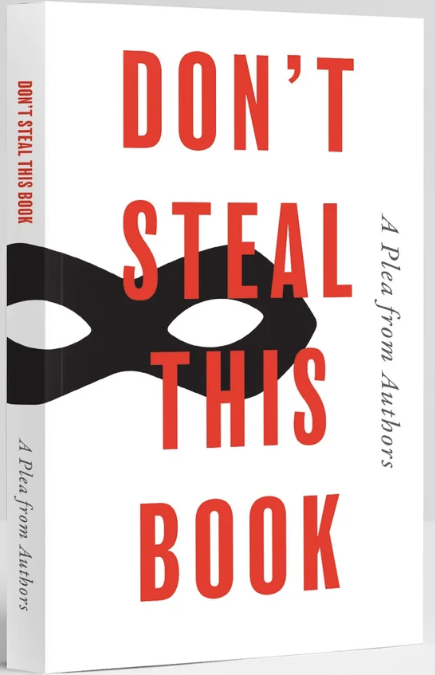
Don't Steal This Book

Don't Steal This Book.

Don't Steal This Book.

Authors and publishers have been unwillingly forced into a game of whac-a-mole with those who use or steal their copyrighted works without payment. There are two versions. One is a blatant case of theft, but where the thieves are hard to locate or prevent from rising up again if they are. The second may not clearly be a case of legal theft, but the victims see it as at minimum a moral case. This one may be resolvable by settlement or it may end up in the hands of the courts to decide.

The first point to recognize is that AI requires enormous amounts of data to function. It needs the data for “training,” which means to have the information necessary to answer virtually every question anyone can think of to ask. AI sites like OpenAI's ChatGPT, Google's Gemini, and Anthropic's Claude, gather much of their data from public sites. Non-copyrighted articles and news sites, learned scientific and other papers, discussion boards, even social media are fair game, though more verification is needed for the discussion boards and social media to be trusted. Books out of copyright, such as those found on HathiTrust and Google Books, can legally be copied and used to “train” AI too. However, copyrighted works, often found online but behind a paywall, may not be copied without permission.

As our topic is books, all but very old ones are subject to copyrights. They may not legally be copied without permission. 

The first case that came up recently is that of Anna's Archive. This is a pirate site. There is little pretense that what they do is legal, and if its anonymous owners believed it was, they would not be anonymous. You can't find out where they are located, and when their url is blocked they simply switch to a new one. As for Anna, there is no such person. It's a made-up name.


What Anna's does is to copy practically every book it can find online. It then offers the books for download, either free or for a “contribution.” Contributions need to be made in bitcoin as that is untraceable. What makes Anna's Archive, or other pirates like LibGen (Library Genesis) so desirable for AI is that they can gain access to millions of books all together. They don't have to go out searching for them one-by-one. The free aspect is the cherry on the top since the AI sites would have to pay a lot to access all these books on a royalty basis. Reportedly, Anna's Archive is demanding bitcoin “contributions.” Meta is currently being sued by authors and publishers for using LibGen to “steal” their copyrighted books for Meta's Llama AI.

In this latest case, 14 publishers have banded together to go after the source of the theft, rather than the ultimate user. The suit is against Anna's Archive. The suing publishers are Hachette Book Group, HarperCollins, Macmillan Publishing Group, Penguin Random House, Simon & Schuster, Apress Media, Cengage Group, Elsevier, John Wiley & Sons, Bedford, Freeman & Worth Publishing Group, McGraw Hill, Pearson Education, and Taylor & Francis Group. Anna's Archive was previously sued by Atlantic records for stealing audio files. At the time they claimed Anna's Archive had stolen 61,344,044 books and 95,527,824 papers. Another 2 million books and 100,000 papers have been added since then according to Parade Magazine.

If past suits by publishers are a guide, what can be expected is that publishers will win. They will win by default judgment which is what you get if the defendant does not show up to defend itself. The publishers will then have to figure out how to enforce its judgment against a party it cannot find (it is believed that at least some of these pirate sites are in Russia and good luck going after them there). Anna's url may be blocked but the pirate will just set itself up again on another url. That is what happened to Atlantic and other record companies along with Spotify whose site was hacked for the music. They won an injunction and several Anna's sites were taken down but they just moved to new ones.

The second case involves the AI search engines using authors' copyrighted books to train their models, that is, provide answers to users' questions. These are the ones who purchased or otherwise obtained the stolen book files from Anna's Archive or other similar sites. You have undoubtedly used these engines such as ChatGPT and Gemini. We noted the suit against the likes of Anna's Archive that steals these authors works. But, what about the end users? Maybe they didn't steal the authors' books, but they are in effect using that stolen merchandise. The AI search engines know they are using books effectively stolen, but do so anyway. Maybe they think there's no other practical way to gain access to millions of books, but need is not a defense for theft.

British authors came up with a plan to at least embarrass those stealing their work. They published a book specially for the London Book Fair. The title is Don't Steal This Book. It was written by nearly 10,000 authors. Don't Steal This Book must be a very large book with all these contributors. Not really. It is almost a blank book. All it contains are the authors' names. All these great writers and all you get is a long, excruciatingly boring read. But, it's not meant to be read. It's meant to make a point.

Their point is that if authors aren't compensated for their work, they will write no more books. They need to eat just like the rest of us and food costs money. New books will be blank pages. The back cover reads, “The UK government must not legalise book theft to benefit AI companies.” The book is aimed at proposed legislation in the UK that in certain cases lets the AI search companies use copyrighted works unless the author opts out, instead of requiring the AI company to first seek permission.

Book organizer Ed Newton-Rex was quoted as saying, “This is not a victimless crime – generative AI competes with the people whose work it is trained on, robbing them of their livelihoods. The government must protect the UK’s creatives, and refuse to legalise the theft of creative work by AI companies.”

Rare Book Monthly

  • Heritage, May 13: Isaac Asimov. I, Robot. The dedication copy, inscribed to John W. Campbell, Jr.
    Heritage, May 13: Aldous Huxley. Brave New World. A fine copy, in a brilliant dust jacket.
    Heritage, May 13: Ray Bradbury. Fahrenheit 451. Presentation copy, inscribed by the author.
    Heritage, May 13: Robert A. Heinlein. Stranger in a Strange Land. A fine copy, signed by the author.
    Heritage, May 13: Jules Verne. Twenty Thousand Leagues Under the Seas. Exceedingly rare true first American edition, first issue.
  • Sotheby’s
    Books, Manuscripts & Objects from Three Important Collections
    Open for Bidding 2-17 April
    Sotheby’s, Apr. 2-17: [Guillaume de Lorris and Jean de Meun]. Le Roman de la Rose, [Geneva or Lyons, c.1481], first printed edition of the most important medieval French vernacular poem. £200,000 to £300,000.
    Sotheby’s, Apr. 2-17: Castiglione. Il libro del cortegiano. [Venice], April 1528, first edition, in a magnificent binding by Jean Picard for Jean Grolier. £100,000 to £150,000.
    Sotheby’s, Apr. 2-17: Jacobus de Cessolis. Schachzabelbuch, Strasbourg, 1483, von der Lasa copy. £50,000 to £70,000.
    Sotheby’s, Apr. 2-17: World Championship, 1972. A collection of 84 press photographs of the famed match between Spassky and Fischer. £2,000 to £3,000.
    Sotheby’s, Apr. 2-17: Ben Franklin. Autograph letter signed, to Lord Shelburne, British Prime Minister, during peace negotiations, November 1782. £15,000 to £20,000.
  • S&D Scandinavian Art & Rare Book Auctions
    Rare Maps, Prints & Art 1478-1882
    April 16, 2026
    SD Auctions, Apr. 16: Ptolemy. North Africa from Ulm edition. Unique copy. 1482-86.
    SD Auctions, Apr. 16: Blaeu. Masterpiece world map. c.1659.
    SD Auctions, Apr. 16: Unknown. Sea Flags printed on silk. Rare. c.1840.
    SD Auctions, Apr. 16: Fredrik Kolstø. Aftenstemning ved Kysten. c.1890-t.
    SD Auctions, Apr. 16: Knut Yran. OL-plakaten Oslo 1952.

Article Search

Archived Articles