Rare Book Monthly

Articles - April - 2026 Issue

Researchers Think Written Communications Began Far Longer Ago Than Previously Believed

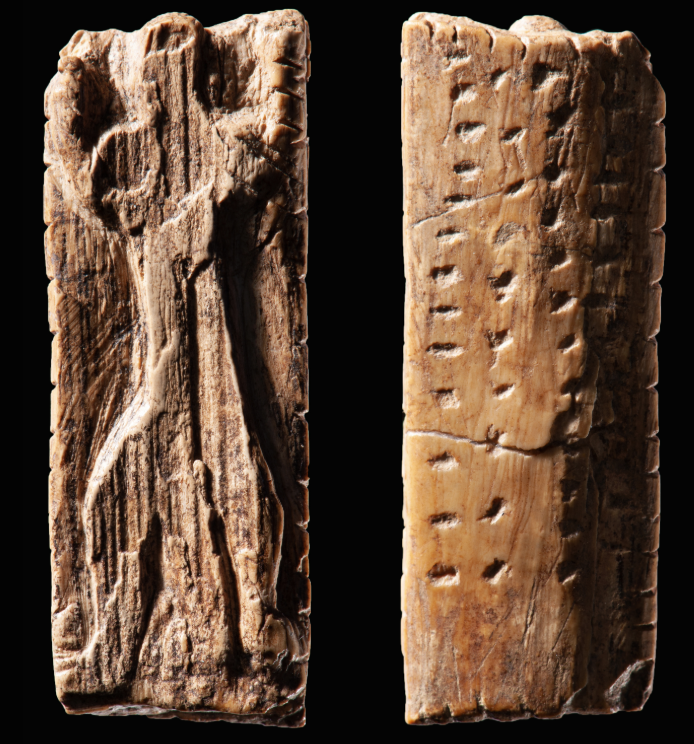
Carved symbols believed to be ancient writing.

Carved symbols believed to be ancient writing.

We all know when printing began, at least on a mass scale as made possible by movable type. That came with Gutenberg around 1455. But, do you know when written language began? That, naturally, is much older.


The first writing has generally been accepted as being around 5000 years old. Cuneiform goes back to around 3,000 BCE, but proto-cuneiform may go as far back as 3,500 BCE. Now, a recent study out of Saarland University in Germany claims it goes back farther still, much, much farther. The authors of this study, Saarland Professor Christian Bentz and Berlin Museum of Prehistory and Early History archaeologist Ewa Dutkiewicz, date the earliest proto-writing to 40,000 years ago. That is a huge recalibration.


How did they reach this conclusion? It's not what you might think – the discovery of some ancient stone tablet deep underground in the layers of prehistory. Actually, it's been in front of our eyes for quite while. However, some more recent discoveries in caves in Germany made the evidence clearer to the researchers. They reached what to them was an unexpected conclusion when investigating objects found in these caves.


According to Saarland University, the researchers investigated 260 objects found in the caves, such as a carving of a mammoth or a figurine that is half lion and half human. Ewa Dutkiewicz explains, “the artefacts date back to tens of thousands of years before the first writing systems, to the time when Homo sapiens left Africa, settled in Europe and encountered Neanderthals.” They were able to date them to 34,000-43,000 years ago.


What they next evaluated were 3,000 signs found on these objects. In an article on the PNAS website, Bentz explained, “The inventory of sign types includes basic shapes such as lines, points, crosses, but also more complex patterns such as stars, grid patterns, and zigzag lines.” They concluded from the patterns that these marks were not the byproduct of some other activity, such as butchering, nor practical for such things as holes for attaching ropes. They also concluded that the information density of the signs indicated there was more to them than just decoration, though meaningful signs can also be decorative, such as with calligraphy.


Next, the researches digitized the sign sequences and ran them through some computer programs for statistical modeling, machine learning, etc. to look for repetition of sequences and compared them to early languages and writing. Bentz explains, “because of the high rate of repetitions and the high predictability of the next sign, we were able to show that the entropy – a measure of information density – is comparable to that of proto-cuneiform, which came much later.” That was the earliest known form of written communications. It used symbols for meaning rather than letters to form words. They are careful not to call what they found on these objects a written “language.” A written language, they say, mimics spoken language. Proto-cuneiform conveys messages, but is not something that can be spoken. The signs on these ancient objects they evaluated can't be spoken either. They are often very repetitive. That can relay a message, but no language has its speaker repeat the same word over and over in sequence. As the researchers say, “broadly defined, writing represents speech.” Perhaps this can be defined as a proto-written language, it can relay messages like language but cannot be spoken.


Bentz continues, “writing is only one specific form in a long series of sign systems.” He elaborates, “We continue to develop new systems for encoding information. Encoding is also the basis of computer systems.” That uses a system of zeroes and ones to convey unlimited amounts of information, but it is not a spoken language converted to writing.


If, then, this is information these early humans were intentionally recording, what does it mean? That is a question the researchers were unable answer. Dutkiewicz noted, “Stone Age humans had already reached a similar stage of development as modern humans. This means they likely had similar cognitive abilities as we do. The ability to record and convey information to others was extremely important for Palaeolithic humans.” In other words, they were as smart as us, they just didn't have access to the same information. The messages would not contain as deeply educated thoughts as they might today, but they wouldn't be baby talk or the grunts and groans of stereotypical cavemen. She says, “It may have allowed them to coordinate groups or even helped them survive.”


Some of the earliest writings involve numbers, trade accounts, inventory, or markings of time. Perhaps these 40,000-year-old marks represent some type of numerical accounting, but we don't know for certain. Perhaps we never will.
Rare Book Monthly

  • Sotheby’s
    Précieuses reliures d’une bibliophile
    Collection Georgette J. Salles
    Open for bidding 8-29 April
    Apr. 8-29: Delaunay, Sonia — Blaise Cendrars. La Prose du Transsibérien. 1913. €120,000 to €180,000.
    Apr. 8-29: Picasso, Pablo — Georges Hugnet. La Chèvre-feuille. 1943. €80,000 to €120,000.
    Apr. 8-29: Schmied, François-Louis ─ Joseph-Charles Mardrus. Cantique des cantiques. 1925. €30,000 to €50,000.
    Apr. 8-29: Bonnard, Pierre — Paul Verlaine. Parallèlement. 1900. €30,000 to €50,000.
    Apr. 8-29: Derain, André — Guillaume Apollinaire. L’Enchanteur pourrissant. 1909. €20,000 to €30,000.
  • Heritage, May 13: Isaac Asimov. I, Robot. The dedication copy, inscribed to John W. Campbell, Jr.
    Heritage, May 13: Aldous Huxley. Brave New World. A fine copy, in a brilliant dust jacket.
    Heritage, May 13: Ray Bradbury. Fahrenheit 451. Presentation copy, inscribed by the author.
    Heritage, May 13: Robert A. Heinlein. Stranger in a Strange Land. A fine copy, signed by the author.
    Heritage, May 13: Jules Verne. Twenty Thousand Leagues Under the Seas. Exceedingly rare true first American edition, first issue.
  • One of a Kind Auctions
    Tesla, Einstein & The American Presidency: Rare Historical Documents
    Ending April 30, 2026
    One of a Kind Auctions, Apr. 30: The Republican Court; Autographs of George Washington, (Signers) Thomas Jefferson, Benjamin Harrison, John Dickinson, Charles Carroll of Carrollton and More!
    One of a Kind Auctions, Apr. 30: Nikola Tesla Signed Holograph Manuscript Page from "Tidal Wave to Make War Impossible," Describing the World's First Conceived Remotely Operated Weapon of Mass Naval Destruction.
    One of a Kind Auctions, Apr. 30: Albert Einstein — Incredible possibly Unique Signed & Inscribed Einsteins hand “Relativitätstheorie / A. Einstein” Booklet: Relativitätstheorie, 10th Ed., 1920, Original Wrappers.
    One of a Kind Auctions
    Tesla, Einstein & The American Presidency: Rare Historical Documents
    Ending April 30, 2026
    One of a Kind Auctions, Apr. 30: James Joyce Personal Copy of Finnegan's Wake (With Signature).
    One of a Kind Auctions, Apr. 30: Buster Keaton Flamingo Films / Kennedy Productions Archive Group, 1933–1937.
    One of a Kind Auctions, Apr. 30: Extremely rare Josiah Henson (Uncle Tom) Signature & Harriet Beecher Stowe Cabinet Card.
    One of a Kind Auctions
    Tesla, Einstein & The American Presidency: Rare Historical Documents
    Ending April 30, 2026
    One of a Kind Auctions, Apr. 30: William Livingston (Signer of DOI), the New Jersey State Convention had unanimously ratified the Federal Constitution.
    One of a Kind Auctions, Apr. 30: Complete 1927 Tunney-Dempsey "Long Count" Fight Ticket Signed by George Getz, with 1923 Dempsey-Firpo Dinner Card and Jack Dempsey Signed Photograph.
    One of a Kind Auctions, Apr. 30: James Buchanan Cabinet Signed Autograph album
    One of a Kind Auctions, Apr. 30: CHARLES LINDBERGH SIGNS HIS NEW YORK CITY MAYORAL BANQUET INVITATION, JUNE 14, 1927 — THREE WEEKS AFTER THE TRANSATLANTIC FLIGHT
  • Jeschke Jádi
    Rare Book Auction 159
    Saturday April 25
    Jeschke Jádi, Apr. 25: Lot 1153 Gerhard Mercator u. Jodocus Hondius. Atlas sive cosmographicae. Amsterdam, Hondius, 1606.
    Jeschke Jádi, Apr. 25: Lot 1378 Martin Höhlig, Collection of 100 photographs Berlin im Licht, 1928.
    Jeschke Jádi, Apr. 25: Lot 192. Fragment of a late medieval liturgical music manuscript. 14th century
    Jeschke Jádi
    Rare Book Auction 159
    Saturday April 25
    Jeschke Jádi, Apr. 25: Lot 1394 Auguste Salzmann. Jérusalem. 40 salt paper prints. Paris, Baudry, 1856.
    Jeschke Jádi, Apr. 25: Lot 1143 Deluxe edition of Prince Waldemar of Prussia's travelogue about Sri Lanka, India and Nepal. Berlin, 1853.
    Jeschke Jádi, Apr. 25: Lot 1225. Koch-Gruenberg. Indianertypen (Indiantypesin the Amazon). Berlin 1906.
    Jeschke Jádi
    Rare Book Auction 159
    Saturday April 25
    Jeschke Jádi, Apr. 25: Lot 862. Cornelis Ploos van Amstel. Viro Amplissimo Nobilissimo. Amsterdam 1765.
    Jeschke Jádi, Apr. 25: Lot 549. Francisco de Goya. Los desastres de la guerra. 80 Etchings. Madrid, 1923.
    Jeschke Jádi, Apr. 25: Lot 1033. Rösel von Rosenhof. Natural History of Frogs. Nuremberg, 1815.
    Jeschke Jádi
    Rare Book Auction 159
    Saturday April 25
    Jeschke Jádi, Apr. 25: Lot 13 Pomponius Mela. Cosmographi. Venice, Renner 1478.
    Jeschke Jádi, Apr. 25: Lot 526 William Shakespeare. Hamlet. Cranach Press, 1928.
    Jeschke Jádi, Apr. 25: Lot 1022. Eugen Johann Christoph Esper. Butterflies Leipzig, 1829-1839.
  • Gros & Delettrez, May 5: APRÈS de MANNEVILLETTE, Jean-Baptiste d’- Le Neptune Oriental.
    Gros & Delettrez, May 5: DELISLE, Guillaume – Atlas françois,1725.
    Gros & Delettrez, May 5: HONTER. SOPHOCLE - Recueil composite réunissant deux ouvrages.
    Gros & Delettrez, May 5: PHÉROTÉE DE LA CROIX, A. - Algemeene weereld-beschryving.
    Gros & Delettrez, May 5: LA PÉROUSE, Jean-François de Galaup de - Voyage autour du monde.
    Gros & Delettrez, May 5: BLAEU, Guillaume & Jean -Septième volume de la Géographie Blaviane.
    Gros & Delettrez, May 5: TATIKIAN, Boğos - Figures et costumes du Levant.
    Gros & Delettrez, May 5: GIRAULT DE PRANGEY, Joseph-Philibert -Monument arabes et moresques de Cordoue, Séville et Grenade.
    Gros & Delettrez, May 5: CHAMPOLLION le jeune. Monuments de l’Egypte et de la Nubie.
    Gros & Delettrez, May 5: CASSAS, Louis-François. - Voyage pittoresque de la Syrie, de la Phénicie, de la Palestine et de la Basse Egypte.
    Gros & Delettrez, May 5: SONNERAT, Pierre. Voyage aux Indes orientales et à la Chine.
    Gros & Delettrez, May 5: GARNIER, Francis. Voyage d'exploration en Indo-Chine.
    Gros & Delettrez, May 5: SUBERBIE, Alix (E. SMITH). Dessins et aquarelles de Madagascar.
    Gros & Delettrez, May 5: BYRON -Viage del comandante Byron.

Article Search

Archived Articles