Researchers Think Written Communications Began Far Longer Ago Than Previously Believed
- by Michael Stillman
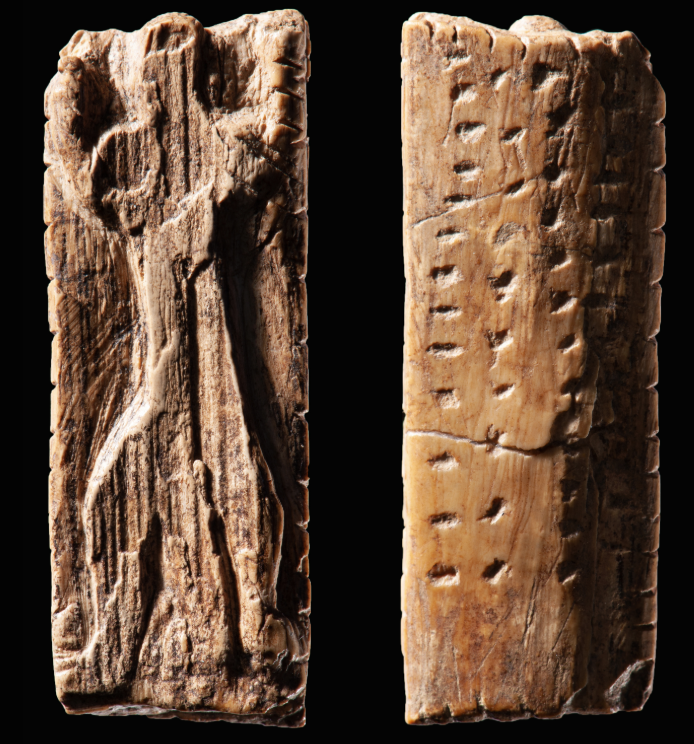
Carved symbols believed to be ancient writing.
We all know when printing began, at least on a mass scale as made possible by movable type. That came with Gutenberg around 1455. But, do you know when written language began? That, naturally, is much older.
The first writing has generally been accepted as being around 5000 years old. Cuneiform goes back to around 3,000 BCE, but proto-cuneiform may go as far back as 3,500 BCE. Now, a recent study out of Saarland University in Germany claims it goes back farther still, much, much farther. The authors of this study, Saarland Professor Christian Bentz and Berlin Museum of Prehistory and Early History archaeologist Ewa Dutkiewicz, date the earliest proto-writing to 40,000 years ago. That is a huge recalibration.
How did they reach this conclusion? It's not what you might think – the discovery of some ancient stone tablet deep underground in the layers of prehistory. Actually, it's been in front of our eyes for quite while. However, some more recent discoveries in caves in Germany made the evidence clearer to the researchers. They reached what to them was an unexpected conclusion when investigating objects found in these caves.
According to Saarland University, the researchers investigated 260 objects found in the caves, such as a carving of a mammoth or a figurine that is half lion and half human. Ewa Dutkiewicz explains, “the artefacts date back to tens of thousands of years before the first writing systems, to the time when Homo sapiens left Africa, settled in Europe and encountered Neanderthals.” They were able to date them to 34,000-43,000 years ago.
What they next evaluated were 3,000 signs found on these objects. In an article on the PNAS website, Bentz explained, “The inventory of sign types includes basic shapes such as lines, points, crosses, but also more complex patterns such as stars, grid patterns, and zigzag lines.” They concluded from the patterns that these marks were not the byproduct of some other activity, such as butchering, nor practical for such things as holes for attaching ropes. They also concluded that the information density of the signs indicated there was more to them than just decoration, though meaningful signs can also be decorative, such as with calligraphy.
Next, the researches digitized the sign sequences and ran them through some computer programs for statistical modeling, machine learning, etc. to look for repetition of sequences and compared them to early languages and writing. Bentz explains, “because of the high rate of repetitions and the high predictability of the next sign, we were able to show that the entropy – a measure of information density – is comparable to that of proto-cuneiform, which came much later.” That was the earliest known form of written communications. It used symbols for meaning rather than letters to form words. They are careful not to call what they found on these objects a written “language.” A written language, they say, mimics spoken language. Proto-cuneiform conveys messages, but is not something that can be spoken. The signs on these ancient objects they evaluated can't be spoken either. They are often very repetitive. That can relay a message, but no language has its speaker repeat the same word over and over in sequence. As the researchers say, “broadly defined, writing represents speech.” Perhaps this can be defined as a proto-written language, it can relay messages like language but cannot be spoken.
Bentz continues, “writing is only one specific form in a long series of sign systems.” He elaborates, “We continue to develop new systems for encoding information. Encoding is also the basis of computer systems.” That uses a system of zeroes and ones to convey unlimited amounts of information, but it is not a spoken language converted to writing.
If, then, this is information these early humans were intentionally recording, what does it mean? That is a question the researchers were unable answer. Dutkiewicz noted, “Stone Age humans had already reached a similar stage of development as modern humans. This means they likely had similar cognitive abilities as we do. The ability to record and convey information to others was extremely important for Palaeolithic humans.” In other words, they were as smart as us, they just didn't have access to the same information. The messages would not contain as deeply educated thoughts as they might today, but they wouldn't be baby talk or the grunts and groans of stereotypical cavemen. She says, “It may have allowed them to coordinate groups or even helped them survive.”
Some of the earliest writings involve numbers, trade accounts, inventory, or markings of time. Perhaps these 40,000-year-old marks represent some type of numerical accounting, but we don't know for certain. Perhaps we never will.