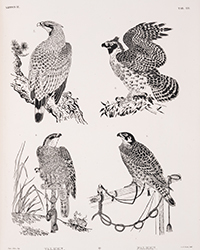
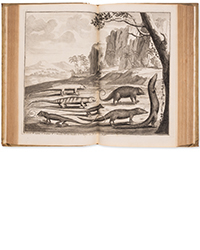
Wood engraving was done with a fine scribe on the end grain of box wood. It was the great illustrative technique of mid to late 19th century. There are endless examples still available almost always on cheap wood pulp paper. Before there were photos in magazines wood engraving thrived. Wood engraving is often interesting, sometimes valuable and mostly found in publications that enjoyed a substantial circulation in their day. This is a format that comes in, is used widely, and then mostly goes away by the early 20th century. There are a few, but not many practitioners of this form today.
Stone Lithography
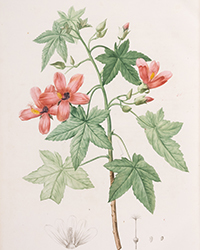
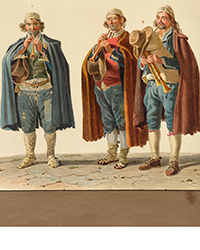
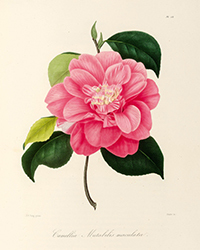
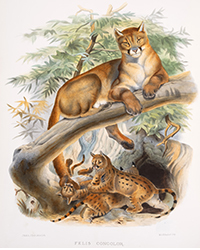
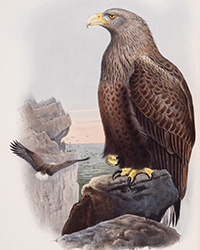
Stone lithography was invented in 1796 and flourished in the 19th century. It is best known for the large and colorful posters, especially by European artists, but it was also used for art and illustration where intense highly saturated color was desired.
Stone lithography is a resist process, the artist draws on the stone with a crayon or similar waxy substance, then a liquid wash is applied that eats away all the parts of the stone block that are not covered by the drawing. The covered portion remains higher and the uncovered parts are very slightly lower. Unlike metal plate, prints made from stone do not have plate marks, and they are very good at showing tonal range.
It’s hard to make a tonal range in metal. Metal plate artists used many kinds of cross hatch and devised other techniques like aquatint to simulate tone, but with the advent of stone lithography tone and color became, if not easy, at least possible and fluid transitions were soon the norm.
Don’t confuse stone litho with offset litho
Do not confuse 19th and 20th century stone lithography with the present day technique called “photo lithography” or ”offset printing” or “photo-offset” and other camera based printing techniques which employ half-tone dots to reproduce images.
The names sound similar and they have some similarities but there are important differences. The most important difference is quantity. Stone lithography is a one sheet at a time process and the press runs are seldom big. Photo- lithography can, did and still does easily run editions in the millions.
Emulsion (Photography -Film)
The camera has a long history and during its earlier periods there were photos on glass and metal. But photography using film with the image printed on papers with emulsions starts in the 1880s and keeps going until the end of the 20th century, when this format was largely replaced by digital computer generated imagery that does not use film and prints on papers that are not emulsion based.
In the period from the late 19th century to the end of the 20th century the most important thing to know about photos printed on paper is that they have an emulsion on one side which is the surface that displays the image and if they are genuine photos there are no half tone dots.
Lots of things that purport to be original photos (and original other things too) are really photomechanical reproductions that have half tone dots. Use magnification to view the sheet. If you see an all over dot pattern chances are very very good it is a photomechanical reproduction.
One reason real photos are collectible is because the usually are made in limited numbers and as a category they have a definite starting and ending period of about 100 years.
Of all the printing technologies photos are the most sensitive to sunlight. This is especially true of color photos of the mid and later 20th century. These will fade, color shift and degrade rapidly if hung or displayed in a bright light. If you collect photography, keep it in a dark, cool, temperature stable place and only put it on display for short periods of time.
![<b>Forum, Mar. 25:</b> Botany.- [Robin (Jean)]. <i>Histoire des Plantes, nouv...](https://ae-files.s3.amazonaws.com/AdvertisementPhotos/9a2a2dbe-8edf-4091-9a08-800f7aba747e.jpg "<b>Forum, Mar. 25:</b> Botany.- [Robin (Jean)]. <i>Histoire des Plantes, nouvellement trouvées en l'Isle Virgine…,</i>, 1620; with Geoffrey Linocier <i>L'Histoire des plantes,</i> second edition, 1619-20. £3,000 - £4,000.")