


“Large internet companies reach many millions of people, but they are less valuable as ways to sell individual books, and more valuable as tools to meet collectors. The internet is a good place to sell some books, but it is a better place to meet customers. The important customers are not one-time buyers, but collectors and institutions, a much smaller group representing bigger and better sales. The web is a tool to reach them and to sell to them, but it is up to the bookseller to make those sales, not to wait for them.”
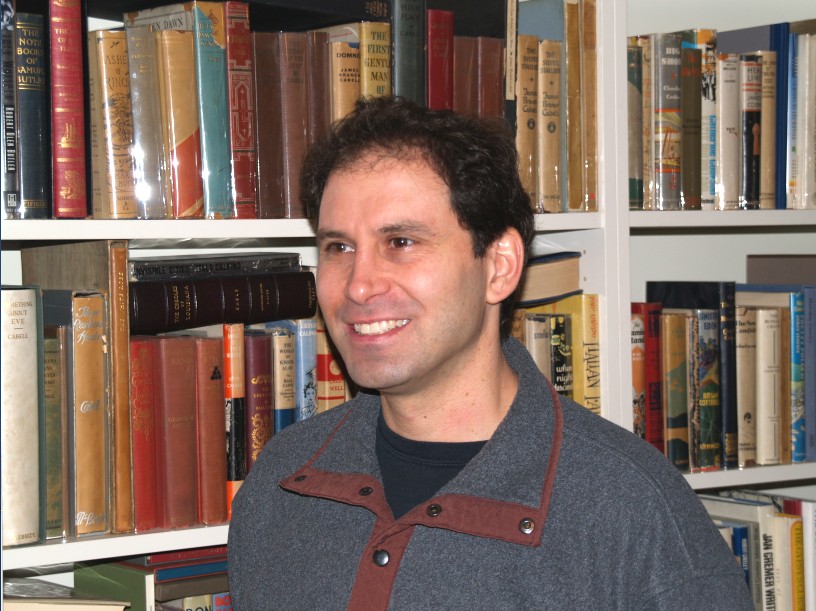
Gregory, 41, teaches the “Books and Technology” course at the annual Colorado Book Seminar. He also wears the General Manager hat at Between the Covers (ABAA/ILAB) – a New Jersey antiquarian firm that does indeed have a snazzy web site and has made a substantial investment in the tech side of its business.
On the phone Gregory comes across as more of a book guy than a geek. Indeed his book credentials are long and strong. He started in a bricks and mortar bookstore around the age of 20 and came up through the ranks of the original Borders’ store in Philadelphia from 1990 to 1996.
Those were the days when Borders was still the best kind of BIG - big enough to have everything you’d ever want to read on its shelves and big enough to host a steady stream of readings and signings by contemporary authors who came down from NY (where there was no Borders) to meet-and-greet at the Philly store.
Through his work there he cultivated his own taste in books. Just as importantly book signings heightened his awareness of collectability, first editions, and helped him meet other book dealers, including his current employer where he has worked from 1996 to the present.
If you’re a mega-lister and your idea of a profitable transaction is one where you make a dime a pop multiplied by many thousands of pops, Gregory’s advice might not be your cup of tea. On the other hand if you’re a bookseller who has a specialty niche, wants to move up in the trade but has neither the time nor money to really bankroll the next big thing you’ll find his explanation of “what works now” persuasive.
“The future of antiquarian bookselling is not by selling through third party sites that take a percentage from each sale,” says Gregory. “That may be the future that those companies hope to see, but their interests are not our interests. To me, those on-line listing sites are not places to sell books, but rather places to meet new customers. If you look at your relationship with those listing sites in this way, their fees become much more palatable. But you have to work at it to make this conversion from merely selling individual books online, to actually meeting valuable customers there.”
According to Gregory his company’s sales can be roughly divided into five sources:
“1) printed catalogs; 2) quotes to customers, which are either phone calls, emails, or printed quotes; 3) our own website; 4) book fairs and 5) sales made on the internet through third party vendors such as ABE, Amazon, Biblio, Barnes & Noble, the ABAA and ILAB sites."
He itemizes the sources of income as: “39% of our sales came from private quotes to customers, 23% from printed catalogs, 18% from our own web site, 11% from third party internet vendors and 9% came from book fairs.
“So the portion of revenue fully under our control, that is catalogs, private quotes, and our website, represents a full 80% of our income. I am very proud of this - these ratios and percentages were no accident. As recently as a few years ago it was 45% and now it is 80%.