Rare Book Monthly
Book Catalogue Reviews - November - 2009 Issue
Important Signed Documents from the Raab Collection

Andrew Jackson's appeal to the Indians to leave their ancestral homelands.
Item 21 is a very important, recently discovered item of American history. It is a letter previously known only in draft form from President Andrew Jackson concerning the removal of America's southern Indians to lands west of the Mississippi. It is an early attempt by Jackson to cajole the Indians into moving voluntarily. Jackson plays the role of benevolent father, trying to preserve their way of life and save them from white settlers. As we now know, when Jackson was unable to cajole them into leaving, he was quite willing to use force to remove them from their homelands. This letter is dated October 15, 1829. It is written to Major David Halley, who was his representative to the Choctaw and Chickasaw nations. In it Jackson explains the message he wants relayed to these tribes. Jackson instructs Haley, "say to them as friends and brothers to listen [to] the voice of their father, & friend. Where [they] now are, they and my white children are too near each other to live in harmony & peace." However, Jackson continues, he has provided land for them on the other side of the Mississippi upon which whites have no claim, "and they & their children can live upon [it as] long as grass grows or water runs, in peace and plenty. It shall be theirs forever." Continuing in a paternalistic tone, Jackson instructs, "Say to my red Choctaw children, and my Chickasaw children to listen." He explains that if they remain, they will be subject to the laws of the states of Mississippi and Alabama, not the laws of their own nation. He next claims that he is powerless to stop the states from exercising this control, "...that so far from the United States having a right to question the authority of any State to regulate its affairs within its own limits, they will be obliged to sustain the exercise of this right." As Raab notes, this is a most interesting claim from Jackson, as the Indians were granted this land for their own nations by federal treaty, and Jackson would have no problem enforcing federal authority over the internal affairs of a state a few years later during the Nullification Crisis. However, Jackson repeatedly proclaims to be the Indians' friend and father, playing the role of someone who wants to preserve their nations, but won't be able to protect them unless they cooperate by agreeing to move. As we know, when most refused to move voluntarily, they were forced to do so, and the lands promised to be "theirs forever" would similarly be taken away only a few decades later. $90,000.
It is unusual to see someone run for president as a nonpartisan, even more unusual for such a person to actually mean it. Zachary Taylor was such a candidate, and in 1848, that approach had enough public appeal to get him elected. The Whigs were facing a difficult election in 1848, having opposed the recently concluded and popular Mexican War, and their most likely candidate, Henry Clay, had already lost a couple of times before. So they turned to Taylor, a non-politician who, as a general and hero of the Mexican War, could neutralize objections to their opposition to the war. Taylor agreed to run, but made it clear he would not be beholden to any Whig doctrines, only to his own beliefs. On March 26, 1848, when his name was being bandied about as a potential Whig candidate, Taylor wrote a letter to Dr. John Kearsley Mitchell of Philadelphia. Writes Taylor, "If honored by election to the Presidency I will strive to execute with fidelity the trust reposed in me, uncommitted to the principles of either party." Taylor lived up to that pledge, unwilling to follow anyone's party line or compromise his way to consensus. However, he died only a little over a year in office, and unlike Taylor, his successors attempted to compromise their way out of the North-South, slave/free issue, only to aggravate the problem beyond repair. Item 22. $7,200
You may reach The Raab Collection at 800-977-8333. Their website is www.raabcollection.com.
Rare Book Monthly
-
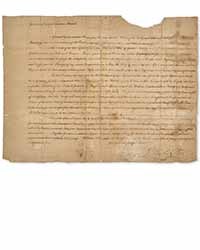
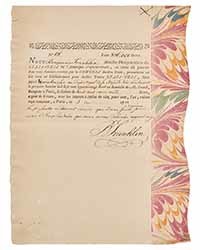
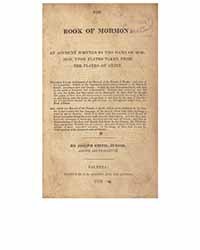
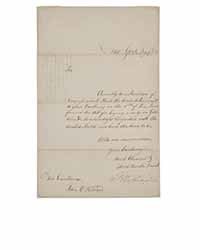

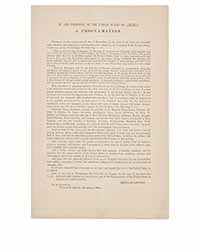 Freeman’s, August 20. President Washington Reaffirms the US Treaty of Friendship and Peace with Morocco, the Longest Unbroken Treaty in US History. $50,000 – 80,000.Freeman’s, August 20. Weeks After Victory at Yorktown, Benjamin Franklin Promises Repayment of a French Loan that Funded the American Revolution. $200,000 – 300,000.Freeman’s, August 20. Rare First Edition of the Foundational Text of the Mormon Church. $100,000 – 150,000.Freeman’s, August 20. President Washington Sends the First Major Law Passed by Congress, the Tariff Act of 1789. $100,000 – 150,000.Freeman’s, August 20. A Scarce Example of Audubon's Depiction of a Brown Pelican, Plate CCLI from his Birds of America. $30,000 – 50,000.Freeman’s, August 20. The Official and First Obtainable Broadside Printing of the Lincoln's Final Emancipation Proclamation. $30,000 – 50,000.
 -