Rare Book Monthly
Book Catalogue Reviews - May - 2009 Issue
Broadsides and Broadsheets from the William Reese Company

The first printing of the Monroe Doctrine; a 1923 air show in St. Louis.
The American flag has undergone many alterations since Betsy Ross, or whoever, sewed the first 13-star spangled banner. Here is a printing of the first law which adjusted the flag: ...An Act Making Alteration in the Flag of the United States, published in 1794. Vermont and Kentucky had just entered the Union, raising the number of states to 15. Interestingly, the law authorized an increase not only in the number of stars to 15, but the number of stripes as well. Somehow the second half of that authorized change was never implemented, just as well as the flag would now have some very thin stripes if that change had been followed. Reese notes that the 15-star flag had a longer life than any iterations other than the last two - 48 and 50 stars. Item 90. $7,500.
Item 65 is a very historic and important broadside, headed, President's Message. National Intelligencer...Extra. Dated December 2, 1823, from Washington, it is the first printing of the Monroe Doctrine. With Latin America in the process of throwing out Spanish rule, this was a notice from the United States that it would not tolerate any further colonization of the Americas. Not that the United States would have had the power to enforce its doctrine at the time, but the sentiments were clear. However, as the U.S. became more powerful, the threat of this doctrine, for the most part (Emperor Maxmilian of Mexico notwithstanding), has kept the Americas free from European colonization. There are only four known copies, in two states (without established priority), of this first issue of the Monroe Doctrine, two in what Reese describes as "deplorable" condition (this copy is "near fine"). $125,000.
It seemed very fast at the time, but this poster for the International Air Races in St. Louis tried to impress us with times not much greater than runway speeds today. The headline screams, Over 200 miles per hour. These races took place on October 1, 2, and 3, 1923. A biplane is shown buzzing a tower, which rather than having radar, has a couple of people on the top, perhaps giving hand signals to the pilots. Over 140,000 people attended this extravaganza, including the man who would soon reflect the spirit of St. Louis, Charles Lindbergh, who landed his plane at the field but did not participate in the races. Item 9. $500.
The William Reese Company may be reached at 203-789-8081 or [email protected]. Their website is www.reeseco.com.
Rare Book Monthly
-
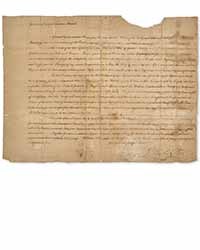
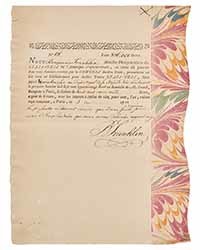
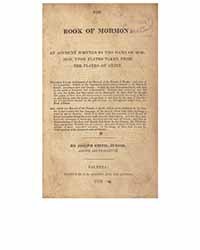
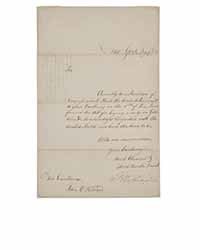

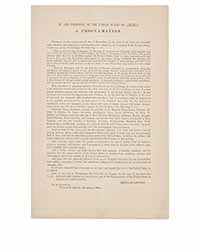 Freeman’s, August 20. President Washington Reaffirms the US Treaty of Friendship and Peace with Morocco, the Longest Unbroken Treaty in US History. $50,000 – 80,000.Freeman’s, August 20. Weeks After Victory at Yorktown, Benjamin Franklin Promises Repayment of a French Loan that Funded the American Revolution. $200,000 – 300,000.Freeman’s, August 20. Rare First Edition of the Foundational Text of the Mormon Church. $100,000 – 150,000.Freeman’s, August 20. President Washington Sends the First Major Law Passed by Congress, the Tariff Act of 1789. $100,000 – 150,000.Freeman’s, August 20. A Scarce Example of Audubon's Depiction of a Brown Pelican, Plate CCLI from his Birds of America. $30,000 – 50,000.Freeman’s, August 20. The Official and First Obtainable Broadside Printing of the Lincoln's Final Emancipation Proclamation. $30,000 – 50,000.
 -