By Julie Carleton
The 19th Century Industrial Revolution introduced dramatic changes to the world. Not only did the invention of new machines bring about changes in the form of mass production of material goods, but it also influenced the socio-economic structure of Europe and America.
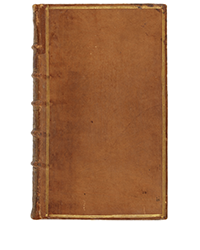
The mechanization of bookbinding in during the Victorian era was one such example of the Industrial Revolution. Beginning around 1820, publisher William Pickering invented the separate cloth book casing, which quickly became used by other publishers. Following this invention, publishers created new machines to quickly and efficiently bind, encase, emboss and illustrate books on a production level. Such instruments as the arming press for blind and gilt decoration were used to emboss gold lettering onto book covers. The newly rising middle class (yet another product of the Industrial Revolution) provided fodder for this new market of men and women, adults and children. Publishers opportunistically took advantage of this new market, and for the first time, books were marketed to appeal to the masses.
Toward the latter part of the 19th Century and early 20th Century, two art forms developed in opposition to industry and mass production of goods. The Art Nouveau and Arts and Crafts schools both sought organic designs and forms, and they applied their craft to the medium of the book as an art form itself. Artists such as William Morris and Aubrey Beardsley designed book covers, illustrations and images in popular periodicals. Their well known stylistic are visually synonymous with the latter end of the Victorian period.
The University of North Texas libraries’ Rare Books Department has created an exhibit called “Victorian Bookbinding: Innovation and Extravagance, 1820-1910.” The website can be found at: www.library.unit.edu/rarebooks/exhibits/binding/default.html
This exhibit, originally created by Kenneth Lavender, previous Curator of the Rare Books Department, provides a wide lens perspective into the world of 19th century bookmaking, book arts and the machines that brought this era into fruition. “Victorian Bookbinding: Innovation and Extravagance, 1820-1910” examines the changes that occurred in the bookbinding process, as well as the changes in designing and selling books during this period. Major styles and inventions are presented in a format that is both educational as well as pleasing to the eye. Several methods, styles and trends of bookbinding for this period are represented. “Victorian Bookbinding: Innovation and Extravagance, 1820-1910” is comprehensive in its coverage; examples from Britain, Europe and North America are included.
“Victorian Bookbinding: Innovation and Extravagance, 1820-1910” is rich in its representation of styles from different periods of the 19th century. Although the Victorian style might be considered too “busy” and “flowery“ for some tastes, the viewer will assuredly gain knowledge and insight through this exhibit.
“Victorian Bookbinding: Innovation and Extravagance, 1820-1910” is divided into four main parts: introduction, tour by time period, tour by subject and the collection catalog. The introduction provides a list with images of eight different inventions that were influential to 19th century bookbinding, such as a large embossing press and a rolling cloth press. After the introduction, the viewer has the option to tour the exhibit by time period or by subject matter. The time period section is divided into six 20-year increments beginning in 1820s and ending in 1910. Fifteen major topics related to Victorian bookbinding and design are discussed in the third section of the exhibit, called “Tour by Subject”. Some examples of major areas represented in this third section are Chromolithography, Embossing, Japanning style, Painted Covers, and Wood block and wood engraving. The final section of “Victorian Bookbinding: Innovation and Extravagance, 1820-1910” displays the full listing of catalog for the exhibit. This catalog is comprised 103 titles; of which 54 are used in the exhibit and then conveniently cross-referenced in the catalog.
Rare Book Monthly
Book Catalogue Reviews - March - 2003 Issue
Victorian Bookbinding Exhibit at the University of North Texas

Casing-in MachineCourtesy of UNT Libraries Rare Books Department.