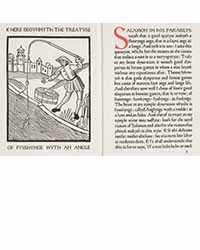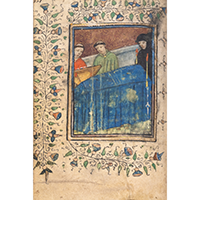
Librairie Clavreuil of Paris and Stéphane Clavreuil Rare Books of London have published a catalogue reflecting the Parisian side. It is mostly written in French. The title is Livres Choisis du XV au XIX Siecle (selected books from the 15th to the 19th century). The books themselves are mostly a mix of ones written in French and others (particularly older ones) in Latin. If your collecting focus is rare and antiquarian, you will find this collection most appealing. Here are a few selections.
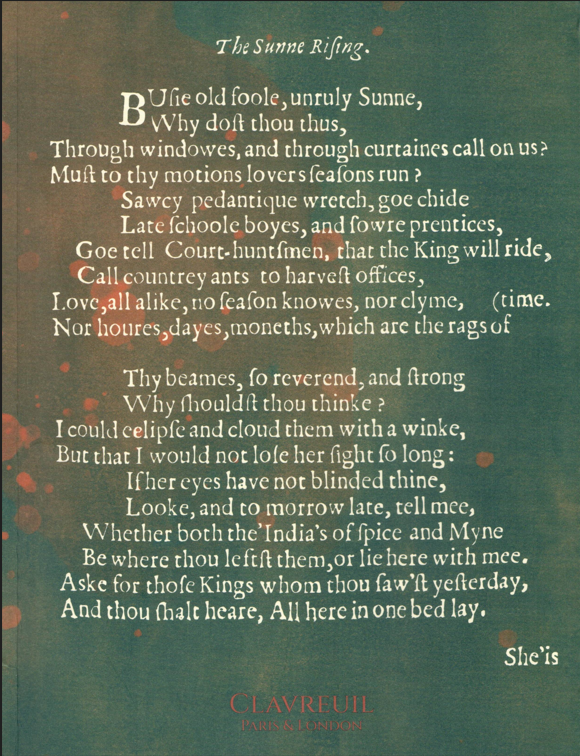
We begin with Poems, by J.D. With Elegies on the Author's Death, published in 1633. “J.D.” was John Dunne, and he had died only two years before the publication date. Virtually all of these poems were taken from manuscripts, many in Donne's personal archives, and had never been published before. Among the poems herein is The Sunne Rising, seen on then cover of this catalogue. “Busie old foole, unruly Sunne, Why dost thou thus, through windows, and through curtaines call on us?” Why indeed, leave us alone. Among those who contributed elegies for the recently deceased poet was Izaak Walton, best known for a love of fishing. Item 21. Priced at 25,000 €.
Next is Ristretto di tavole vestite et adornate, molto useful e necessario a dilettanti di cucina, credenza, e bottiglieria. That translates to something like “narrow of tables dressed and decorated, very useful and necessary to amateurs of kitchen, cupboard, and bottling” (courtesy of Google translate). This book was dedicated to Grand Duke of Tuscany Giovanni Battista de Medici by its author, who was de Medici's cook, Gualberto Chicchi. It was not a printed book but rather a manuscript. It was written in cursive script with 15 watercolor drawings displaying different ways of setting a table. It includes recipes for soups, sauces, and French and Italian dishes, along with instructions for preparing meals for various occasions. Item 15. 45,000 €.
This is a book that was despised almost as much as it was read when published in 1791. The title is Justine, ou les malheurs de la vertu (Justine, or the misfortunes of virtue). The author was the notorious Marquis de Sade. The early version of this tale was written while de Sade was imprisoned in the Bastille. He was freed during the French Revolution. The story is of a very virtuous woman who is repeatedly abused sexually in the most obscene and sadistic ways. The word “sadism” is derived from the Marquis' name. There was apparently a moral lesson in here of right and wrong though wrong was triumphant, perhaps eliciting sympathy for the woman and what is right. Nonetheless, de Sade surely must have known the book would appeal to readers' prurient interests. This was not the sort of book one published in those days, which made it all the more popular, quickly running through six editions. Men had to read it so they could know for themselves how bad it was. Item 64. 30,000 €.
Pierre Fauchard has been given a title that would not make him a favorite of children, but hopefully adults appreciate his contributions. That title is the “father of dentistry.” His book is Le Chirurgien dentiste, ou Traité des dents (the dental surgeon, or treatise on teeth). The long title continues, “Wherein are taught the means of keeping them clean and healthy, of beautifying them, of repairing their loss and of remedying their diseases, those of the gums and the accidents which may occur to other parts near the teeth.” Printing and the Mind of Man describes this book as “the first scientific work on its subject, and modern dentistry begins with its publication.” It adds, “Fauchard was the true pioneer of dental surgery.” He describes everything from fillings to dental surgery and artificial dentures. He also used antiseptics in a time before anyone understood germ theory. Item 28. 25,000 €.
Here is a test of your knowledge you will most like fail. Who invented the pressure cooker? The answer is Denis Papin, a French inventor and scientist who lived in the 17th to the early 18th century. However, Papin was a Huguenot (French Protestant), and though already an accomplished scientist in his homeland, he needed to flee to England to avoid persecution. There, he worked with the famed chemist Robert Boyle. It was at this time that he invented a forerunner of the pressure cooker. He used a cast iron pot, the top secured tightly with screws. A safety valve prevented the pressure from becoming dangerously high. With the pressure, the temperature could rise above the normal boiling point of water, allowing for faster cooking and more tender meat. Papin explains, “By means of the machine we are talking about here, the oldest and toughest cow can be made as tender and as tasty as the best chosen meat.” Item 60. 4,500 €.
Clavreuil may be reached as follows:
London. Stéphane Clavreuil Rare Books, +44 798 325 2200 or [email protected].
Paris. Librairie Clavreuil, +33 (0)1 43 26 97 69 or [email protected].
Their website is www.librairieclavreuil.com.