David M. Lesser Fine Antiquarian Books has released a new catalogue of Rare Americana. This is No. 215 in a long-running series of catalogues focused on historic America, mainly late 18th to 19th century, though a few go back even farther and some reach into the early twentieth century. Many of the works address the issues of the day, generally political ones. Some things never change. The issues of the 19th century often have great similarities to those of today. Here are a few of the topics that were on Americans' minds a century or more ago.
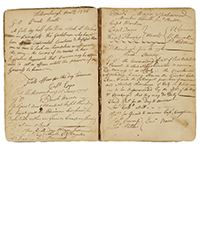
Americans are swimming in debt today, some unable to repay it. Such was the situation of Thomas King, “a Negro Man,” in 1797. We don't know how he became indebted to Isaac Tracy and Benjamin Ames, but unable to repay them, King ended up in debtor's prison. Item 60 is a legal document in manuscript. It is directed to Tracy and Ames from a court in New London, Connecticut. It says, “Whereas Thomas King a Negro Man is now confined in the common gaol in Norwich at your several suits on attachments and it is said Thomas is poor and has not property to support himself. King could have found himself imprisoned forever as he had no way to earn the money to repay his debts while in jail. However, something known as the “poor prisoner's oath” allowed such a person to be freed by swearing he had no funds. If the creditors objected, the court could compel them to support the poor debtor. The result was that neither Tracy nor Ames objected to King being freed. This process was something of a precursor to bankruptcy laws. Priced at $1,250.
This is the 1908 equivalent of what is known as “NIMBY,” “not in my back yard.” It is an oblong printed card reading, “Scratch the word 'NO' on Your Ballot and vote 'YES' for the Public Park and Playground to be located at Cottage, Goode, St. Ferdinand and Pendleton Aves.” Public parks are a great thing, but that was not the real reason for this solicitation. It was what some residents didn't want that was the motivating factor. In 1875, a high school was opened in St. Louis for black children, a requirement of the Reconstruction Constitution of 1865 in Missouri. In 1908, the local Board of Education sought to remove the African-American high school to a new location. However, many white residents of the area were opposed, hence the idea of opening a park at the location. The card's message continues, “This proposition should receive the vote of every White Man, as it will prevent the placing of a Negro High School by the Board of Education on white residents over their protests.” Ultimately, the protests failed and the new Sumner High School, named for Massachusetts abolitionist Senator Charles Sumner, was constructed on the site. Item 98. $450.
Next are three pieces pertaining to one of the more infamous murder trials of the 19th century. The main one is Trial of Rev. Mr Avery. A Full Report of the Trial of Ephraim K. Avery, Charged with the Murder of Sarah M. Cornell, Before the Supreme Court of Rhode Island...May 1833... This is a second edition published in 1833. It is offered with a supplemental edition and arguments of counsel. Ms. Cornell, five months pregnant, was found hanging from the rafters of a barn. It was assumed to be suicide until a note was found with her possessions, reading, “If I should be missing, enquire of the Rev. Mr. Avery, of Bristol, - he will know where I am.” Rev. Avery was presumed to be the would-be father. Rev. Avery had the support of his fellow pastors, but the public mostly believed that Avery had strangled her, then strung her up to mislead authorities. It was a spectacular trial. It lasted 27 days and 196 witnesses were called. In the end, the jury acquitted the Reverend. The public never did, with Avery being driven out of town, to Connecticut and then Ohio, where he lived out his days in obscurity. Item 4. $750.
Even in 1855 we had political parties that feasted on attacking immigrants and minorities. The immigrants came from Europe rather than Latin America, their skins were white, and their religion was Catholicism rather than Islam, but they were still unwelcome. A political party was formed to keep them out. This party was originally known as as the Order of the Star-Spangled Banner, later the American Party, but everyone knew them as the Know Nothing Party. Perhaps they didn't outright lie, they simply answered questions about their party by claiming to know nothing. At their height, they even had a former President, Millard Fillmore, run under their banner for President. However, after that election (1856), they quickly faded away, as the public became focused on North-South rather than nativist-immigrant rivalries. Item 62 is Formulary of the State Council of the State of New-York, Adopted May, 1855. It states their aim is “to promote the American interest; to protect every American citizen in the legal and proper exercise of all his civil and religious rights and privileges; to resist the insidious policy of the Church of Rome, and all other foreign influences against our republican institutions, in all lawful ways...” Item 62. $450.
It's hard to know what to make of this description of the antebellum South, then followed by the war years, Reconstruction and later. The title is White and Black Under the Old Regime, published in 1899. The author was Victoria V. Clayton, “widow of the late Henry D. Clayton, Major General C. S. A., Judge of the Circuit Court of Alabama, President of the University of Alabama.” Mrs. Clayton has fond memories of the slavery era, but that doesn't mean she was an apologist for the system. She and her husband brought pro-slavery settlers to Kansas before the war, but she says nothing about the cause, only the nice people she met and regretting going in the first place. She has no hard feelings toward the Northerners during the Civil War, but praised a Union General who protected her. She feels sorrow her “nation” lost, but no anger. After the war, rather than being a supporter of the lost cause, General Clayton quickly became a loyal supporter of the Union. She finds faults with the old system, but believed it was good for slaves as well as their masters, perhaps more so for the slaves. She says they were well cared-for, happy, treated almost like family of their owners. They interacted warmly, visited each other, ate in each other's homes. The slaves homes were small, but well tended and places of love and friendship. Was it really like this? Obviously not for all slaves, many of whom were brutally mistreated. But, was it much more benevolent in the Clayton household? It's clear that Mrs. Clayton saw it this way, not just making up a story to disguise reality. But, it is hard to tell whether this is close to accurate from the slaves perspective or total fantasy to them. We hear only one side. Perhaps the Claytons were unusually beneficent owners, or maybe it was wishful thinking. Item 18. $500.
David M. Lesser Fine Antiquarian Books may be reached at 203-389-8111 or [email protected]. Their website is www.lesserbooks.com.