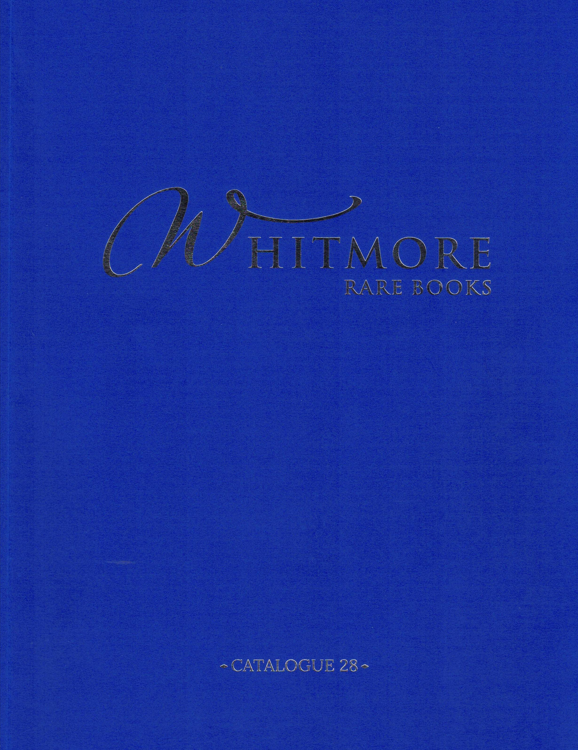
Whitmore Rare Books has published a new selection of fine books in their Catalogue 28. Whitmore doesn't specialize in a particular category of books, various subjects being offered. What they do focus on is important books and very fine copies. It's always the best copies of highly collectible, often rare books. These are a sample of the items you will find being offered by Whitmore.
Who would be the perfect illustrator for the insane logic of Lewis Carroll's Alice's Adventures in Wonderland? Certainly, there is no need to replace the wonderful originals of John Tenniel, but someone whose illustrations share Carroll's appreciation of surrealist logic would be Salvadore Dali. Fortunately, there is such an edition. This is it, a limited edition of 2,500 copies published by the Maecenas Press in 1969. It contains twelve original illustrations and comes in a clamshell case with the original leather straps and clasps intact. Whitmore explains, “this set is basically as new, with the original paper wrapper, shipping box, and packing material.” They note that the illustrations are “giving insight into how the painter experienced Carroll's story.” This is copy no. 1,638, signed on the title page by Dali. Item 13. Priced at $16,500.
This is an important book, one that, despite its age, is even more important in today's political climate. The title is Memoirs of Extraordinary Popular Delusions, the first edition in three volumes, published in 1841. It is an analysis of crowd psychology from a time when people were drawn to strange beliefs adopted by others. Among its subjects are alchemy, the Crusades, fortune-telling and haunted houses. Of particular interest today are economic bubbles and political beliefs. People will follow the crowd no matter how illogical the beliefs, ones they might consider more carefully if not adopted by a crowd. Mackay writes, “Men, it has been well said, think in herds; it will be seen they go mad in herds, while they only recover their senses slowly, and one by one.” Whitmore notes the book's far-reaching influence, in “diverse fields as popular psychology and charting the stock market.” Years ago, the New York Times recommended that investors read Mackay's description of “Tulipomania,” the 17th century phenomenon when the Dutch spent increasingly large amounts of money on tulips, only to see those prices crash and the buyers end up broke, when people were no longer willing to pay insane prices for them. Item 45. $17,000.
Edmund Burke was a founder of political conservatism. He favored tradition, a political order headed by inherited power rather than the general population. His was a focus on the practical rather than the ideal, with changes being gradual, not revolutionary. As such, he was very much against the French Revolution. He wrote about it in Reflections on the Revolution in France, and the Proceedings of Certain Societies in London Relative to that Event. At the time of publication, 1790, the French Revolution was still in its infancy. Burke saw it ending poorly, and ultimately he proved right as it devolved into a bloodbath. However, in 1790, there was reason to hope it would turn out more like the American Revolution, or perhaps a constitutional democracy with a King who shared power with elected officials rather than being all-powerful. Burke was particularly concerned that the ideals of the French Revolution would spread to Britain, consequently his fear of “certain societies.” Time would prove Burke right about the French Revolution and other idealistic revolutions have had similar fates, but then again, radical change has been needed and successful in other instances such as abolition and civil rights movements. Hindsight is easy, but foresight difficult as the varying outcome of revolutions in France and America attest. Item 7. $5,750.
The next book is a much less weighty tome though it has been far more widely read than Burke's treatise. It's the classic children's tale, Make Way or Ducklings. It doesn't generate much in the way of important political thought though it does teach us to allow ducklings and their mother to cross the road unimpeded. Perhaps there's a lesson on how to treat others in there. Robert McCloskey's 1941 book is based on an incident when ducklings making their way through Boston halted traffic several times. McCloskey, who provided the illustrations as well as the text, went to Boston so he could accurately portray the city and obtained some ducklings to serve as his models. The story is particularly beloved in Boston where a statue to the tale was erected in the Boston Public Garden. Item 48. $19,500.
This one is a weighty story, but in a different way than the French Revolution. It is about a very heavy frog that started perhaps America's greatest writer on his way. This is a short story, that of The Celebrated Jumping Frog of Calaveras County, Mark Twain's first book, published in 1867. The fix was in when the frog didn't jump, his belly having been loaded with lead shot. Whenever there is betting on some competition, there will likely be someone trying to fix the outcome. What did jump was Twain's reputation after the publication of the story, whose humor made the author an international sensation. This is a first edition of the story, but hardly an ordinary first. It is rare because it is a first issue and it is is a presentation copy from the author, “with the compliments of Mark Twain New York, May 9, 1867.” Item 70. $115,000.
Whitmore Rare Books may be reached at 626-714-7720 or info@whitmorerarebooks.com. Their website is www.WhitmoreRareBooks.com.