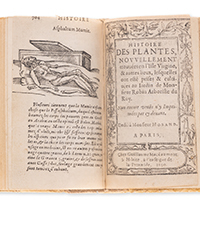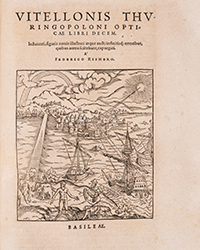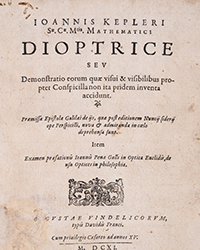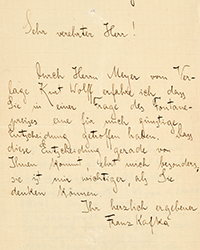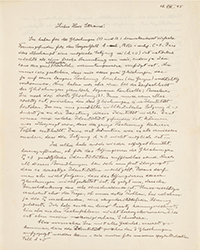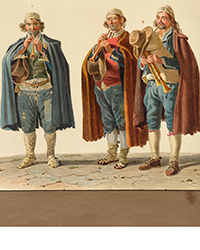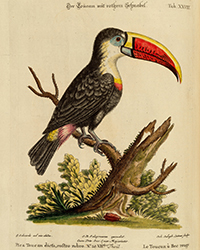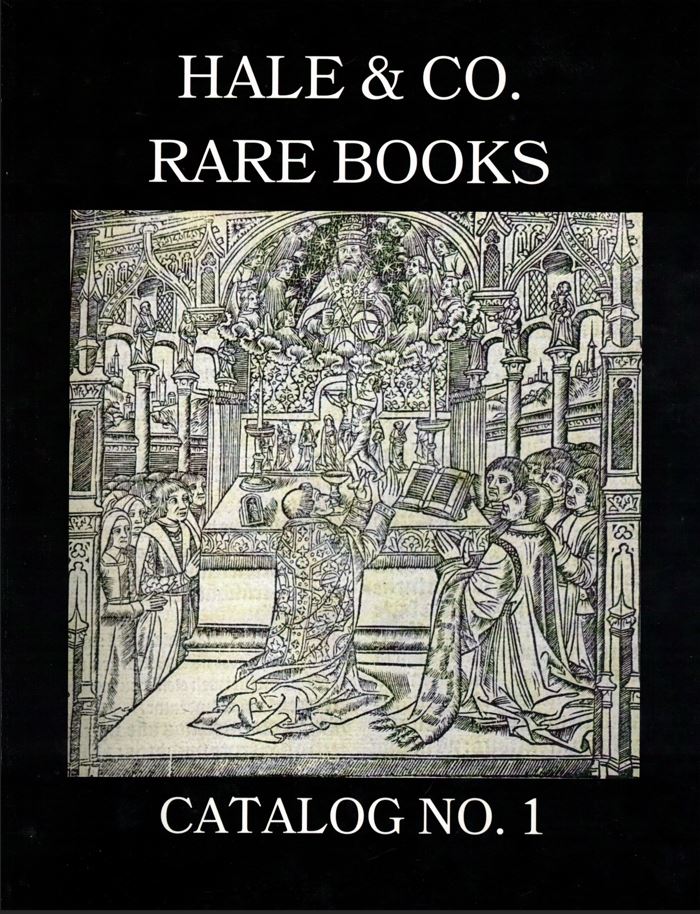
Hale & Co. recently issued their Catalog No. 1. The company was founded by William Hale, also the founder of the Ageless Literature website, which not only connects sellers and buyers but provides a community for those interested in the preservation of literature. This is an exceptional catalogue, designed to preserve great ideas from over the centuries for those who share the founder's passion for books. The catalogue is many steps above what you normally find, reflective of that passion. Here are a few items you will find inside.
We begin with what is considered "the first non-alchemical chemistry text." The title is Tyrocinium Chymium, by Jean Beguin. Beguin studied pharmacy, his interest in chemistry a result. He was seeking medical cures, but based on empirical data rather than speculative alchemy which naturally was useless. This book was first published in 1610, but this is the expanded 1669 edition which was augmented and annotated by Gerard Blaes. It became the definitive chemistry manual of the 17th century and continued in use in numerous editions for years later. This copy carries the armorial bookplate of Jacob Reinbold Spielmann. He operated a pharmacy that had been in the family for several generations, but also expanded his knowledge to become a professor of medicine and chemistry at the University of Strasbourg. He was also the author of several medical-related textbooks. Spielmann is noted for his most famous pupil. Johann von Goethe studied chemistry under Spielmann. Few remember Goethe as a chemist, or for that matter, as a lawyer though he ran a law practice for four years. Goethe's main love was literature, poetry in particular. Nevertheless, he conducted numerous chemical experiments at home as a young man and his interest in the subject lasted a lifetime. He also wandered at times into alchemy. The actual person, Georg Faust, was an alchemist, and Faust, Goethe's most notable writing, makes use of chemistry and alchemy in his search for a purpose of life. Item 22. Priced at $4,500.
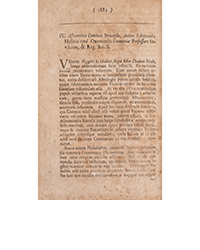
Next we have the Proceedings of the Geological Society of London, volumes I and II. Volume II, published in 1838, has the most interesting material, though it was hardly noticeable at the time. It is the first edition of Charles Darwin's earliest scientific publications, six of them. Darwin had recently returned from the voyage of the Beagle on which he had studied flora and fauna in southern South America. He was still putting what he had observed together in his mind. In one publication, he observed the effects of the uplift of the Chilean coastline. In another, he looks at such activities as volcanic processes, earthworms effect on soil, and the gradual extinction of mammals. These were gradual processes that took a long time. He became a follower of, and close friend to geologist Charles Lyell. Lyell propounded a theory later called "uniformitarianism." The theory posited that geologic processes go at a uniform pace, that is, as slowly in the past as they do today. That contrasted with he dominant theory of the time, catastrophism. That claims that major geological changes come in short, intense outbursts. That theory is consistent with creationism, that the world and its life forms, even humans, were created in a short period of time. It was this slow-moving uniformitarianism that enabled Darwin to come up with his theory of evolution by natural selection. Such evolution would not be possible in the short time span of 5,000 years under creationism, but was possible given the almost limitless time to work under Lyell's theory. This was, in effect, the "missing link" Darwin needed for his theory of evolution. Item 32. $25,000.
This is an item from the person who wrote the U.S. Constitution. You are probably thinking of Madison, maybe Hamilton, or even (incorrectly) Jefferson, who was overseas at the time of the Constitutional Convention. The best answer may be a whole group of people, and in a sense that is correct, but this document comes from the pen of the man who literally wrote it. That was Jacob Shallus, whose name likely is unfamiliar to you. Evidently, Madison was too busy at the end or perhaps his handwriting was not so good, but it was Shallus who, pen in hand, literally wrote the document known as the U.S. Constitution. You are never going to possess that example of Shallus' handwriting, but you can have this one. It is a handwritten deed in Shallus' distinctive script. Such documents are exceptionally scarce, most being in institutional collections. It was written in the year of his most famous document, 1787. The physical writer of the constitutional document was unknown for many decades, only revealed after a Library of Congress investigation in 1937. Item 26. $12,500.
This is another one of the most important documents in U.S. history, like the Constitution and Declaration of Independence, but this came after the founders had passed from the scene. This is the Emancipation Proclamation, the document that turned America's theoretical freedom into something real. No one would be a slave any more. The original Proclamation is extraordinarily rare and unobtainable, six copies known. This is the earliest obtainable copy, and though it had a more sizable print run, it is nonetheless extremely scarce. This copy is a Preliminary Emancipation Proclamation, likely printed in September 1862. It was one of numerous General Orders issued to officers during the Civil War. This set was owned by Captain John Horne Young, who served with distinction at the Battle of Chickamauga. He had his orders custom bound in three small octavo volumes, his name in gilt on each volume's cover. Young's annotations on many items indicate its use in the field. The three volumes include numerous other orders. Other orders are signed by Assistant Adjutant General E. D. Townsend, Adjutant General Lorenzo Thomas, and Brigadier General W. Scott Ketchum. It all forms a very interesting collection, though it's the Proclamation that stands out high above everything else. Item 35. $150,000.
There are no more illustrious names in the history of American internal travels than those of Merriwether Lewis and William Clark. They were assigned the task of exploring the newly acquired Louisiana Territory by President Thomas Jefferson. They traveled up the Missouri River from St. Charles, Missouri, in 1804, going all the way to the Pacific. The territory they traversed was unknown to all except the native tribes who inhabited the area. They returned two years later with all sorts of information and tales to tell, but the two were faster travelers than writers. The journey took two years but it took seven to complete their account. That was a result of the time taken by their editor to edit their journals. The wait would have been agonizing for the public desperate to know more about the new land, but fortunately, Patrick Gass satisfied much of their curiosity. He was supposed to wait for the official account to be published first, but he jumped the gun. His was the first account written by a participant on the journey. Gass was quick. He published his book, A Journal of the Voyages and Travels of a Corps of Discovery, under the Command of Capt. Lewis and Capt. Clarke...During the Years 1804, 1805 & 1806, published in 1807, a year after their return. Gass messed up on the spelling of Clark's name adding an "e" at the end. Otherwise, his book is far more accurate. Gass was hired as a skilled carpenter but was promoted to sergeant when one of the sergeants on the journey died. Item 28. $12,500.
Hale & Co. may be reached at bill@agelessliterature.com.