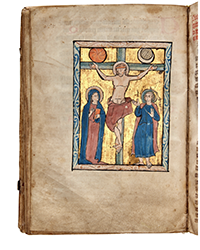
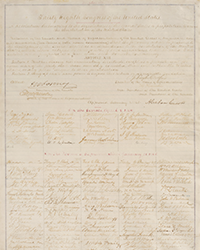
David M. Lesser Fine Antiquarian Books recently published their Catalogue 196 of Rare Americana. There are lots of new items we have never seen before, nor, most likely, have you. Some are one-of-a-kind documents and letters, others guides, broadsides and other printed material that is usually quite rare. Collectors of early Americana will find much worth pursuing in this collection. These are a few items.
An English immigrant who became a very successful merchant, Robert Morris was America's richest person at the dawn of the Revolution. Antagonistic to his native country's taxes and demands on the colonists, he supported the revolutionary cause. He signed both the Declaration of Independence and the Constitution. Washington called on him to manage finances during the Revolution, earning him the sobriquet “Financier of the Revolution.” He became one of Pennsylvania's first senators. In the 1790s, he turned his energies and wealth to real estate and that's when it all went wrong. We begin with Plan of Association of the North American Land Company, Established February, 1795. The company acquired 6 million acres of land scattered through six states. With two others, he founded the company and issued 30,000 shares valued at $100 each. Two million acres in Georgia were in the wilderness and not inviting to settlers. Stock sales were slow. He sent his son-in-law off to sell shares in Europe but he was unsuccessful. Morris went bankrupt, ending up spending three years in debtors' prison despite his great service to the country. He lived a modest life once released, dying in 1806. Item 89 is the plan that led to Robert Morris' downfall. Item 89. Priced at $3,500.
How much are you, or your family members, worth in terms of dollars? How do you even put a number like that on human beings? That was the job of R. B. Johnson, an agent for the state of South Carolina, and Thomas Nixon. They were appraising the value of eight slaves owned by John C. Zimmerman, the largest land owner in Spartanburg County. They were just eight of 107 slaves he owned. In 1864, the slaves had been impressed into service of the Confederacy, a common practice as the war ran on and they needed people to fill non-combatant roles. They couldn't afford to use able-bodied white men needed for fighting. The impressed slaves were appraised in case they were injured or killed. They were valued at amounts between $3,000-$4,000 each. Of course, it would not be the slaves or their families who would be compensated. They were no more than the property of Zimmerman and he is the one who would be paid under this macabre life insurance policy. Item 6. $850.
Who would you turn to for an account of Custer's Last Stand? How about Anheuser-Busch, maker of Budweiser Beer? Item 33 is a pamphlet titled Authentic History of the Indian Campaign which culminated in "Custer's Last Battle", June 25, 1876. It was compiled by Arthur Koenig for Anheuser-Busch Brewing of St. Louis. It was taken from comments by people who had knowledge of the event, though obviously not first hand from any of Custer's men. The natural question is why was the brewer of Budweiser interested in Custer's Last Stand? Eberstadt speculated it was because Adolphus Busch had obtained a painting of the battle from a saloon owner who could not pay his debt, from which they made numerous prints that were used in advertising at this time. This is an 1895 printing of a pamphlet first published in 1892. $275.
The assassination of Abraham Lincoln brought an outpouring of sorrow, in the North anyway, rarely seen in America. These two items reflect that grief. Item 81 is a carte de visite image of Lincoln Welcomed to Heaven in the Loving Arms of George Washington, by J. A. Arthur. In it, Lincoln and Washington are seen rising above the clouds, Washington holding a laurel over Lincoln's head while he embraces the newly arrived resident of heaven. It is as touching an image as you will ever see. $275. Item 82 is another carte de visite of a photograph taken from a lithograph by James F. Bodkter of The Father, and the Savior of Our Country, also from 1865. The father and savior are not the same here. Washington is the father, Lincoln the savior. They are standing next to each other, arms entwined. $350. Maybe they weren't perfect, but we could sure use those guys today.
Not all Presidents were remembered with such fondness. James Buchanan fits in that dubious pantheon. He directly preceded Lincoln in the presidency and many believed he was responsible for the Civil War, though it is unlikely anyone could have prevented it by that time. Buchanan was the ultimate northern man with southern principles. His way of staving off civil war was essentially to give the South whatever it wanted and hope the North would grudgingly accept it. However, it was more than a strategy but consistent with Buchanan's view as can be seen by this broadside of his opinions in 1850. Unheaded and unattributed, it is identifiable as it is almost verbatim what Buchanan wrote in a public letter. It begins, “It is my decided opinion, that none of the injuries which the South have suffered, great as I admit them to be, are of sufficient magnitude to justify a resort to the last dire extremity of dissolving the Union.” He expresses support of southern positions such as distrust of abolitionists, sympathy for the South, strengthening the Fugitive Slave Law, opposition to abolishing slavery in the District of Columbia, and opposition to the Wilmot Proviso, which would have banned slavery in the territories captured during the Civil War. Then, he adds, “But if, in the midst of such temporary excitement, the Union should be dissolved, the mischief will then be irreparable.” Buchanan's actions as President were entirely consistent with his personal views as expressed earlier, that the South was aggrieved and should be given whatever it wanted except the right to secede. As such, Buchanan remained loyal to the Union after the South seceded. Item 11. $500.
David M. Lesser Fine Antiquarian Books may be reached at 203-389-8111 or dmlesser@lesserbooks.com. Their website is www.lesserbooks.com.