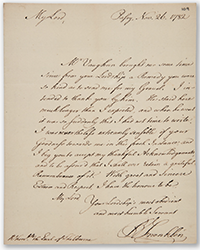
Stuart Lutz Historic Documents has published a new, though unnamed catalogue. The vast majority of the items have been autographed. Lutz describes this as “the largest and most varied catalog I have ever produced.” He notes the reason is he recently purchased the stock of the noted Florida manuscript dealer Joseph Rubinfine. Joe Rubinfine, who died in 2019, was an exceptional dealer of autographed material. He not only was well-liked and highly respected in the trade, he also carried an abundance of great items through his long career. He specialized in American material, including major items from Washington, Lincoln, many American leaders and major patriots, and the writer of the most famous autograph of all, that of John Hancock. We reviewed many of his catalogues over the years, from 2005-2019, and those reviews can be found in our review archives. Combining Rubinfine's stock with Lutz's own will create some exciting catalogues, and this is one of them. These are some examples.
George Catlin was a trained lawyer with little interest in the field his father had selected for him. He decided instead to become an artist, which better fit with his natural skills. After a meeting with some western Indians visiting Philadelphia, he became fascinated with their culture. Realizing that the influences of European Americans would soon overwhelm and forever change that culture, he decided to preserve it while he still could. He took several trips to the West where he painted and wrote about America's natives while they still retained much of their old culture. Catlin painted many portraits, and then took those paintings on a traveling exhibition. His aim was to teach America's settlers about the natives who inhabited the land. He displayed them around the East to audiences who knew little about America's natives, and eventually on to Europe. He brought along some living Indians to even better educate others about what were undoubtedly an exotic people to them. Unfortunately, this turned out to be a declining business venture and Catlin determined the best plan was to sell his entire collection to the U.S. government. It would be able to preserve what he had preserved, and better educate America's citizens. It was in that spirit he wrote this letter on May 14, 1846, from Paris. He tells his unidentified correspondent he has enclosed “a Memorial from the American artists in Paris, praying for the action of Congress on my application that my collection may be added to the records of our country.” He continues, “I believe that if the subject be rightly presented that the Govt will honour me with their due appreciation of my works and place them under their protection for the benefit of historians and artists...” He concluded that this will enable him to spend the remainder of his life rescuing what remains of traditional Indian life. The government refused and eventually Catlin was forced to sell his entire collection to industrialist Joseph Harrison, Jr., who made his fortune building locomotives he sold to Russia. Fortunately, after Catlin died, Harrison's wife gave them to the Smithsonian. Item 22. Priced at $5,000.
Some people, to their great detriment, do not learn from experience. This next item is the epitome of tragic irony resulting from not learning from the past. The letter was written on November 20, 1837, by William Henry Harrison, one of the losing Whig presidential candidates from the 1836 election, won by Martin Van Buren. Harrison would get his electoral revenge four years later when he defeated Van Buren in a rematch. Harrison congratulates Gulian C. Verplanck, who won his race for a congressional seat from New York. He explains, “Your letter...found me suffering under a severe inflammatory rheumatism in the knee from having foolishly exposed myself to rain when under the operation of medicine for a previous cold.” Of course, Harrison is the President whose term is remembered for little else than being the shortest in American history, his dying after only 30 days in office. The commonly believed explanation was that Harrison foolishly gave a very long-winded inauguration speech while standing hatless in the rain, only to become ill and die 30 days later. Item 51. $3,500.
This next letter also concerns a President who died in office, and it too is quite tragic. It is a signed letter from First Lady Lucretia Garfield written on August 8, 1881. President Garfield was shot by an assassin on July 2, and what proceeded was an agonizing two and one-half months wait while Garfield's health waxed and waned until finally he died on September 19. A bullet entered his back, but physicians were unable to locate it, despite probing the wound with unwashed hands. It made treatment difficult, while poor sanitary habits (common in the day) made things worse. Xrays had not yet been discovered, but Alexander Graham Bell had developed a primitive metal detector. It was unsuccessful. However, at this point, Mrs. Garfield's hopes had been renewed. She writes to Mr. Bancroft, “Your kind note came at a time when there was a return of that anxiety which delayed all responses. Now the dear man gives us reason to hope more surely than ever before for his recovery, and I am very glad to say it to you, my dear friend.” Item 41. $2,500.
Any fans of classic country and western music will be amazed by this piece. It is a copy of WSM’s Official Grand Ole Opry History-Picture Book from the early 1960s. It belonged to a young country fan named Mike, and he has inserted some pictures of himself with stars. What is really amazing is the extensive collection of autographs he was able to gather. Among the stars who signed his program were Roy Acuff, Chet Atkins, June Carter (not yet Cash), Marty Robbins, Grandpa Jones, Hank Snow, Ernest Tubb, Ferlin Husky (those two should have formed a duo), Hawshaw Hawkins, Jim Reeves, Minnie Pearl, Lester Flatt (without Earl Scruggs), Porter Wagoner, Faron Young, Roy Drusky, Cowboy Copas, Billy Grammar, Wilma Lee and Stoney Cooper, Skeeter Davis, George Hamilton IV, and the Jordanaires. Item 43. $1,000.
If you are uncertain about whether you want to collect autographs, I can assure you that you will be in good company if you do. Here is a letter from Franklin D. Roosevelt, but not as President. It is on his stationery of the Assistant Secretary of the Navy, and the date of April 22, 1913, precedes his assent to the presidency by almost 20 years. Writing to George C. Hale of Brooklyn, likely an autograph seeker, Roosevelt says, “My dear Sir: I have a fellow feeling for you, as I too have for many years accumulated autographs. Very truly yours Franklin D. Roosevelt.” Item 115. $1,250.
Stuart Lutz Historic Documents may be reached at 877-428-9362 (or 862-252-6292 for overseas callers), or at HistoryDocs@aol.com. The website is www.HistoryDocs.com.