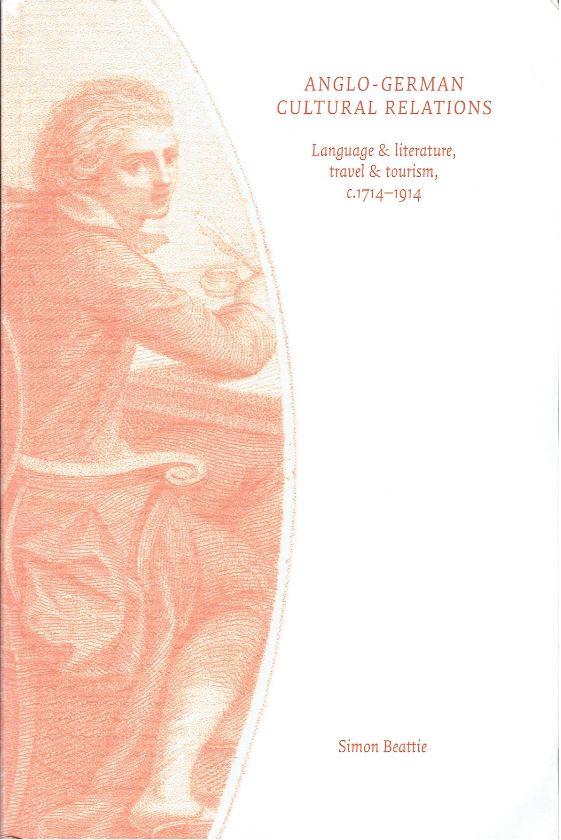
Simon Beattie Ltd. has issued a catalogue entitled Anglo-German Cultural Relations. Language & Literature, Travel & Tourism. c.1714-1914. There were many friendly connections between the people of those two nations over the two centuries. Queen Victoria's mother was a German princess. Unfortunately, that ending date is self-explanatory. The year 1914 was that of the outbreak of World War I, and the two nations would meet on the battlefield, rather than at cultural events. This catalogue is filled with books and other material documenting the long history of connections between the two nations, including many translations of German works to English and English works to German. Here are a few of the items you will find in this Anglo-German catalogue.
Speaking of Queen Victoria and her mother, her mother was Princess Victoria of Saxe-Coburg-Saalfield, later Duchess of Kent after marrying Victoria's father, the Duke. We might also mention that Queen Victoria's husband, Prince Albert, was the Prince of Saxe-Coburg and Gotha. The German connections ran deep. The Queen's mother died in 1861, which led her to have this work privately printed: German Hymns and Sacred Songs Selected by Her Majesty the Queen from the Collection of Her Late Royal Highness the Duchess of Kent. With an English Translation. It was printed the year the Duchess of Kent died – 1861. The Queen has inscribed this copy “To Lady Charlotte Locker In recollection of the dearly beloved Duchess of Kent from Victoria R.” Charlotte Bruce Locker was a close friend of Queen Victoria. Too soon, the Queen would have to have the translator of these songs, Edgar A Browning, create a second such work. Later that year, the Queen's husband, Prince Albert, also died. It was a loss she would never get over though she lived another 40 years. Item 204. Priced at £4,000 (British pounds or approximately $5,130 in U.S. currency).
This next piece combines two works about the Rhine, but it was obviously meant for an English audience as it was published in London in the English language. The works are Panorama of the Rhine and the Adjacent Country from Cologne to Mayence by F. W. Delkeskamp and The Steam-Boat Companion from Rotterdam to Mayence, Describing the Principal Places on the Banks of the Rhine, Together with a Table of Distances... It was published circa 1830. The panorama consists of five sections pasted together that open accordion style. Judging by the type of data provided in the Steam-Boat Companion, it appears that this book may have been intended for practical use by travelers planning on visiting the Rhine. Item 153. £300 (US $384).
The noted German composer and conductor Felix Mendelssohn had a long and affectionate relationship with England. He made ten visits between 1829 and 1847 and was well-received in Britain. Item 184 is a handbill noting that he would be leading a performance of his oratorio, Elijah, on April 23, 1847. Mendelssohn had been invited to be the chief conductor at the Birmingham music festival the previous year, and offered to come back to England for the premiere of Elijah once it was completed. He returned in April 1847 and conducted four performances. One was attended by Queen Victoria and Prince Albert. He also visited Buckingham Palace during that, his tenth and final visit. He returned home exhausted and in poor health and Mendelssohn died later that year. £150 (US $192).
I'm not sure whether this technically qualifies as Anglo-German as the author was the very American Mark Twain. Nevertheless, his quote about learning German does resonate. Item 219 is Samuel Clemens/MarkTwain's A Tramp Abroad, retelling his foreign adventures. It was published in 1880. Speaking of comparative languages, he writes, “My philological studies have satisfied me that a gifted person ought to learn English (barring spelling and pronouncing) in thirty hours, French in thirty days, and German in thirty years. It seems manifest, then, that the latter tongue ought to be trimmed down and repaired. If it is to remain as it is, it ought to be gently and reverently set aside among the dead languages, for only the dead have time to learn it.” £400 (US $511).
This is a tragic story written by an obscure young man who soon would no longer be unknown. It was originally written by the great writer, Johann Wolfgang von Goethe, when he was just 24. In German, the title was Die Leiden des jungen Werthers (the sorrow of young Werther). Item 41 is the second German translation, but a first edition of the first translation directly from the German. The previous one had been translated from a French translation. The title here is Werter and Charlotte, a German Story... published in 1786. In it, Werther falls in love with Charlotte, but she is betrothed to another man. His pain is great and he decides to leave, but later returns. By this time, Charlotte and Albert are married though she cares for him. Werther strikes up a three-way friendship, but the pain is unbearable. He can take it no more. He borrows a gun from Albert on the pretense of going on an adventure, but he shoots and kills himself instead. This very sad story turned Goethe into a sensation overnight. It was enormously popular throughout Europe and England and helped establish German as a literary language. Goethe's writing would change from this sort of romance and he came not to like it, and yet it was also deeply personal and painful for him. It was based on his own love for an engaged, later married woman also named Charlotte, which could never become anything closer than afar. Fortunately, Goethe never went to the extreme of killing himself over it. £3,000 (US $3,832).
In the mid-19th century, there were many Germans living in London, mainly working as laborers. As the introduction to this book explains, “Among the number of foreigners living in London, it is estimated that no less than six-sevenths, or upwards of 30,000 are natives of Germany...a large proportion of them being poor but industrious mechanics and craftsmen, or hard-working labourers, employed...in other occupations injurious to health...” It was decided that a hospital should be built to treat German-speaking patients. The “German Hospital” was built with the support of Queen Victoria and Prince Albert. It remained open until the start of World War I when all things German were not so much appreciated in Britain. Item 182 is a book describing the hospital, German Hospital, Dalston, Supported by Voluntary Contributions, published in 1853. £350 (US $448).
Simon Beattie Ltd. may be reached at +44 (0) 1494 784954 or [email protected]. Their website is www.simonbeattie.co.uk.