The William Reese Company has issued a new catalogue of Young America: The United States from the Constitution to the Monroe Doctrine, 1787-1823. It begins with America, having achieved its independence, deciding to be one nation, rather than a loose confederation of small, weak states. By the end, it is asserting itself as an international power, even if it wasn't quite on that level yet. That also marked the end of the Era of Good Feelings, a time of greater unity than the nation has experienced through much of its long history. We could certainly afford to restore some of those good feelings today, but that seems a long way off. Here are some selections from America's youth.
George Washington was the father of his country, beloved by all. Not quite. In his time, not even Washington was free from critics in his homeland. One such person was William Duane, a Philadelphia newspaperman, a proponent of Jefferson's Democratic-Republicans and virulent opponent of the Federalists. He saw Washington as more in the latter's camp. In 1796, he published A Letter to George Washington, President of the United States; containing Strictures on his Address of the Seventeenth of September, 1796, notifying his Relinquishment of the Presidential Office. Published under the pseudonym of "Jasper Dwight," it is a response of Washington's Farewell Address. You might think Duane would be happy that Washington was leaving, but he couldn't resist some parting shots. Sabin writes of this response, "One of the most violent invectives against Washington, and far more abusive than the famous letter of Thomas Paine. An example: 'Had you obtained Promotion, as you expected for the services [you] rendered after Braddock’s Defeat, your sword would have been drawn against your country.'" Considering that Paine's more understandable beef was that Washington did nothing to save his life when he faced execution in a French prison during their revolution, Duane's level of invective was a bit over the top. Item 51. Priced at $2,750.
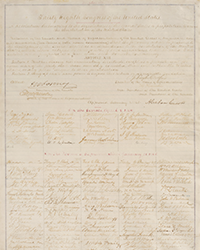
Duane would have appreciated this writing more. It represented the vanquishment of the hated Federalists. Item 90 is The Inaugural Speech of Thomas Jefferson from 1801, a broadside printed on silk. Perhaps it would not have been quite to his tastes, this message being quite conciliatory after a bitter campaign. Jefferson notes that having conquered religious intolerance, little will have been gained if we countenance political intolerance. Says Jefferson, "Every difference of opinion is not a difference of principle. We have called by different names bretheren of the same principle. We are all republicans: we are all federalists." $8,750.
Here is a man of high moral principles. Even Jefferson could have learned a thing or two from him. Item 67 is An Enquiry Concerning the Intellectual and Moral Faculties and Literature of Negroes; Followed with an Account of the Life and Works of Fifteen Negroes and Mulattoes Distinguished in Science, Literature, and the Arts, by Henri Gregoire. This is an 1810 American edition and apparently the only English translation of the 1808 book by Gregoire written in French. Gregoire was a priest and Bishop of Blois in France, but quite a radical man for his time. He was a supporter of the French Revolution, though like so many, he ended up in prison, but escaped the guillotine. His career was devoted to promoting the causes of the oppressed, the poor and minorities. He was an opponent of royalty and Napoleon, but his prestige was sufficient to protect him. Gregoire was also a noted abolitionist, and this book promotes the abolition of slavery. Part of his method of doing so was to show the intellectual abilities of great writers and artists who happened to be black, whose achievements are remarkable considering the obstacles they had to overcome. $2,250.
John Hauer was not so moral a man as Henri Gregoire. Morality didn't intersect much with his life. Item 107 is A Correct Account of the Trials of Charles M'Manus, John Hauer, Elizabeth Hauer...For the Murder of Francis Shitz... published in 1798. Francis Shitz suffered misfortunes even greater than having that name. Francis and his brother, Peter, received the bulk of their father's estate when he died. However, the will provided that if the brothers had no children, part would go to his daughter. John Hauer, who happened to be daughter Elizabeth's husband, set out to make sure the brothers never had children by killing them. He half succeeded. Hauer hired four recently arrived Irishmen (including M'Manus) to kill his brothers-in-law. They got Francis with an ax, but Peter escaped. Hauer and M'Manus suffered a fate similar to Francis, except theirs came at the end of a rope. $1,750.
Stephen Boorn almost had a similar encounter with a noose as did Hauer. He did not deserve it, but it took a last minute miracle to spare his life. Russell Colvin, said to be mentally deficient, was married to one of his sisters. In 1812, Colvin disappeared from their Vermont home. Townsfolk assumed that Stephen and his brother, Jesse, killed him. They were convicted and sentenced to hang, though the state legislature commuted Jesse's sentence to life in prison. As a last resort, a notice was placed in newspapers seeking information about Colvin, and a farmer in New Jersey believed the description fit a hired hand in the area. That hired hand, who suffered mental issues, was enticed to Vermont, and when he arrived, people recognized who he was. Colvin had wandered off on his own. Item 23 consists of two pamphlets bound together, an 1820 second edition of Mystery Developed; or, Russell Colvin, (Supposed to Be Murdered,) in Full Life... and The Trial, Confessions and Conviction of Jesse and Stephen Boorn... and the Return of the Man Supposed to have been Murdered, from 1873. $1,000.
Next is the most notable of all American internal explorations, and a symbol of the young nation's rapid growth in those early years. In 1803, President Thomas Jefferson, seeking to obtain New Orleans from France to protect the nation's right to navigate the Mississippi, instead received an offer he could not refuse. France offered him the whole of the Louisiana Territory, some 828,000 square miles, for the price of $15 million. Overnight, America doubled in size. The following year, President Jefferson sent Captains Meriwether Lewis and William Clark out into the wilderness to find out what he had purchased. They returned in 1806, having made it all the way to the Pacific Ocean, with loads of information. It would take eight more years, but finally, in 1814, they published the official account: History of the Expedition Under the Command of Captains Lewis and Clark...to the Pacific Ocean. Wagner-Camp describes this book as "the definitive account of the most important exploration of the North American continent." This copy of the first edition includes the large folding map which was not supplied with all copies. $130,000.
The William Reese Company may be reached at 203-789-8081 or amorder@reeseco.com. Their website is www.williamreesecompany.com.