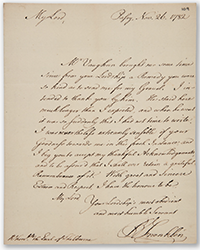
The William Reese Company is noted for offering rare books in the field of Americana. This latest catalogue is still overwhelmingly Americana, and the items extremely rare as they are unique, but the focus has shifted from books to manuscripts. This is all handwritten material (occasionally a filled-in form), the title being 96 American Manuscripts. No 96 Tears here. This is all exceptional material, and most is not just collectible, but fascinating to read. These are written by witnesses to history, and their observations are perhaps even more interesting to read today. These are a few examples.
Item 4 is a fascinating letter from the founder and Boston patriot Sam Adams, written shortly after independence was secured. It anticipates the division between the more privileged classes of people in America and the ordinary citizens, a division that would lead to the creation of political parties and endless hassles ever since the death of Washington. In this 1784 letter to future Vice-President Eldbridge Gerry, Adams laments George Washington joining the Society of Cincinnati. This society (still in existence today) was formed by American officers of the Revolution, along with their French counterparts who assisted the American cause. The egalitarian-minded Adams is quite concerned about the message – Washington joining a group that denied membership to the ordinary foot soldiers who implemented the officers' plans. Adams remains totally deferential to Washington, not questioning his motives or enormous contributions. Indeed, he explains, “That gentleman has an idea of the nature & tendency of the order very different from mine; otherwise I am certain he would never have given it his sanction. I look upon it to be a rapid stride towards a hereditary military Nobility as ever was made in so short a time.” Sam Adams expresses concern that the sanction of someone so beloved as Washington will unintentionally foster this class division. While praising the American commander, Adams notes, “We ought not however to think any man incapable of error.” Priced at $27,500.
Item 14 is another deeply interesting letter, this one from Delaware Representative James Asheton Bayard, to his cousin Samuel Bayard. If Bayard's name isn't instantly recognizable, his role in the presidential election of 1800 is. In those days, rather than voting separately for president and vice-president, electors voted for the two together. The result was that Thomas Jefferson, the presumptive presidential candidate, and Aaron Burr, the presumptive vice-presidential nominee, each received the same number of votes. The race was thrown into the House of Representatives, where members of the losing Federalist party saw an opportunity for mischief. Intensely disliking Jefferson, they voted for Burr. Jefferson could only carry delegations from 8 states, and 9 were needed. Thirty-five ballots went by this way. Finally, Bayard, who as the lone representative from Delaware, and a Burr supporter for the first 35 ballots, abstained, and helped convince a few others to change their ballots. It resolved what had become an enormous constitutional crisis. It is believed that Alexander Hamilton, an ardent Jefferson opponent who supported him nonetheless, on the grounds that a principled opponent was better than someone with no principles, convinced Bayard. There is also an unproven suspicion that Jefferson agreed not to fire too many Federalist officeholders. In this letter, dated January 30, 1801, less than two weeks before the balloting began, Bayard correctly projects that Burr will get 6 votes, Jefferson 8 (one short of the 9 needed). He fully understands the risks, and writes, “...what increases her [Delaware's] importance has the power of preserving the union from the terrible situation of being without a head.” He also notes that, “One member one way & three the other can turn the scale on either side.” What he could not have realized at the time is that he would be that “one member.” Bayard also has some intriguing comments about the President and fellow Federalist John Adams. His cousin is hoping for an appointment, but Bayard says he cannot make any promises to him. “We know of no scale or even principle of influence with the President. It is harsh to say his appointments are the result of mere caprice, but in fact they are generally unaccountable. Nobody knows who advised nor what motive induced. It is generally thought no one is ever consulted.” $15,000.
Item 11 is what Reese modestly describes as “the greatest Texas letter ever.” Written on February 25, 1836, it comes from the “Father of Texas,” Stephen F. Austin. Austin had started a colony years earlier with the approval of Mexican authorities, but as American and European immigration increased, Mexico became wary. It was no longer so happy with its guests. Santa Anna was already in Texas by this time fighting rebellious Texians. Austin, long cooperative with Mexico, was now on a mission to seek funding and assistance for the revolution. In this letter, he writes to an old friend, General John McCalla of Kentucky, urging him to come to Texas and bring along 2,000 troops. Austin proceeds to describe the countryside in glowing terms (not sure which part of Texas he was talking about) and how cheap the land is. He then describes McCalla's proposed mission in the most glowing and patriotic of terms. “The timid may shrink, the wealthy may buy their gold & stay at home but bold spirits & philanthropic hearts enough will be found who go to Texas & 'do or die.'” Who could resist an entreaty like this? Apparently, McCalla, as we find him still in Kentucky in the 1840s, and later taking an appointment in Washington from President Polk. $375,000.