
Rare Book Monthly
Mission Seeks to Find the Lost Discoverer of the South Pole

The Search For Amundsen website.
By Michael Stillman
Some of the greatest nonfiction writers were those who participated in history. Among the greatest of the great are the explorers who expanded the tiny pre-Columbian known universe to the entire world. Names like Columbus, Cook, Lewis and Clark, while perhaps not the most noted masters of prose, wrote some of the greatest books (or letters, as in Columbus' case) ever. Of course, no one gets to write the final chapter of his or her story. That is left to those who survive.
By the 20th century, pretty much all of the places you might want to live had been discovered and explored. Columbus' America, Cook's Australia, Lewis and Clark's Louisiana were all well known and populated by European descendants. Exploration was now left to the most inhospitable regions on Earth, notably the poles. Only the hardiest could hope to enter these lands where death awaited every turn. These are places settlers will never settle. Six months of darkness and twelve months of bitter winter welcomes no one. Still, the explorers came, and among those were Norwegian Roald Amundsen and Englishman Robert Falcon Scott.
Amundsen cut his exploratory teeth in the Antarctic in the waning days of the 19th century as part of a Belgian expedition. By 1903, he was off leading his own expedition, and it was a momentous one. After centuries of unsuccessful attempts, Amundsen led the first successful attempt to traverse the Northwest Passage, a route through Arctic waters north of the Canadian mainland. That brought him to his attempt to be the first to reach the South Pole in 1911.
Robert Falcon Scott was more of a traditionalist. It was his Navy career that put him in charge of the ship Discovery when it traveled to Antarctica at the time Amundsen was tracking down the Northwest Passage. His trip, too, was a great success, but no attempt was made to reach the Pole. In 1911, however, he joined the competition with Amundsen, attempting to reach the South Pole. Unlike Amundsen, who was up on using sled dogs and techniques of those who lived in far northern climates, Scott resorted to a combination of horses, motorized sledges, dogs, and simple manpower, humans pulling the heavy sledges of supplies.
History records that both were successful in their attempts to reach the South Pole. It also notes, of course, that only one made it first. That would be Amundsen, with his speedy dogs (Amundsen also needed fewer supplies as he cleverly ate the dogs on the way back). The Norwegian was well prepared for every possible contingency, and his journey to the Pole and back was as uneventful as could be under such harsh conditions. Forty-five days later, Scott arrived, to the horror of finding a Norwegian flag resting on the Pole. From there it was all downhill. The weather turned brutal, even by polar standards, and Scott and his men were not equipped for a return trip under such conditions. They froze. Shortly before his death, Scott wrote the next-to-last chapter of his life, which appeared in his final book. The following spring, Scott's last written words and his remains were found by a search party.
Rare Book Monthly
-

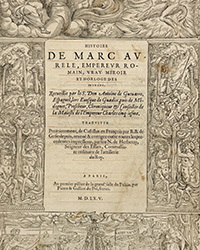
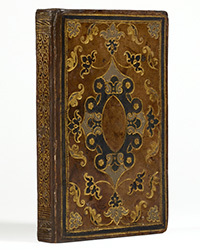
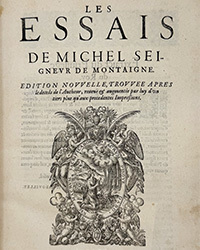

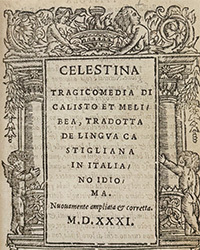
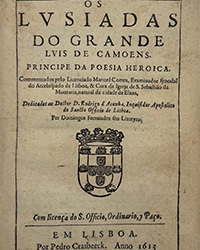
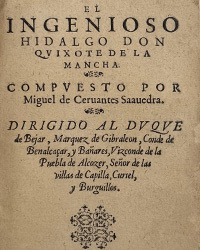

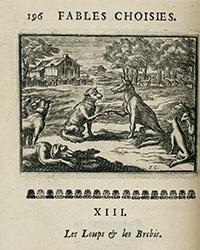
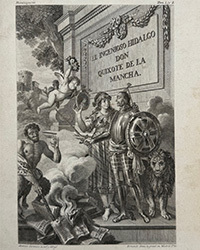
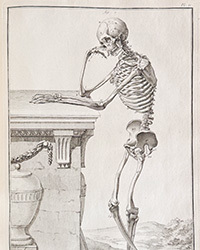

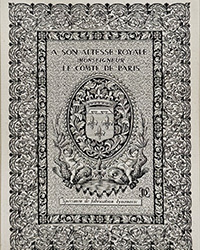
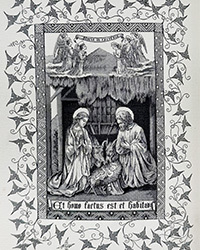 ALDE, Apr. 8: GUEVARA (ANTONIO DE). Histoire de Marc-Aurèle, Empereur Romain, vray miroir et horloge des Princes. Paris, Pierre et Galliot du Pré, frères, 1565. €3,000 to €4,000.ALDE, Apr. 8: HEURES DE LA VIERGE. Horæ in laudem beatissimæ virginis Mariæ ad usum Romanum. Paris, Charles L'Angelier, 1556. €4,000 to €5,000.ALDE, Apr. 8: MONTAIGNE (MICHEL DE). Les Essais. Édition nouvelle, trouvée après le deceds de l'autheur… Paris, Abel L'Angelier, 1595. €6,000 to €8,000.ALDE, Apr. 8: [ROJAS (FERNANDO DE)]. Celestina, tragicomedia di Calisto et Melibea, tradotta de lingua castigliana in italiano idioma… Venise, 1531. €2,000 to €3,000.ALDE, Apr. 8: CAMÕES (LUÍS DE). Os Lusiadas. Lisbonne, Pedro Crasbeeck, 1613. €2,000 to €3,000.ALDE, Apr. 8: CERVANTES (MIGUEL DE). El Ingenioso hidalgo Don Quixote de la Mancha. Bruxelles, Roger Velpius & Huberto Antonio, 1611. €6,000 to €8,000.ALDE, Apr. 8: LA FONTAINE (JEAN DE). Fables choisies, mises en vers. Paris, Denys Thierry et Claude Barbin, 1678-1694. €6,000 to €8,000.ALDE, Apr. 8: CERVANTES (MIGUEL DE). El Ingenioso hidalgo Don Quixote de la Mancha. Madrid, Joaquin Ibarra, 1780. €3,000 to €4,000.ALDE, Apr. 8: DIDEROT (DENIS) ET JEAN LE ROND D'ALEMBERT. Encyclopédie, ou dictionnaire raisonné des sciences, des arts et des métiers. Paris, 1751-1765. €15,000 to €20,000.ALDE, Apr. 8: [LIVRE TISSÉ]. LAMARTINE (Alphonse de). Les Laboureurs. Poème tiré de Jocelyn… Lyon, J. A. Henry, 1883. €8,000 to €10,000.ALDE, Apr. 8: [LIVRE TISSÉ]. Livre de prières tissé d'après les enluminures des manuscrits du XIVe au XVIe siècle. Lyon, [A. Roux], 1886. €5,000 to €6,000.
 -
Sotheby’s
Books, Manuscripts & Objects from Three Important Collections
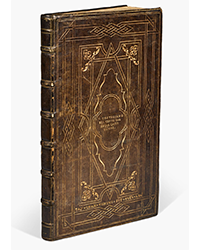
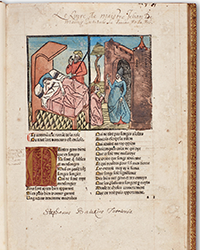
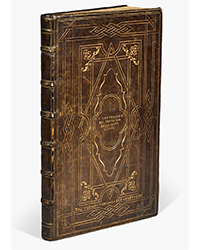
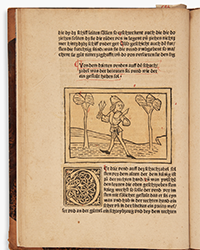
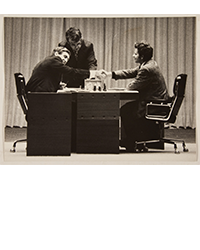
Open for Bidding 2-17 AprilSotheby’s, Apr. 2-17: [Guillaume de Lorris and Jean de Meun]. Le Roman de la Rose, [Geneva or Lyons, c.1481], first printed edition of the most important medieval French vernacular poem. £200,000 to £300,000.Sotheby’s, Apr. 2-17: Castiglione. Il libro del cortegiano. [Venice], April 1528, first edition, in a magnificent binding by Jean Picard for Jean Grolier. £100,000 to £150,000.Sotheby’s, Apr. 2-17: Jacobus de Cessolis. Schachzabelbuch, Strasbourg, 1483, von der Lasa copy. £50,000 to £70,000.Sotheby’s, Apr. 2-17: World Championship, 1972. A collection of 84 press photographs of the famed match between Spassky and Fischer. £2,000 to £3,000.Sotheby’s, Apr. 2-17: Ben Franklin. Autograph letter signed, to Lord Shelburne, British Prime Minister, during peace negotiations, November 1782. £15,000 to £20,000.