
Rare Book Monthly
A New AED Source: Early Railroad Literature
A Collector's Gem
By Bruce McKinney
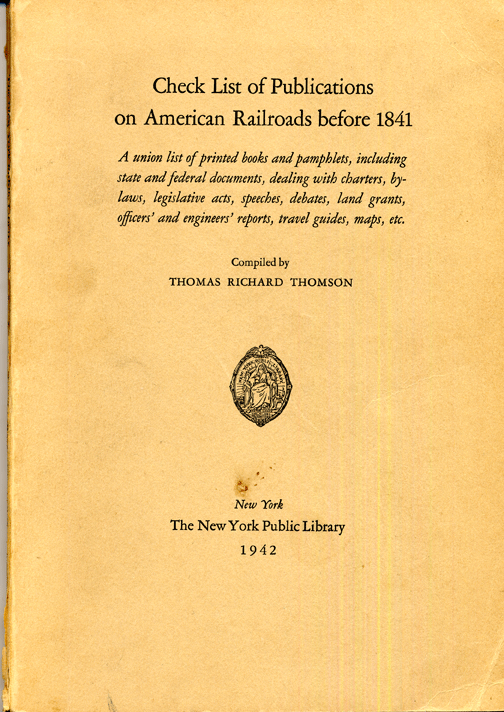
In 1942 the New York Public Library issued a 250 page catalogue on early books and other printed materials relating to the development of the railroad in the United States. It's a gem and we have added it both to the Americana Exchange Database and have created a Wiki Bibliography based on it. There are 2,865 entries for the period 1800 to 1840. It's a remarkable picture of early railroad development.
The 1841 cut-off seems to almost predate railroads but it turns out interest in rights-of-way and rail systems based on pre-steam power made the subject of "rail roads" a well-developed idea by 1840. The explosion in railroad construction, a national obsession to build railroads to connect almost every burg, village, town, city and port, would begin in earnest to take hold in the 1840's and lead to widespread railroad bankruptcies in the 1870's. In time many branch and feeder lines would be consolidated into the trunk systems from which the major 20th century American railroads emerged.
In the mid 19th century American population was mostly rural and there seemed to be little expectation among railroad promoters that, rather than simply connecting the countryside to cities, railroads would facilitate city migration. It turned out to be more of a one way street than most expected because [1] increasing farm efficiency reduced the labor component per bushel and gallon and [2] the developing industrial economy created better paying jobs in metropolitan areas. For many, once they saw city life, there was no going back except for the occasional visit. The mass exodus, already underway, would accelerate with the easy access and egress that railroads provided but more and more of the tickets would be one way. With the coming of the automobile even the trunk lines, that succeeded the initial panoply of branch lines, would begin to fail. Peoples' commitment was to convenience and all forms of transportation simply a means. Today the few feeder lines that still exist and offer coach service are novelties, Sunday excursions for holiday seekers.
This source captures a fair picture of the development of railroads in America as it enters the industrial age. The sources identified, begin in 1800 with references to the first efforts to transport by rail if not yet by steam power. Fulton applied steam, as a source of power, to boats in the first decade of the nineteenth century. George Stevens, of New Jersey, did the same for the railroad in 1826. By the early 1830's, demonstration railroads were operating in half a dozen states. By mid-decade, the railroad as corporation was emerging. By 1840 the nation was on the verge of transformation from an agricultural to an industrial economy. The railroads would turn out to be merely relay runners on a race on which they ran a single lap. In their time they were essential but soon expendable and it quickly turned out that most towns had too little to send out or bring in to justify the capital and labor involved. What no town was willing to live without in the 1850s and 1860s soon became failed investments in the 1870s.
Rare Book Monthly
-
Sotheby’s
Shelf Life: Books, Manuscripts and Works on Paper from the Library of Stanley J. Seeger and Christopher Cone
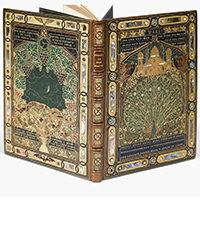
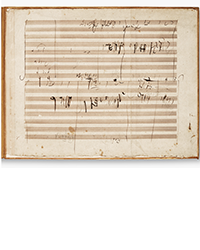
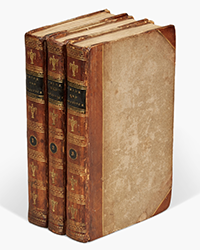
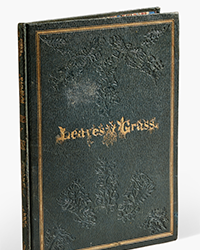
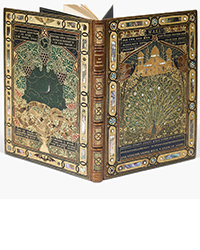
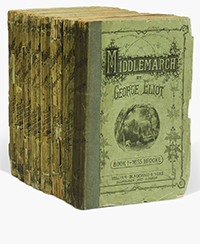
25 June – July 7Sotheby’s, July 7: Ludwig van Beethoven. Autograph sketches for the overture "Die Weihe des Hauses", op.124, [1822], UNPUBLISHED. £150,000 to £200,000.Sotheby’s, July 7: Jane Austen. Pride and Prejudice, 1813, first edition, 3 volumes, contemporary half calf. £50,000 to £70,000.Sotheby’s, July 7: Walt Whitman. Leaves of Grass, Brooklyn, 1855, first edition, first issue, original green cloth, the Doheny copy. £50,000 to £70,000.Sotheby’s, July 7: Binding—Sangorski & Sutcliffe—Omar Khayyam. Rubaiyat, London, 1872, third edition, in a magnificent jewelled Peacock binding. £15,000 to £20,000.Sotheby’s, July 7: George Eliot. Middlemarch, Edinburgh and London, 1871, first edition in the original parts. £20,000 to £30,000. -
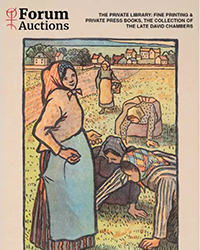
Forum Auctions
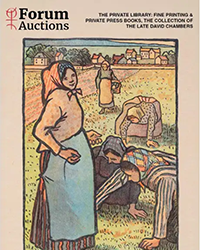
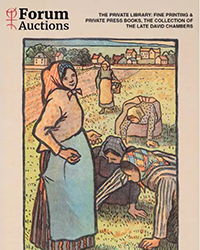
The Private Library:
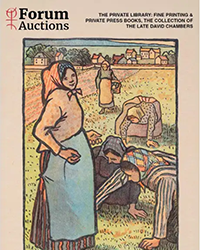
Fine Printing & Private Press books, the collection of the late David Chambers
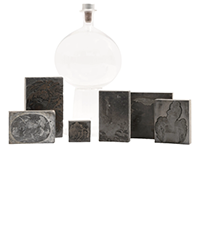
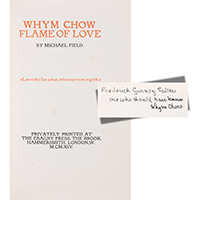
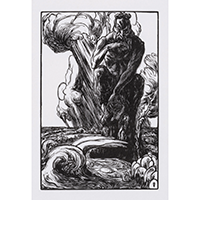
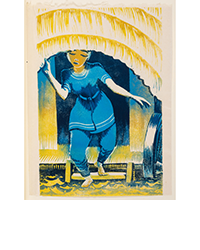
July 9, 2026Forum, July 9: Hassall (Joan) A large collection of over 300 original woodblocks of engravings for various books, v.d., with Hassall's engraver's glass water-globe (Qty) - Est. £10,000-15,000Forum, July 9: Eragny Press.- [Bradley (Katherine Harris) & Edith Emma Cooper], "Michael Field." Whym Chow, Flame of Love, one of only 27 copies, inscribed by Bradley, the rarest book from the press, 1914. - Est. £3,000-4,000Forum, July 9: [Moore (Thomas Sturge)] [Wood Engravings], 71 wood-engravings printed by David Chambers from the original blocks, the only set on Japanese Hosho paper, from an edition of 5 sets, [1970]. - Est. £3,000-4,000Forum Auctions
The Private Library:
Fine Printing & Private Press books, the collection of the late David Chambers
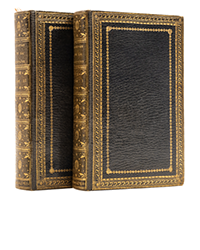
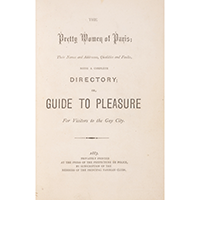
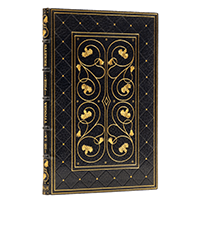
July 9, 2026Forum, July 9: La Fontaine (Jean de) Contes et Nouvelles en vers, 2 vol., engraved plates after Eisen, fine early 19th century blue morocco, gilt, by Bradel l'ainé, Amsterdam [Paris], 1762. - Est. £2,000-3,000Forum, July 9: Erotica.- Prostitution.- Pretty Women of Paris (The); Their Names and Addresses, Qualities and Faults..., [Paris], privately printed at the Press of the Prefecture de Police, 1883. - Est. £3,000-4,000Forum, July 9: Vale Press.- Ricketts (Charles) & Lucien Pissarro. De la Typographie et de l'Harmonie de la Page Imprimée…, [one of 216 copies], bound in dark blue morocco tooled in gilt, by Sarah T.Prideaux, 1898. - Est. £1,000-1,500Forum Auctions
The Private Library:
Fine Printing & Private Press books, the collection of the late David Chambers
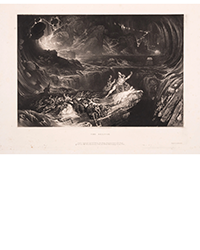
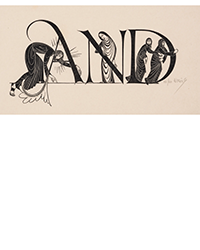
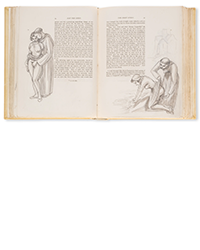
July 9, 2026Forum, July 9: Martin (John) Illustrations of the Bible, complete set of 20 mezzotints, good impressions, rarely found in early states, [c.1831-1835]. - Est. £1,000-1,500Forum, July 9: Golden Cockerel Press.- Four Gospels of the Lord Jesus Christ (The), one of 500 copies, Mary Gill's copy, Waltham St. Lawrence, 1931 with a signed proof of engraving on japon numbered 10/10 (2) - Est. £5,000-7,000Forum, July 9: Boccaccio (Giovanni) The Decameron, 3 vol., vol.1 extra-illustrated by John Buckland Wright with c.150 erotic original drawings in pen & ink and pencil, 1886 [extra-illustrated c.1940]. - Est. £10,000-15,000Forum Auctions
The Private Library:
Fine Printing & Private Press books, the collection of the late David Chambers
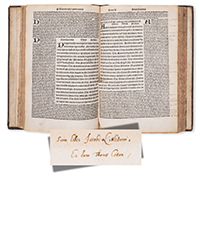
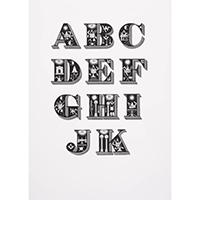
July 9, 2026Forum, July 9: Cox (Morris) Collection of Gogmagog Press Books, 35 vol., rare complete collection of printed books issued by the press, limited editions, most signed by Cox, 1957-83. - Est. £10,000-15,000Forum, July 9: Wynkyn de Worde.- [Terentius Afer (Publius)] [Comedie...], [Paris, Josse Badius: sold in London by Wynkyn de Worde, & others], [15 July 1504]. - Est. £4,000-6,000Forum, July 9: Mosley (James) Ornamented Types. Twenty-Three Alphabets from the Foundry of Louis John Pouchée, 2 vol., one of 10 copies for presentation, from an edition of 210, 1992-93. - Est. £1,000-2,000 -




Forum Auctions
The 10th Anniversary Sale
Fine Books, Manuscripts and Works on Paper
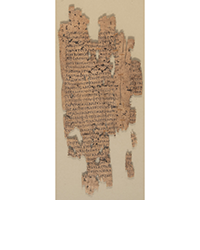
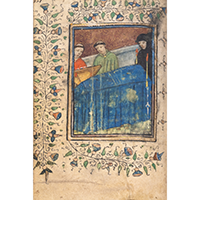
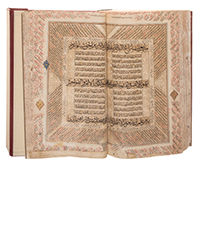
July 16, 2026Forum, July 16: Inundation papyrus. P.Michael 4, the ‘Inundation papyrus’, a geographical account of the Nile near Canopus, in Greek, remains of two columns from a manuscript scroll on papyrus, Egypt, second century CE. £12,000-18,000Forum, July 16: Book of Hours, use of Sarum, manuscript on vellum, 6 full-page miniatures, with famous Middle English inscriptions, Southern Netherlands for the English market, [c.1430]. £30,000-50,000Forum, July 16: Qu'ran, Arabic manuscript on burnished, stencilled, and gold-flecked paper, 447ff., Sultanate Gujarat, Ahmadabad, [after 1411 but no later than 1442]. £15,000-20,000Forum Auctions
The 10th Anniversary Sale
Fine Books, Manuscripts and Works on Paper
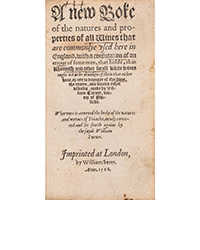
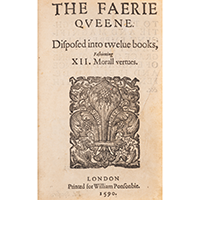
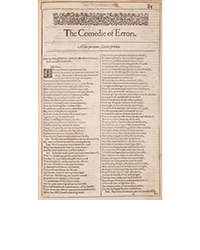
July 16, 2026Forum, July 16: Turner (William). A New boke of the natures and properties of all wines that are commonly vsed here in England, rare first edition of the first English book on wine, By William Seres, 1568. £20,000-£30,000Forum, July 16: Spenser (Edmund). The Faerie Queene. first edition, Printed [by John Wolfe] for William Ponsonbie, 1590. £30,000-40,000Forum, July 16: Shakespeare (William). The Comedie of Errors, extracted from the first folio, Isaac Jaggard and Edward Blount, 1623. £15,000-20,000Forum Auctions
The 10th Anniversary Sale
Fine Books, Manuscripts and Works on Paper
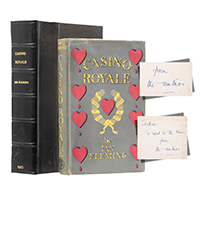
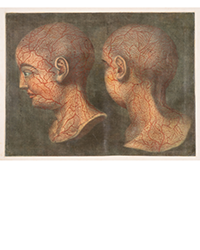
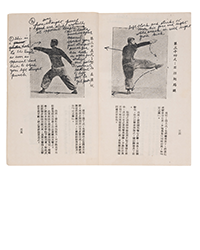
July 16, 2026Forum, July 16: Fleming (Ian). Casino Royale, first edition, signed presentation inscription from the author, 1953. £40,000-60,000Forum, July 16: d'Agoty (Jacques-Fabien Gautier). Anatomie de la Tête, first edition, Paris, chez le Sieur Gautier, 1748. £10,000-15,000Forum, July 16: Martial Arts.- Lee (Bruce). 'Praying Mantis style' Kung Fu book, containing numerous annotations, diagrams and graphs in Bruce Lee's hand, c. 1960. £50,000-70,000Forum Auctions
The 10th Anniversary Sale
Fine Books, Manuscripts and Works on Paper
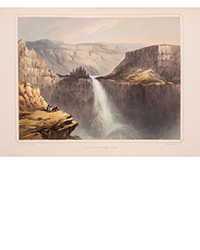
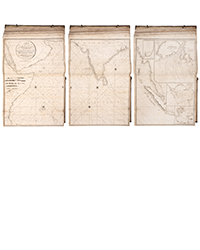
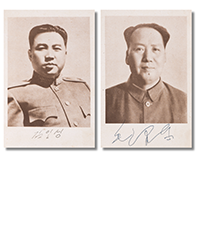
July 16, 2026Forum, July 16: Warre (Capt. Henry James). Sketches in North America and the Oregon Territory, first edition, rare hand-coloured issue, 1848. £30,000-40,000Forum, July 16: Norie (John William). The Marine Atlas, or Seaman's Complete Pilot for all the principal places in the known world..., 1826. £30,000-50,000Forum, July 16: Mao Tse-tung.- Kim Il-sung.-[Note book for visitors from China to Korea], signed by Mao and Kim, [Beijing, 1954]. £10,000-15,000