Rare Book Monthly
Articles - November - 2007 Issue
Taking Stock

Good stuff sells and is worth preserving.
It would be nice if I could focus on these things, but the reality of daily life in a bookstore is much more complicated. First, there are the daily orders which we push out. We've added FedEx ground services and UPS Mail Logic (both discounted in certain ways over the United States Post Office), but each with their own shipping fine points. There is no quicker way to lose your shirt than to pay insufficient attention to accurate and timely shipping matters.
It would be nice to go through my entire inventory and get rid of the books that are taking up room on the shelves and listings in my database, that have no particular value, but the physical reality of doing that is horrendous. At the same time, if we don't do it, we continue to make numbered boxes that take up room and that will eventually force an expansion of very expensive warehouse space.
In the microcosm, there are the daily follow-ups of all sorts, mainly from customers. Scheduling photographs, hauling books to the bindery for repair and rebinding, watching over auctions (both ours and others), answering the telephone and fax and email -- I'm sure you know the score, but with time limited each of these items sometimes appears to be happening in slow motion, where I'm listing each task in its minute sequences in advance, as I'm going through them all. It seems that before I can simplify and come up with the equivalent of the fundamental theorem of calculus for a bookseller, I will have to go through an encyclopedia's worth of minute bookstore building and maintenance detail.
This is not the first time that I've longed for simplicity. When I was interested in pursuing a study in pure mathematics, I remember discovering the fundamental theory of calculus, brilliantly taught by a professor at Boston University's School of Engineering. After an entire semester going through the historical development of calculus (and that meant endless pages of algebra), he finally disclosed Newton and Leibniz's work.
"Why had he waited?" I asked. "That would have saved us a lot of time," I said, looking at notebooks full of meticulous calculations and the simple expression he had chalked on the board.
"If I had written it out at the beginning of the year," he said, "you wouldn't have appreciated it."
So, when I make that sublime discovery, you know the one which enables you to go triumphantly to Christie's, sit in the audience with a knowing smile and without a paddle, and retire to high ground, I will do so with all the intense appreciation of one who has built a business from endless piles of books, and struggled with every aspect of their valuation, description, storage, marketing, delivery, and acquisition. I can only hope, that like Mrs. Zobel, I will retire having made some contribution to knowledge and the preservation of increasingly rare print materials.
Renée Magriel Roberts can be reached at renee@roses-books.com.
Rare Book Monthly
-

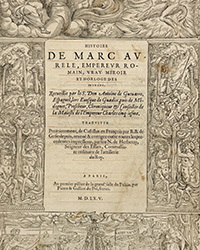
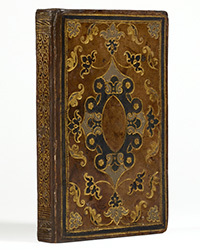
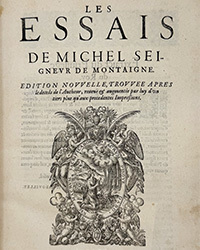

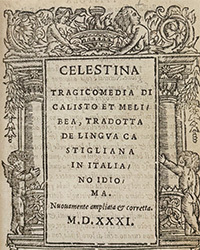
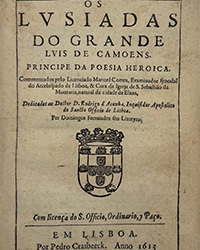
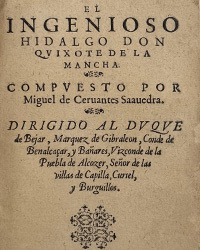

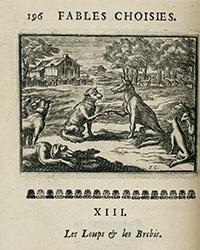
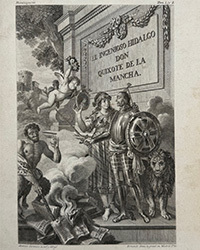

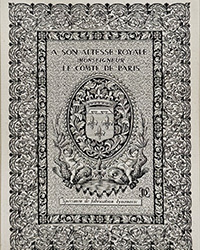
 ALDE, Apr. 8: GUEVARA (ANTONIO DE). Histoire de Marc-Aurèle, Empereur Romain, vray miroir et horloge des Princes. Paris, Pierre et Galliot du Pré, frères, 1565. €3,000 to €4,000.ALDE, Apr. 8: HEURES DE LA VIERGE. Horæ in laudem beatissimæ virginis Mariæ ad usum Romanum. Paris, Charles L'Angelier, 1556. €4,000 to €5,000.ALDE, Apr. 8: MONTAIGNE (MICHEL DE). Les Essais. Édition nouvelle, trouvée après le deceds de l'autheur… Paris, Abel L'Angelier, 1595. €6,000 to €8,000.ALDE, Apr. 8: [ROJAS (FERNANDO DE)]. Celestina, tragicomedia di Calisto et Melibea, tradotta de lingua castigliana in italiano idioma… Venise, 1531. €2,000 to €3,000.ALDE, Apr. 8: CAMÕES (LUÍS DE). Os Lusiadas. Lisbonne, Pedro Crasbeeck, 1613. €2,000 to €3,000.ALDE, Apr. 8: CERVANTES (MIGUEL DE). El Ingenioso hidalgo Don Quixote de la Mancha. Bruxelles, Roger Velpius & Huberto Antonio, 1611. €6,000 to €8,000.ALDE, Apr. 8: LA FONTAINE (JEAN DE). Fables choisies, mises en vers. Paris, Denys Thierry et Claude Barbin, 1678-1694. €6,000 to €8,000.ALDE, Apr. 8: CERVANTES (MIGUEL DE). El Ingenioso hidalgo Don Quixote de la Mancha. Madrid, Joaquin Ibarra, 1780. €3,000 to €4,000.ALDE, Apr. 8: DIDEROT (DENIS) ET JEAN LE ROND D'ALEMBERT. Encyclopédie, ou dictionnaire raisonné des sciences, des arts et des métiers. Paris, 1751-1765. €15,000 to €20,000.ALDE, Apr. 8: [LIVRE TISSÉ]. LAMARTINE (Alphonse de). Les Laboureurs. Poème tiré de Jocelyn… Lyon, J. A. Henry, 1883. €8,000 to €10,000.ALDE, Apr. 8: [LIVRE TISSÉ]. Livre de prières tissé d'après les enluminures des manuscrits du XIVe au XVIe siècle. Lyon, [A. Roux], 1886. €5,000 to €6,000.
 -