Rare Book Monthly
Articles - October - 2007 Issue
Book Review: Al Gore's <i>The Assault On Reason</i>

Al Gore's The Assault On Reason
By Michael Stillman
The latest book from environmental crusader and former Vice-President Al Gore, The Assault on Reason, is now on the shelves. Gore combines sharp insight, strong political views, and a plodding writing style to create his latest polemic. It is a worthwhile, if at times tiresome, read. One should not confuse Gore's basic dullness with an absence of good ideas. Many did that in 2000, and, in many people's opinion, we have paid a very high price.
Gore has much of a political nature to say, which should at least be heard by the other side, but won't be. Reality is two kinds of people will read his book: those who agree, and those looking for a way to discredit him. Such is the nature of politics today. We hear what we want to hear and close our ears to all else. No wonder reason has been assaulted.
I'll refrain from writing about the more political parts of the former Vice-President's observations (which is most of the book). Gore offers several insights on issues of the day that are hard to argue, and then explains how they have been used by the other side to the detriment of our well-being. We will try to stick to the observations and leave it to you to decide whether you wish to listen to his explanation of how they are misapplied.
Gore is very focused on how the growth of television has negatively affected our ability to reason. Few in the book trade will dispute him on this point. Television is a one-way medium. In the day, pamphleteers could express differing points of view, and people were more likely to listen to candidates and debate their ideas. The publishing of pamphlets was not prohibitively expensive. Unfortunately, you cannot discuss opinions with a television set. The communications all come in one direction, and with a cloak of authority. Those who control the airwaves can effectively control what people hear, and very few people of modest means can afford to own a television station. That limits who gets to speak.
Add to television sophisticated marketing techniques and the mess gets much worse. The result is the 30-second spot, which tells you nothing of substance about the candidate, but is nonetheless very effective in convincing people how to vote. Gore gives a candid look at the effectiveness of television advertising from his first senate campaign. His experts told him, "If you run this ad at this many points, and if Ashe responds as we anticipate, and then we purchase this many points to air our response, the net result after three weeks will be an increase of 8.5 percent in your lead in the polls." Gore adopted the plan and described himself as "astonished" when, three weeks later, his lead had increased by precisely 8.5%. No one in marketing would be so astonished. It is a science, but it is downright scary for Gore's example shows our democracy can be readily manipulated by marketing strategies, not substance. We are doing what we are told, rather than reasoning for ourselves.
Rare Book Monthly
-
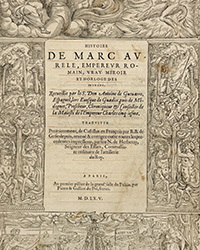
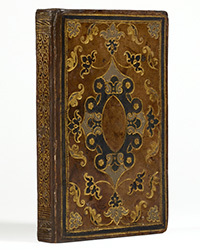
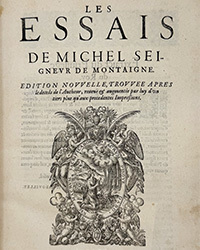
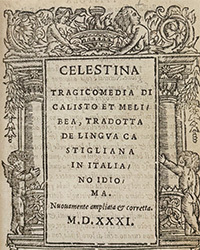
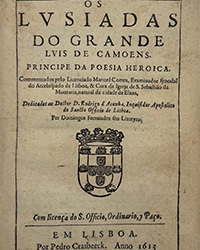
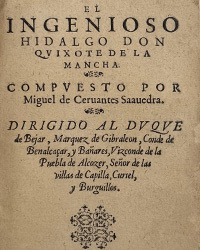
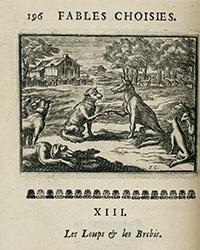
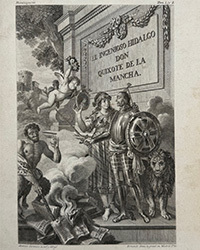
 ALDE, Apr. 8: GUEVARA (ANTONIO DE). Histoire de Marc-Aurèle, Empereur Romain, vray miroir et horloge des Princes. Paris, Pierre et Galliot du Pré, frères, 1565. €3,000 to €4,000.ALDE, Apr. 8: HEURES DE LA VIERGE. Horæ in laudem beatissimæ virginis Mariæ ad usum Romanum. Paris, Charles L'Angelier, 1556. €4,000 to €5,000.ALDE, Apr. 8: MONTAIGNE (MICHEL DE). Les Essais. Édition nouvelle, trouvée après le deceds de l'autheur… Paris, Abel L'Angelier, 1595. €6,000 to €8,000.ALDE, Apr. 8: [ROJAS (FERNANDO DE)]. Celestina, tragicomedia di Calisto et Melibea, tradotta de lingua castigliana in italiano idioma… Venise, 1531. €2,000 to €3,000.ALDE, Apr. 8: CAMÕES (LUÍS DE). Os Lusiadas. Lisbonne, Pedro Crasbeeck, 1613. €2,000 to €3,000.ALDE, Apr. 8: CERVANTES (MIGUEL DE). El Ingenioso hidalgo Don Quixote de la Mancha. Bruxelles, Roger Velpius & Huberto Antonio, 1611. €6,000 to €8,000.ALDE, Apr. 8: LA FONTAINE (JEAN DE). Fables choisies, mises en vers. Paris, Denys Thierry et Claude Barbin, 1678-1694. €6,000 to €8,000.ALDE, Apr. 8: CERVANTES (MIGUEL DE). El Ingenioso hidalgo Don Quixote de la Mancha. Madrid, Joaquin Ibarra, 1780. €3,000 to €4,000.ALDE, Apr. 8: DIDEROT (DENIS) ET JEAN LE ROND D'ALEMBERT. Encyclopédie, ou dictionnaire raisonné des sciences, des arts et des métiers. Paris, 1751-1765. €15,000 to €20,000.ALDE, Apr. 8: [LIVRE TISSÉ]. LAMARTINE (Alphonse de). Les Laboureurs. Poème tiré de Jocelyn… Lyon, J. A. Henry, 1883. €8,000 to €10,000.ALDE, Apr. 8: [LIVRE TISSÉ]. Livre de prières tissé d'après les enluminures des manuscrits du XIVe au XVIe siècle. Lyon, [A. Roux], 1886. €5,000 to €6,000.
 -