Book publishers won an overwhelming victory in court against Anna's Archive, a “shadow library” that has been stealing their copyrighted works. Shadow libraries operate by copying copyrighted works without paying the authors or publishers, and then making the text available online to others. Frequently, they can be accessed through the shadow library free, but if you want a lot of them, you will either have to pay or be expected to pay. That, and contributions, is how Anna's Archive raises the funds to operate.
The number of books these shadow libraries hold is staggering. Anna's Archive's aim is to have access to digital copies of every book in existence. They are well on their way. They access tens of millions of books, and by now, it may be hundreds of millions. The other two large shadow libraries, LibGen (Library Genesis) and Z-Library, also have large numbers of books, though apparently not as many as Anna, which steals their stolen books too.
Their primary users today are the creators of Large Language Models. These are the huge consumers of data that feed the major AI (artificial intelligence) search engines. That would include Open AI's ChatGPT, Google's Genesis, Anthropic's Claude and Meta's Llama. In the not so long-ago days before AI, the primary users were students looking to evade the high cost of textbooks, but AI search engines use their books at a different level of volume.
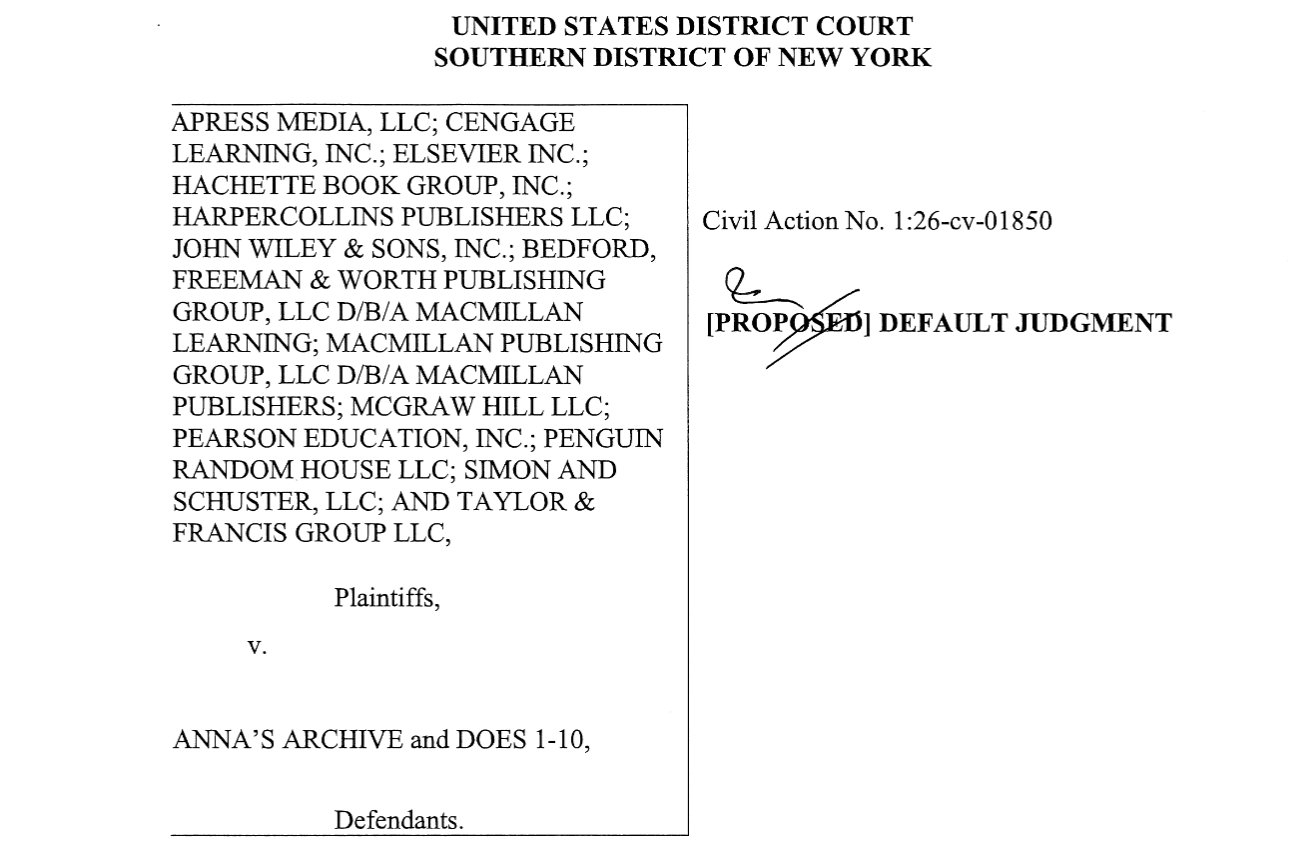
In March, thirteen publishers got together and filed a suit against Anna's Archive. They sought heavy damages, almost $20 million. The victory came swiftly and the court gave the publishers everything they wanted. It wasn't even a contest. The publishers didn't have to prove their case. The defendant didn't fight back. Anna's Archive didn't even bother showing up in court. The court awarded the publishers a default judgment, which is what happens when a plaintiff files a claim and the defendant doesn't bother to challenge it. The claim is effectively assumed to be correct.
The 13 publishers each presented ten books for which copyright violations were claimed. They asked for statutory damages of $150,000 apiece. That is 130 books at $150,000 each, for a total of $19,500,000. The court gave them $19,500,000. The court also ordered the defendant to destroy all of their copies of the books within ten days and provide the court a “detailed description” of how they complied with this order. It also ordered Anna's Archive to provide the publishers with contact information, including mailing address, email address, and phone number.
Of course, this barely touches the surface of the potential payout to the publishers. They only sued for copyright infringement on 130 titles, but there must be millions of books whose copyrights Anna's Archive violated. The ultimate award could come to hundreds of billions of dollars or even trillions.
The publishers must be having one amazing party. They've got it made. Wait... Not so fast. The devil is always in the details. The publishers still have to collect the money. There is no way Anna's Archive has the money to pay this judgment, but not even that is relevant. The reality is neither the publishers nor the court has any idea of who is behind Anna's Archive or where they are located. If you think they are going to comply with the order to identify themselves or their address you are dreaming. This is why they are called “shadow libraries.” No one knows who they are and they aren't telling.
One thing of which we can be confident is they aren't located in the United States, western Europe, or anywhere that is likely to have any interest in enforcing an order from a U.S. Court. It is likely someplace that doesn't like America and the number one suspect, no surprise, is Russia. They have a history of trying to mess things up for America and cybercrime is the most effective and easiest way to wreak havoc on someone else. They are the primary reason all sorts of Americans, American businesses, and the American government have to employ all kinds of security against cybercrime. Their fingerprints are all over this sort of stuff.
Even if the urls they use are blocked, they will just keep switching to new ones. If Russia or whoever is the host nation does not cooperate, they will be able to get away with endlessly dodging the law. In other words, the verdict won't even stop the shadow libraries from continuing to steal more. It is essentially meaningless.
While the thieves are likely beyond the reach of the law, there are related parties who aren't. Those are the users of these stolen books. Many are likely also beyond reach, such as Chinese AI developers, but not Open AI, Google, Anthropic, or Meta. Their expected defense will center on the legal doctrine of “fair use.” This is the rule that allows you to quote or copy a small selection of a copyrighted work for a report, book review, or in the case of students, a term paper. A difference here is that the AI search engines copy everything, though what they display at any one time is a small “snippet.” Cumulatively, depending on the number and variety of searches, they could end up displaying everything in multiple small bits.
A lower court has already ruled on a claim against Meta. It concluded the use of the copyrighted books was “fair use,” but that they violated copyright law by using stolen copies of the books. Anna's Archive and the others don't buy the books they copy. This verdict is being appealed and there will likely be many more legal challenges in the days ahead. The issues are of enormous importance. Many people are now accustomed to doing question and answer searches, rather than searching for links. It is expected to be the dominant method of searching within a short time. We depend on AI, and AI depends on vast sources of data. We have come too far to go back. However, authors and publishers are entitled to just compensation for their work. They can't continue to write books without pay. They have a right to be paid. How these conflicting aims are to be reconciled will be up to the courts. Presumably, there will be a compromise as there has to be one. Stealing books was easy. Resolving the aftermath will be extremely difficult.