Courbé means “bent” in French, and it’s not the best name to start a business that you expect to be flourishing. But in the early 17th century, Augustin Courbé decided to turn his weakness into strength and used his name as the symbol of his tremendous success.
The Big Three
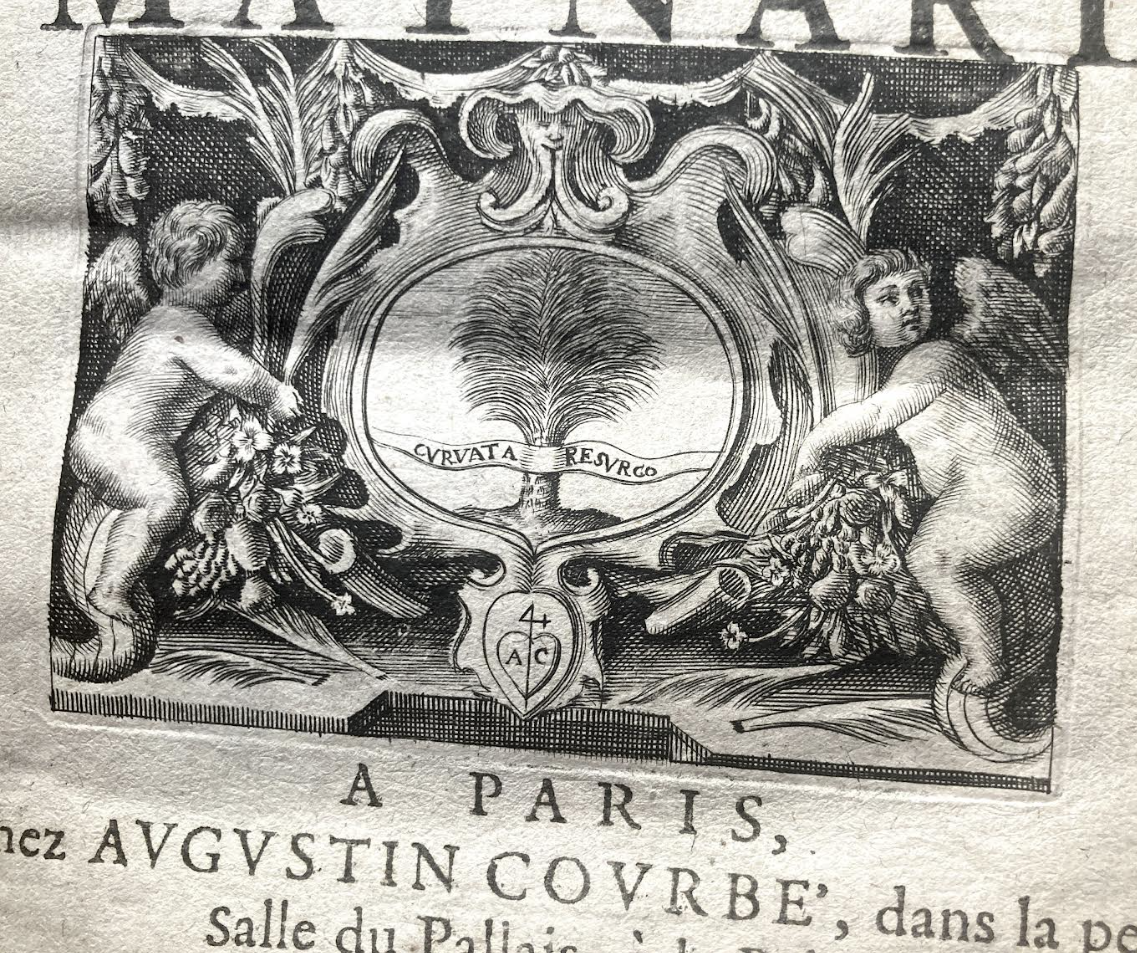
If you open a 1646 copy of Maynard’s Poésies, you’ll probably be more attracted to the printer’s vignette than to the author’s portrait that faces it. It’s a huge copper plate printed right in the middle of the title page that features two angels surrounding a cartouche with a palm tree in the middle. There’s a banner across it that reads curvata resurgo—I Rise As I Bend. Yes, you’re holding a book printed by one of the most successful printers of the early 17th century, namely Augustin Courbé. “Courbé made quite a fortune in the book business,” Alain Riffaud writes*. He started as an apprentice at Jean Gesselin’s in 1613, and was received Master ten years later. It didn’t take long before his name was printed on dozens of title pages: “By 1630, three booksellers had clearly taken over the business in Paris: Augustin Courbé, Toussaint Quinet and Antoine de Sommaville”, Riffaud resumes. “Those three booksellers were buying every manuscript they could get their hands on, and they left nothing but crumbs to the others.” Their bookshops were located at the same place, in the “small gallery of Le Palais”, in the Justice Court, in Paris. Courbé and Sommaville worked at least twice together, for La vraye Astree, by Honoré d'Urfé (1637) and Histoire de la vie de Henry Duc de Montmorency, by Du Cros (1643). Sommaville’s shop was L’Escu, while Courbé’s was La Palme—The Palm; just like the palm tree featured on his vignette.
Subcontractor
Courbé built his success on asphyxiating the market, but it meant printing rapidly and at a good price. Consequently, he didn’t bother buying a printing shop like most booksellers, but developed a network of small Parisian printers instead. “It enabled him to cut down the cost price, and to print books rapidly while working with several subcontractors”, Ruffaud says. He even called upon printers outside Paris. In the 1650s and the 1660s, several of his publications like Balzac’s Le Socrate Chrétien (1654), Histoire Sacrée de Sulpice Severe (1659), or Corneille’s Stilicon (1660), were “printed in Rouen”. This was very efficient if we refer to the Bibliothèque Nationale de France (BnF)’s data** that credits Courbé with 200 publications between 1627 and 1662. He was also able to adapt to new trends, and in her book Don Quichotte à Versailles (2022), Marine Rousillon gives another reason behind Courbé’s success. She says that the translation of Cervantes’ Don Quichotte in 1614 created a Middle Age revival in France. Reviewing her book, L’Histoire writes: “Augustin Courbé was among the most influential booksellers to spread this reinvented past that triumphed with the translation of François de Rosset’s Roland furieux (1643) or the publishing of Alaric..., Georges de Scudéry’s heroic poem (1655).” He was also a pioneer in the filed of communication, turning a bending name into a rising emblem.
Bending To Rise
Notwithstanding the somehow negative connotation of his name, Courbé was among the first printers to sell it as a brand, and his title pages became his favourite playgrounds. Some of his publications, like De le Vie et des actions d’Alexandre Le Grand (1655), came without vignette, but a vast of majority feature the two angels, the palm tree, and the motto curvata resurgo— I Rise As I Bend. “This was quite an ingenious choice,” Riffaud resumes. “Courbé’s shop was named “la Palme” (the Palm); and the motto is an appropriation of the word “bent” (or “courbé”, in French); the negative connotation of something going down is here inversed: indeed, the more palm trees grow, the more their numerous leaves bend on their sides—it’s also a reference to the “palms” that were given to the winners, or to the martyrs (...). Courbé had nothing to envy to our modern publicists.” Courbé’s emblem also features the initials AC (Augustin Courbé). He’d used a wooden block most of the time, but he sometimes used a copper plate that “raised the cost of the book, and increased the delay of printing,” Riffaud underlines. Using a copper plate was more than a detail; it was a commercial statement. As a matter of fact, Courbé hardly ever used the same plate twice. Just like a palm tree, his emblem grew bigger and bigger as time went by. It’s quite present on Maynard’s title page, indeed; but even more so on Les Histoires de Polybe... (1655). This is the hugest one I could find, featuring not two but four angels surrounding a framed cartouche with a palm tree in the middle. Courbé was showing off his success. At the height of his career, he was the official printer for the King’s brother (aka Monsieur).
The Palm Shop
At the time, title pages would indicate where you could buy a book. Courbé’s bookshop was located in the Justice Court (le Palais), in Paris—as the title page of Relation du Groenland (1646) reads, “in the small room of haberdashery.” The BnF website says: “The gallery of the Justice Court was then a sort of fashionable mall, where, as shown on this engraving, the cloth merchants shared their stand with booksellers.” The engraving here referred to is Abraham Grosse’s La Galerie du Palais** (circa 1638). The only one of its kind for the period, it represents Courbé’s Palm shop, with a cloth merchant right next to it. Well, there’s no palm tree in sight, but the female seller shows a customer a copy of Tristan l’Hermite’s La Mariane, published in 1637 by... Augustin Courbé! And guess who engraved the frontispiece of this one? Abraham Bossse—an early mise en abyme, and the result of Courbé’s determination to use his name and image as business tools. Booklovers will spend hours looking closely at this valuable testimony as the backs of the open wooden shutters read several names or titles as L’Astrée, Godeau, Sceneque, Plutarque, Boccace, Alexandre, Desmarets, Machiavel etc—just like the numerous bending leaves of a palm tree indeed.
Augustin Courbé apparently retired in 1663, selling his business to Thomas Jolly, who kept the name La Palme, as well as the stand in Le Palais—but not the emblem. It proves that Courbé had successfully established his name as a brand. As a matter of fact, books were still printed under his name by 1692, still rising although laid to rest.
Thibault Ehrengardt
* Riffaud Alain. Imprimer son identité : l’exemple des pages de titre du théâtre imprimé au XVIIe siècle. In: Littérales, n°39, 2007. Écriture, Identité, Anonymat, de la Renaissance aux Lumières. pp. 71-111.
** https://essentiels.bnf.fr/fr/image/82273b85-aa63-46f1-a2cd-c49008381f15-galerie-palais