As the world of collectibles expands and things like comic books and sports trading cards bring astronomical prices, the question of authenticity becomes an urgent concern. Allegations of deceptive practices, conflict of interest and outright fraud and forgery are increasingly frequent.
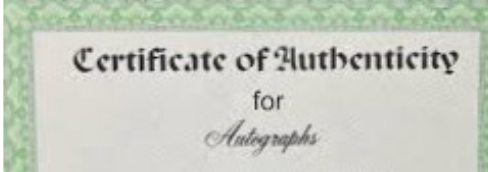
Certainly most buyers have heard the term Certificate of Authenticity (COA). Likewise, third party authenticators like PSA (Professional Sports Authentication) a leading authority for trading cards and autographs, JSA (James Spence Authentication) known for autograph authentication and Beckett (BAS/BGG) a, firm specializing in both grading cards and authenticating autographs (and other companies) are well known to both buyers and sellers.
But what has come in for increasingly heated discussion and strongly expressed views is the split between many long established dealers in books and other kinds of collectible paper who think that COAs are worthless (termed “scum” by one dealer) and the position held by those who believe that COAs and third party authentication are useful and reliable tools.
The argument revolves around whether these claims of authenticity have any real value at all. Some buyers who relied on third party authentication found to their dismay that disclaimers are frequently hidden in the fine print of the agreement. These are terms which limit or void liability in the event of error, and are not long term guarantees, but if they exist at all, may be limited to a very brief period.
On the other hand, established dealers, especially those belonging to trade associations like the ABAA (Antiquarian Booksellers of America), IOBA (Independent Online Booksellers Association) or Professional Autograph Dealers Association (PADA) subscribe to a code of ethics that require them to take back merchandise found to be not genuine.
“I tell people that anyone can print a COA,” said Alexander Akin, ABAA president and co-owner of Bolerium Books in San Francisco in a recent phone conversation,“but membership in the ABAA means that authenticity is guaranteed by the dealer, not for a limited time, but as long as they are in business. It is far better to trust vetted membership in the Association - with its appeal process for unsatisfied customers - rather than anyone’s COA.”
A similar, and more detailed case is made for this point of view by Scott Brown of Downtown Brown Books (ABAA, IOBA) in Portland, OR. His March 4, 2024 Substack article is titled Why I Don’t Trust COAs. He states bluntly, “I think COAs for autographs are bullshit, and here's why.” If you’re looking for extensive documentation of what the book trade doesn’t like about COAs, and by extension third party authenticators, look no further.
https://downtownbrown.substack.com/p/why-i-dont-trust-coas
Also recommended is Brown’s article Why You Are Not Bill Gate’s Bookseller and Other Antiquarian Tales which takes a close look at Kenneth W. Rendell, one of the world’s leading experts on forgery. downtownbrown.substack.com/p/why-you-are-not-bill-gatess-bookseller
Another point of view comes from Bill Kemps of Bookcharmed Books in New Jersey. An IOBA member and veteran dealer specializing in books signed by public figures and celebrities, he focused on the issue of “trust.”
“Unless you stood there watching it being signed,” he said, “you have to extend a certain degree of trust or it all falls apart.” Kemps expressed more faith in PSA, JSA and other third party authenticators because he thinks they have specialized knowledge and use scientific tools to help assure accuracy. “Without them,” he said, “it’s the Wild West out there.” Still, he acknowledged when it came down to the bottom line “it’s only an opinion,” albeit one that is supposed to be expert.
Kemps was one of several who pointed to what he called “offshore forgeries of signatures,” which he said often appeared on eBay. ”A lot of forgers are in China," he continued. “Their forgeries are excellent. The internet has made it possible for people to get rich off of theft and not get caught.”
John Reznikoff of University Archives is at the other end of the spectrum. He heads a well known Connecticut based auction house and is a staunch advocate for third party authentication. Reznikoff is an anomaly among auctioneers, because he also belongs to ABAA and subscribes to their policy of giving a refund should his authentication prove to be in error.
In a brief phone conversation he described himself as “a consultant for PSA and JSA, two of the leading third party authenticators.” His specialty is books, manuscripts and autographs.
Perhaps his most valuable contribution to the discussion had little to do with the pros and cons of authentication, but was more a suggestion on bridging the gap between those who prefer to buy at auction, where the firms rarely offer long term guarantees of the genuineness of the goods sold, and working with the established dealers, especially at the higher end, who invariably stand behind their merchandise.
Rezinkoff urged those who are new - or not yet thoroughly experienced in the world of auctions - to cultivate relationships with experienced dealers, and when circumstances warrant to have those dealers act as their agents.
He gave several reasons for this opinion: First, an experienced dealer is likely to know as much or more than the auction house about the goods being offered. Also, a dealer who is familiar with the process of auctions often has multiple established contacts within the firm(s). He said that using a dealer as an agent is a negotiable agreement, with the fee running from about 3 to 10% of the selling price or other mutually acceptable terms.
The only things that seems certain about this subject is that it’s getting more controversial, is thinly regulated, shady practices abound and the controversy is not going away.