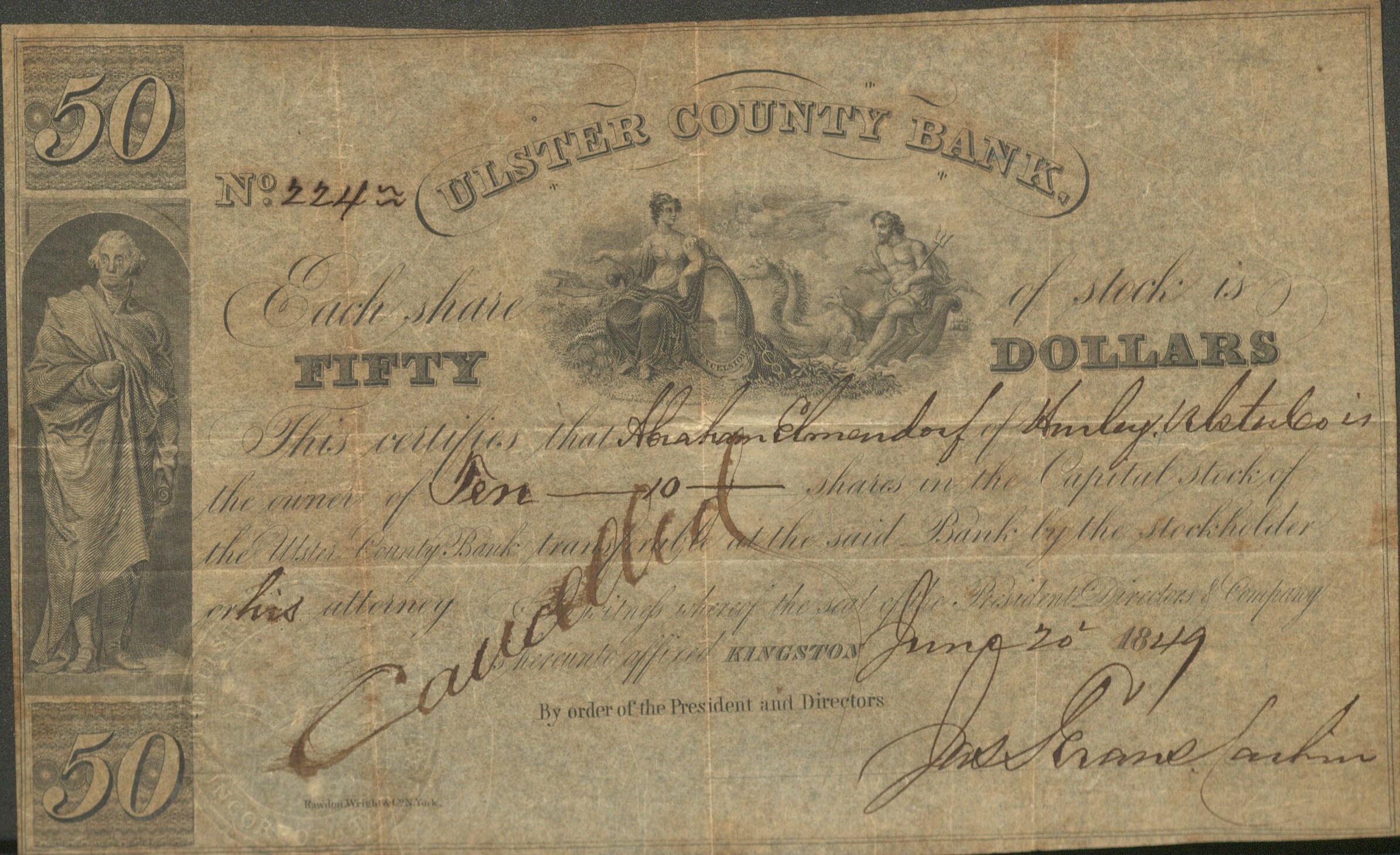
As a collector of books, manuscripts, and maps relating to Ulster County, New York, I’ve acquired an enormous amount of material. About 20 years ago I ran into stock certificates for a bank I’d never heard of: the Ulster County Bank. Those certificates fell into another category called scripophily and I became hooked. They’re a branch of ephemera.
Over the years I’ve encountered and bought 20 examples. With this article I’m updating what I’ve learned about and from them. It all started on eBay when a new dealer posted 5 of them individually and I bought them at her start prices: $15- each. No one else bid.
Here you go!
Ulster County in the Hudson Valley emerged under the British as a subsistence farming area in the 17th century and continued to be poor into the later decades of the 18th century. The local Lenape Indians were relatively peaceful and treaties could be made. The early houses were built of stone for protection. They lived during a period of uncertainty. During the Revolutionary War (1777), the British burned Kingston less than a year after it was named the first capital of what was becoming New York State. After peace was made, the town was soon rebuilt but the county continued to rely on agriculture. By 1800, Ulster was supporting a population of 24,855, 90% working on farms to raise food to trade for sundries and services nearby. The town and city model was emerging.
On the Hudson River nearby Robert Fulton introduced a commercially viable steamboat in 1807. Improving travel and increasing traffic to and from New Amsterdam (now known as New York City) would begin to bring Ulster County’s resources within reach to what would become America’s leading city in the 19th century. Steamboats would prove to be just one of the ways that would bind Ulster County to the growing metropolitan area.
Ulster County would become the breadbasket of Manhattan, its crops first carried on sloops during the 9 to 10 months when the river water was ice free. We were at the doorstep of the industrial revolution. There was beginning to have a cash economy. In Kingston, investors joined to start a bank. It was called the Ulster County Bank. The year was 1829.
The Delaware & Hudson Canal that connected Honesdale, Pennsylvania’s anthracite coal fields to the Hudson River at Rondout (Kingston and Rondout would eventually merge), would make Kingston/Rondout a financial center. The canal opened 1828. The Ulster County Bank opened in 1829.
While the canal was being dug, engineers found that Rosendale (that was on the D & H route) had locally mined cement that had a unique property; it could be set underwater. For the D & H Canal by luck, they had a second cargo to transship to cities north and south.
Rosendale Cement Co. would dominate their category
for almost a hundred years.
Ulster County was in its golden moment.
Over the years I’ve found twenty of the Ulster County Bank’s stock certificates.
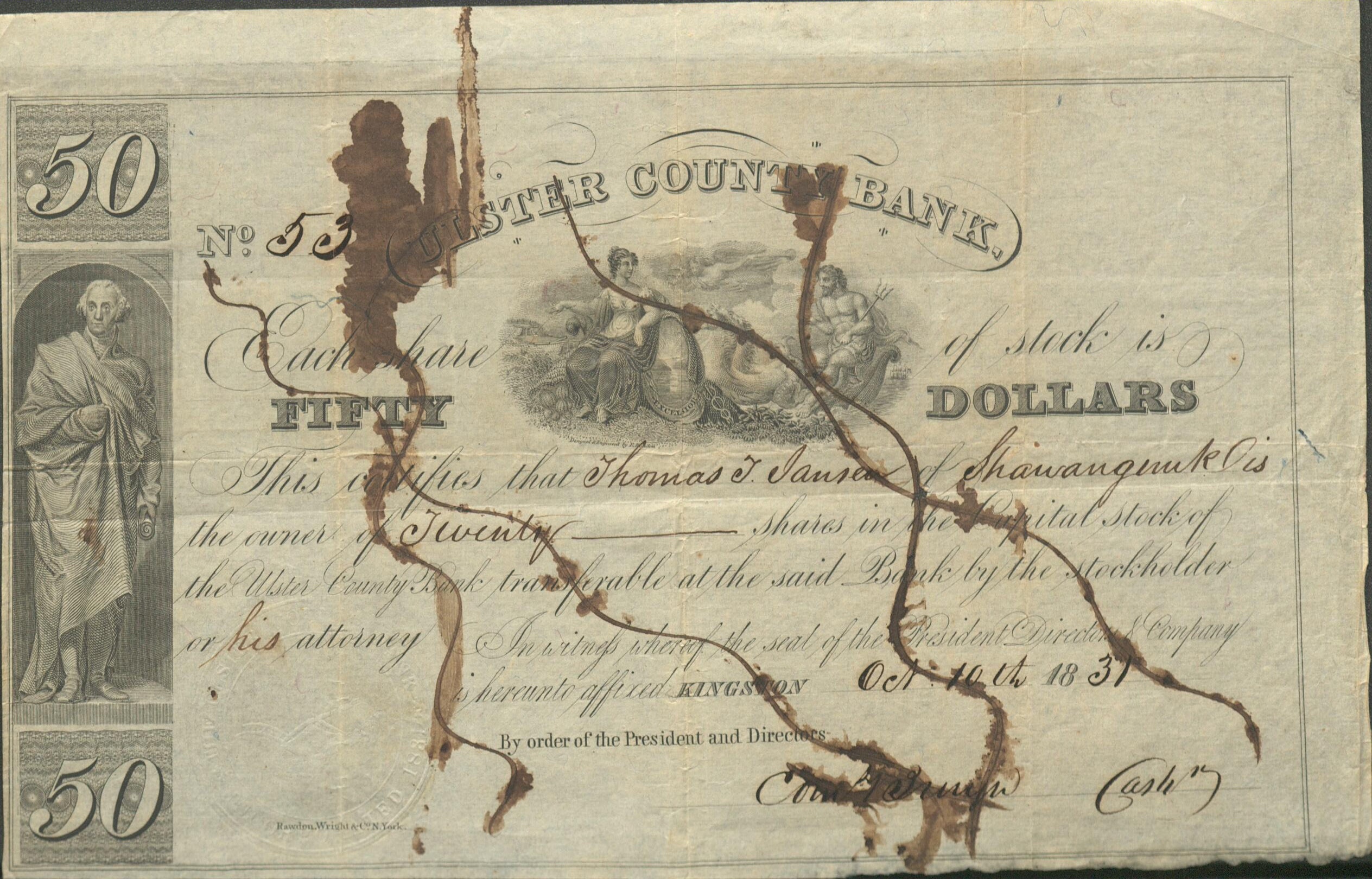
They are dated and numbered:
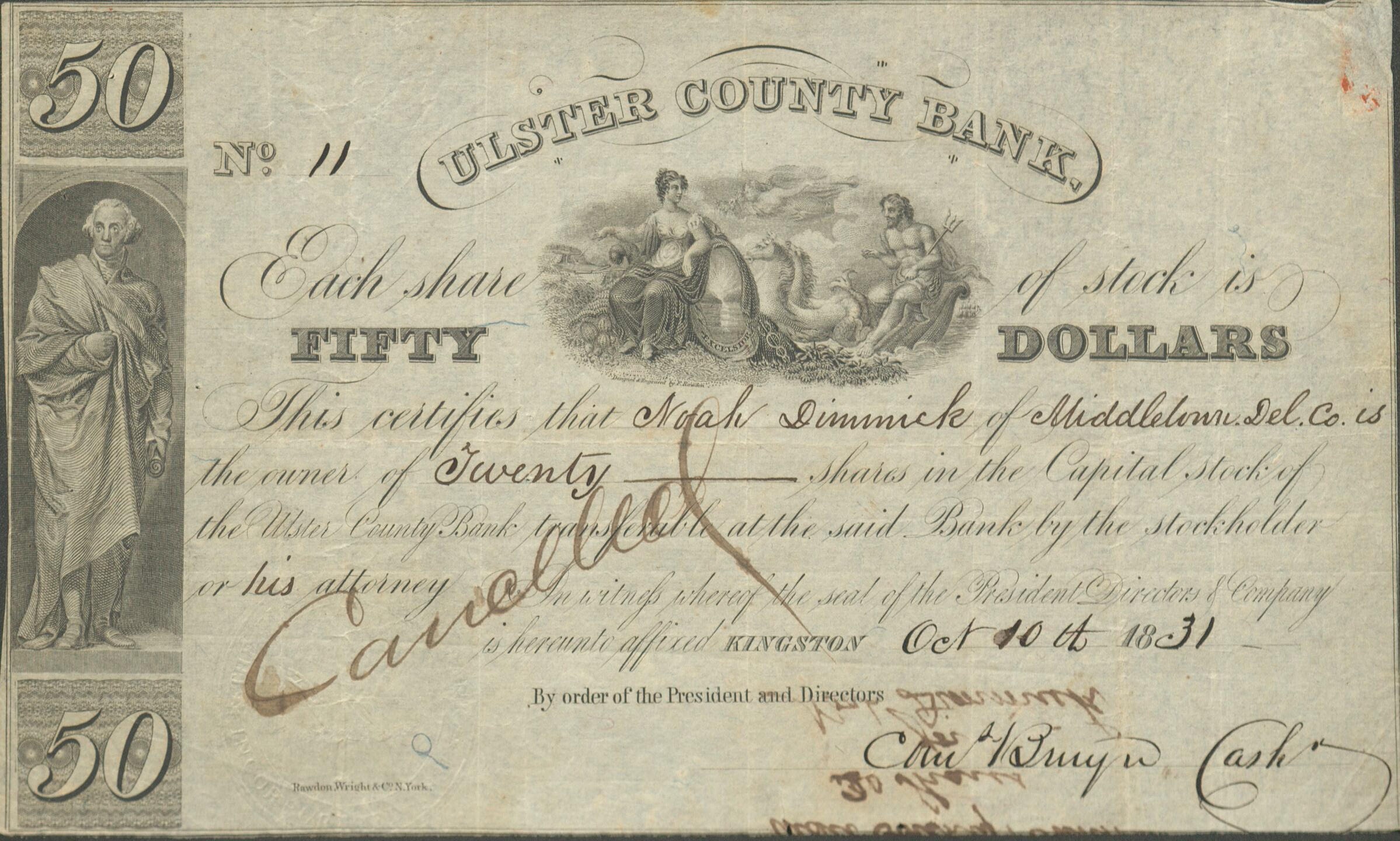
| 11 | Noah Dimmick of Middletown, Del. Co. | 20 | C… H. Bruyn, Cashier | October 10th, 1831 |
|
|
||||
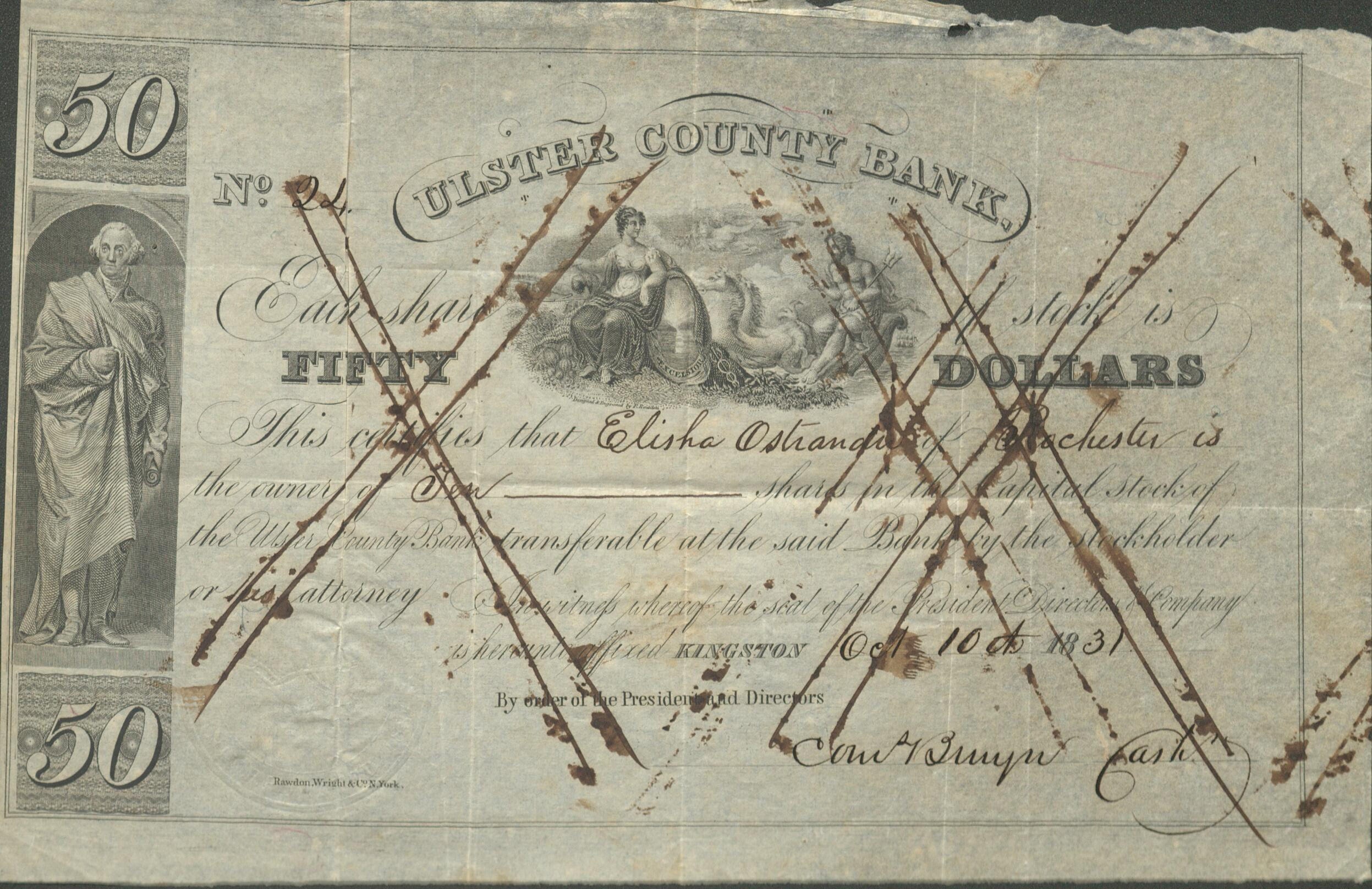
| 24 | Elisha Ostrander | 10 | C… H. Bruyn | October 10th, 1831 |
|
|
||||
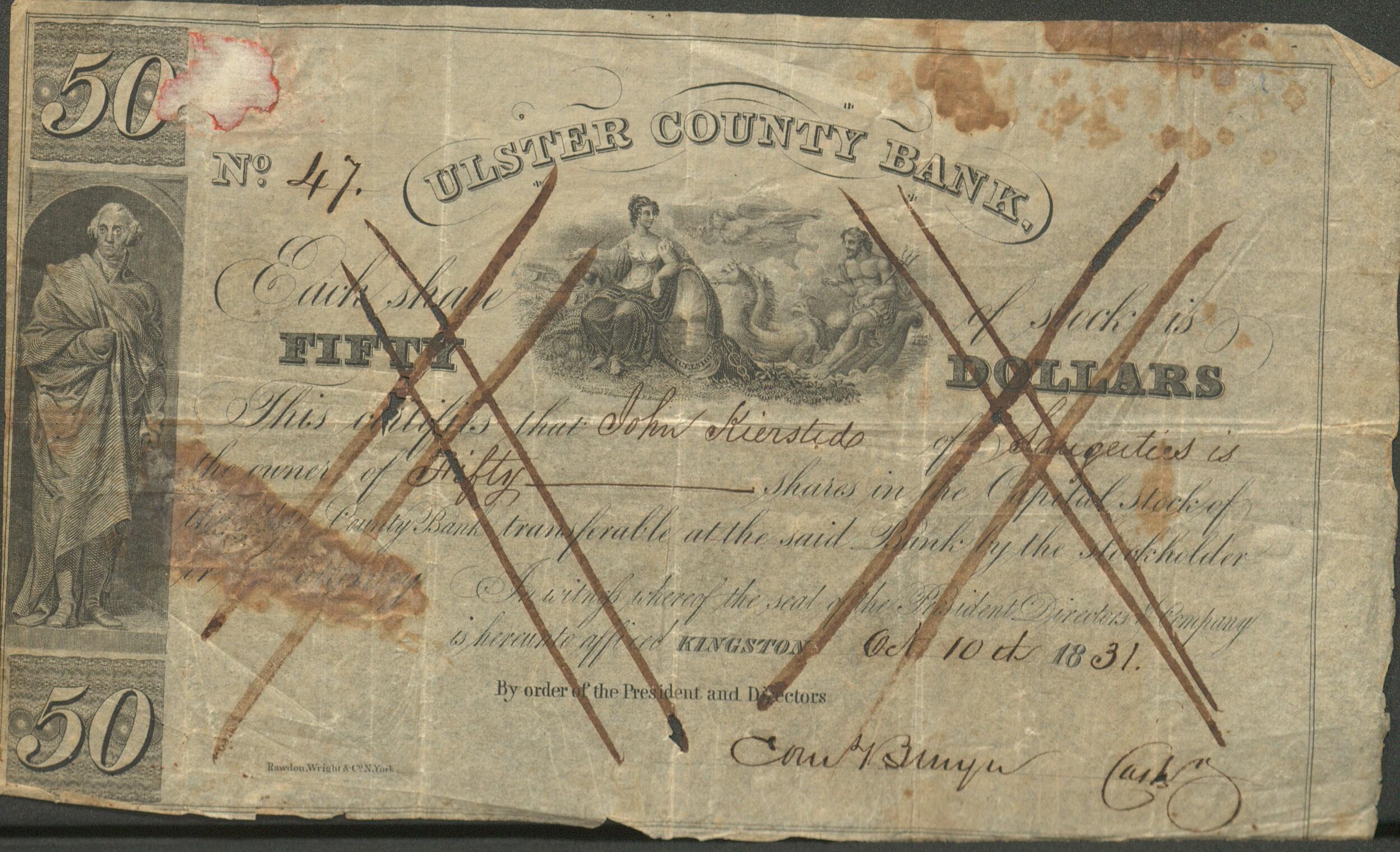
| 47 | John Kierstids | 50 | C… H. Bruyn, Cashier | October 10th, 1831 |
|
53 |
Thomas J. Jansen of Shawangunk | 20 | Cornilius Bruyn | Octoberr 10th, 1831 |
|
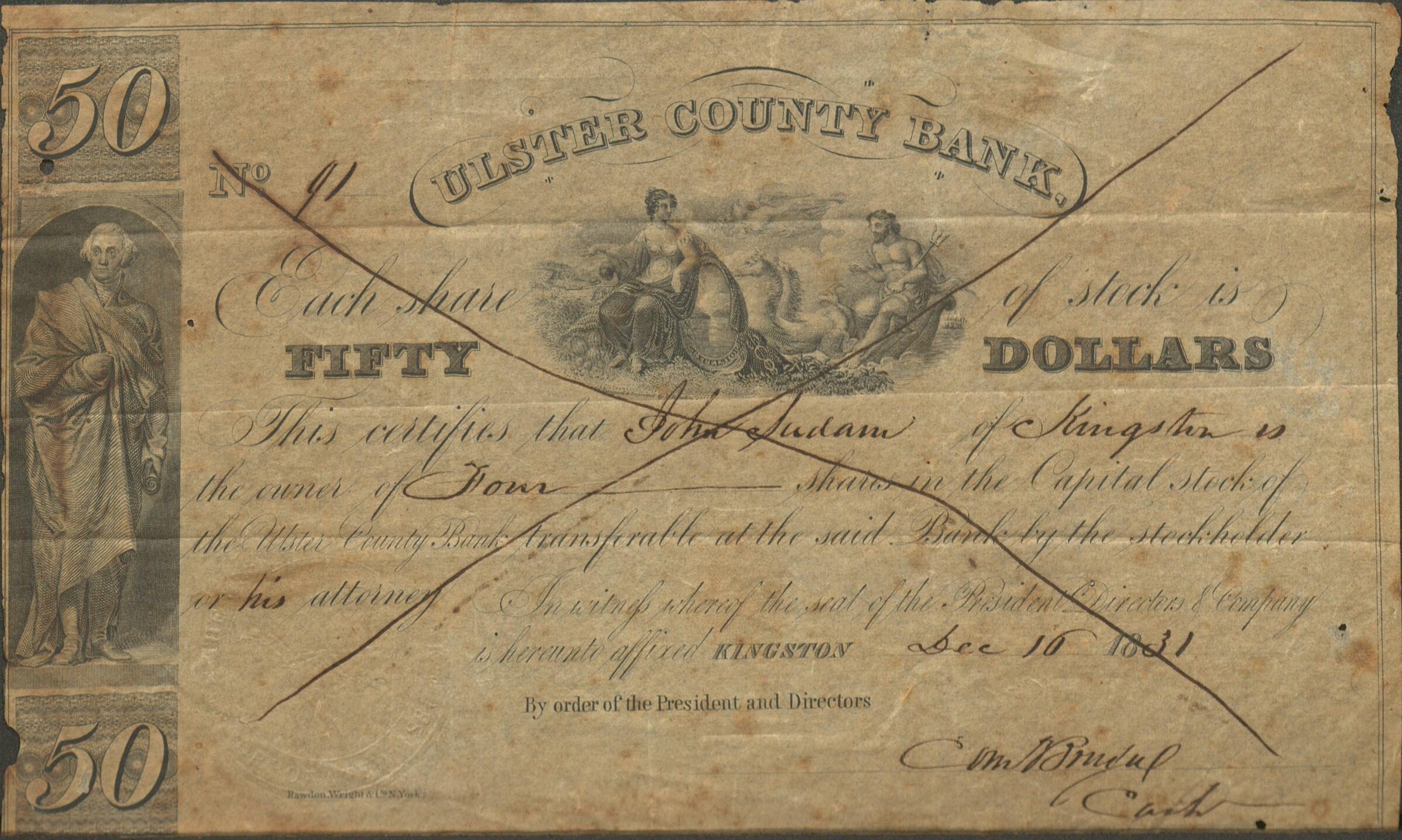
91 |
John Sudam | 4 | Cornilius Bruyn | December 10, 1831 |
| 103 | Francis Northrup | 15 | C. Romyn, Cashier | October 2nd, 1837 |
|
110 |
Joseph Hasbrouck, Jr | 20 | Cornilius Bruyn | November 20th, 1833 |
|
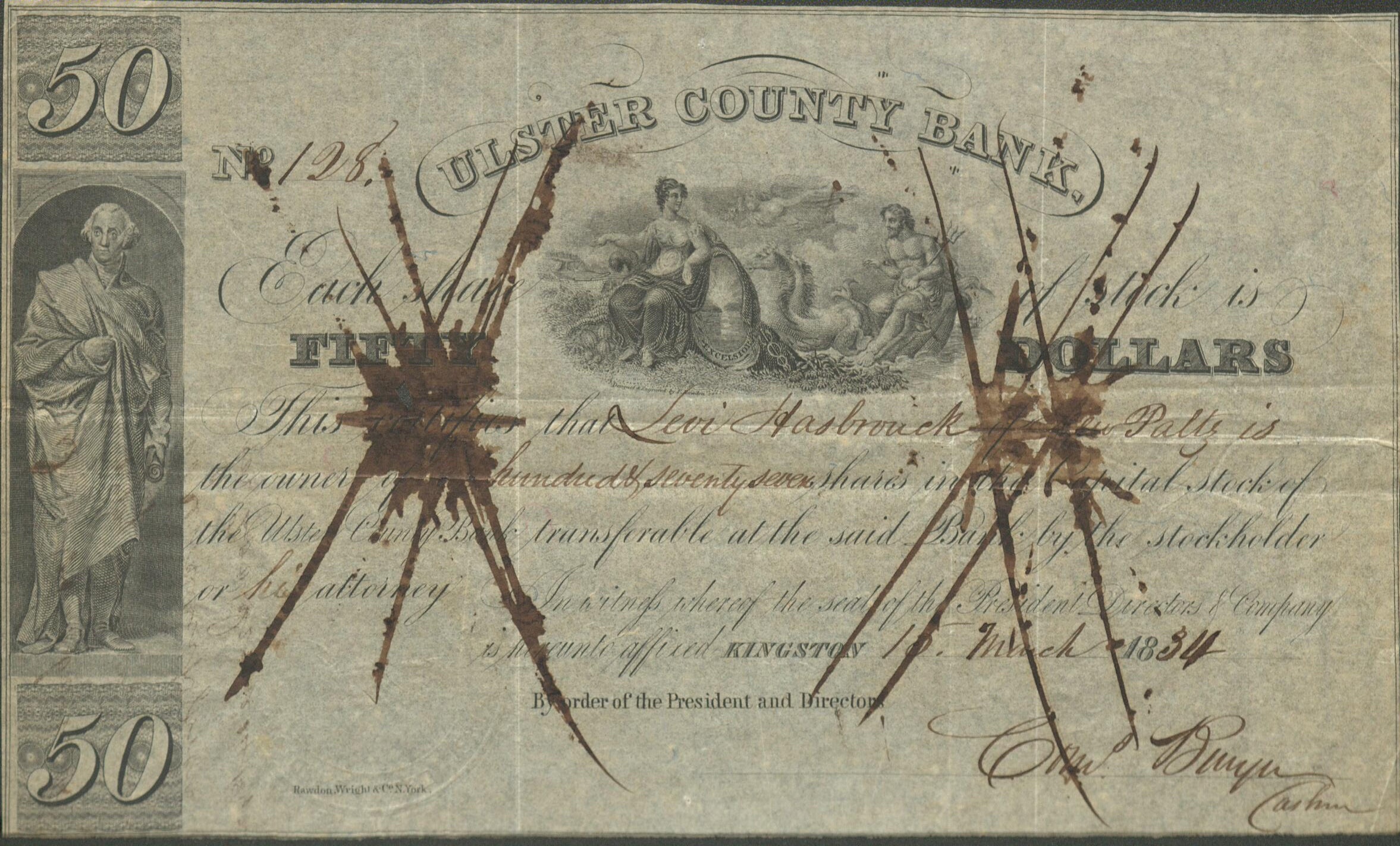
128 |
Levi Hasbrouck of New Paltz | 177 | Cornilius Bruyn | March 15, 1834 |
|
139 |
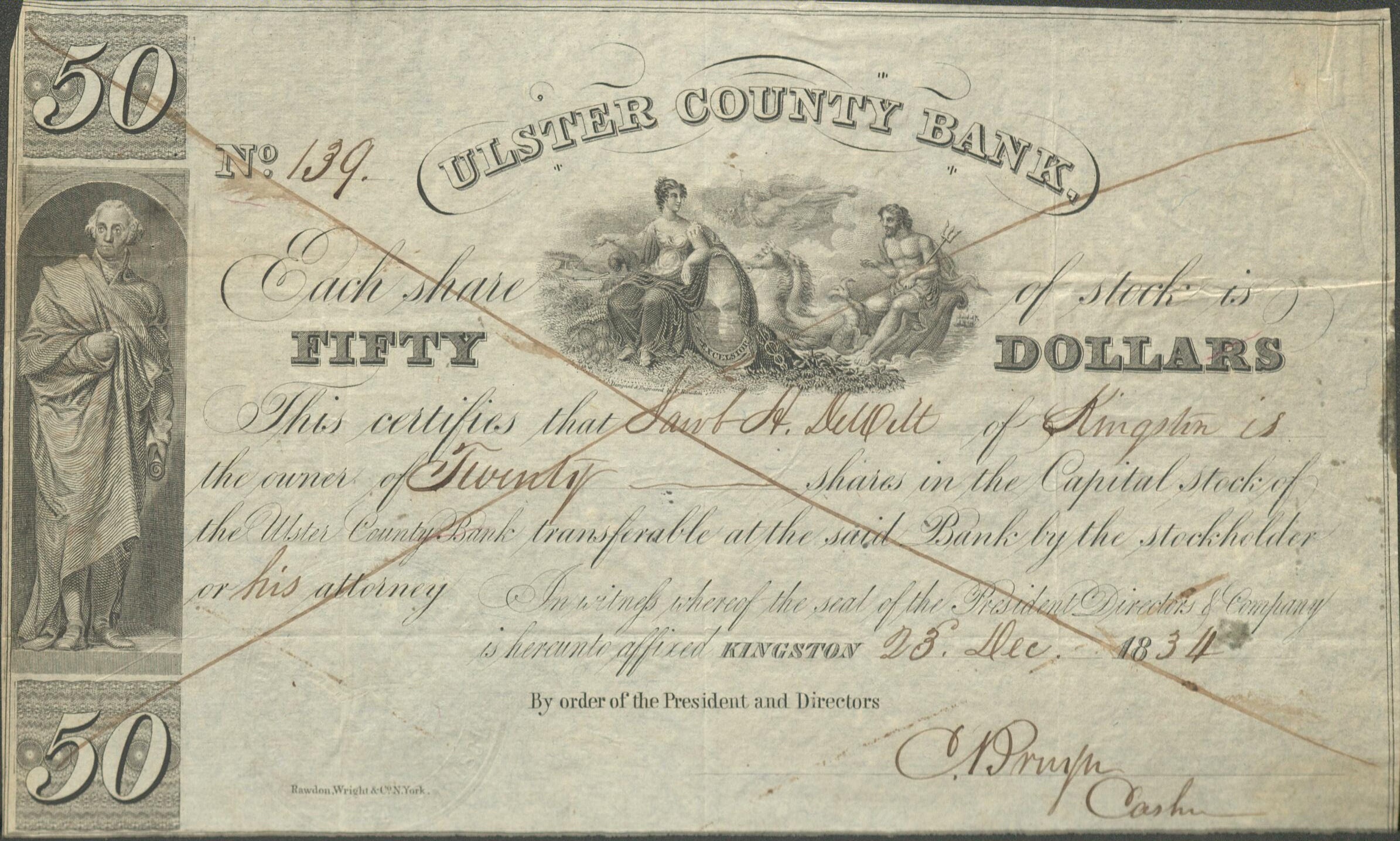
Jacob H. Dewitt | 20 | C. Romyn, Cashier | 23 December, 1834 |
|
151 |
Jacob H. Dewitt | 10 | C. Romyn, Cashier | 20th May 1838 |
|
153 |
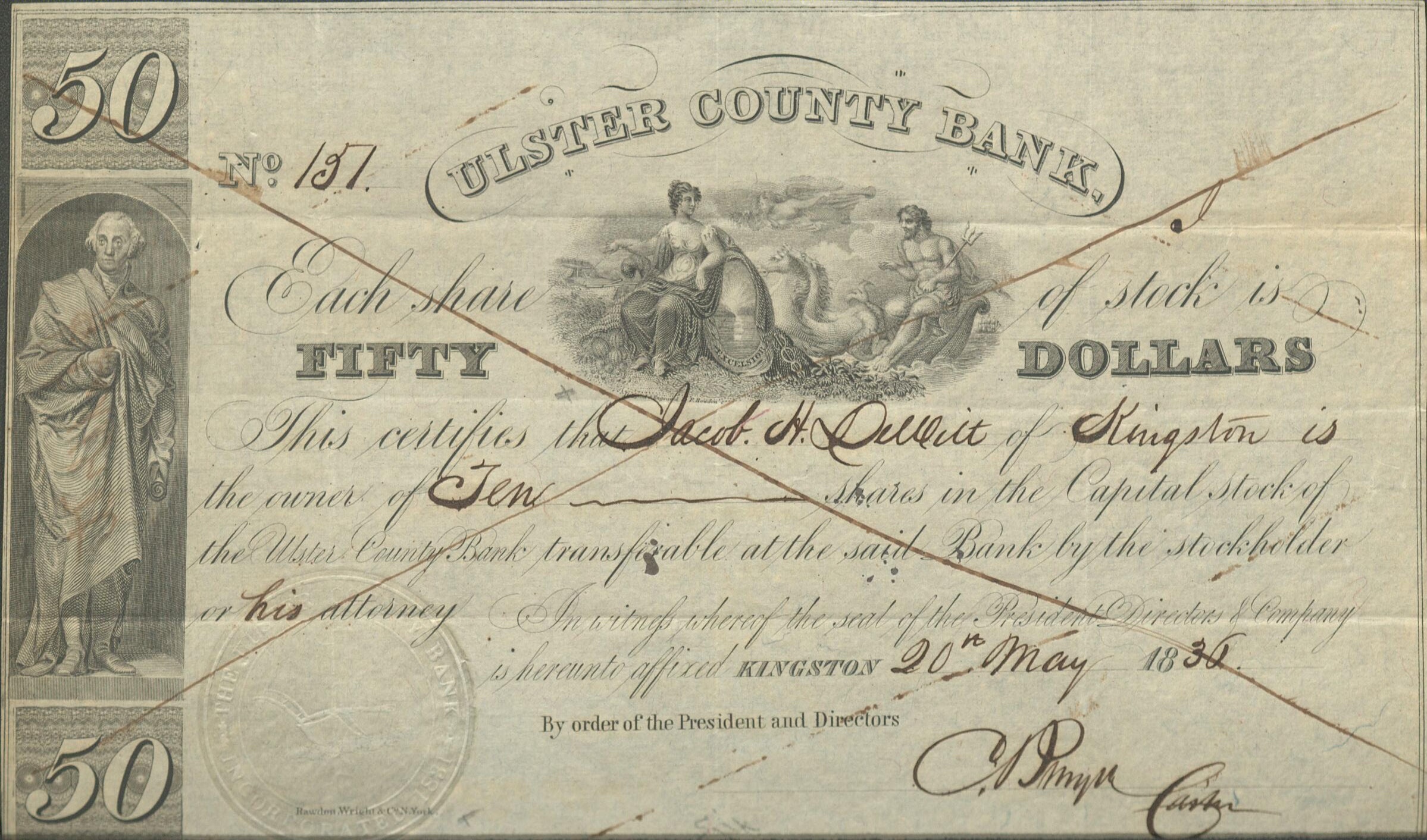
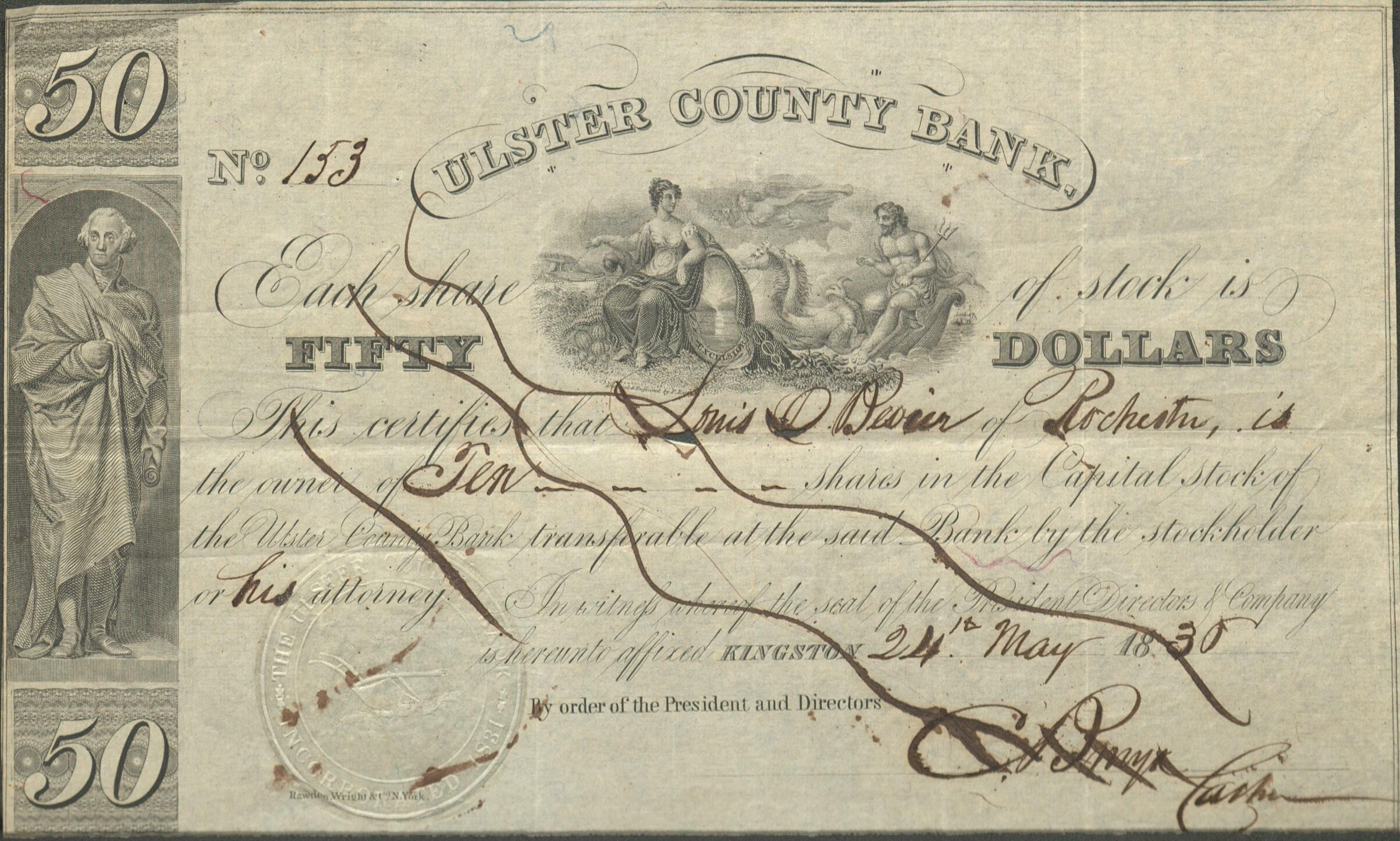
Louis D. Bevier of Rochester | 10 | C. Romyn, Cashier | 24 May !838 |
|
173 |
Soloman Shears of Hurley, Ulster Co. | 15 | Jas. S. Evans | February 27th, 1841 |
|
184 |
Jon D. Oshrander of Kingston, N.Y. | 22 | Jas. S. Evans | May 4th, 1842 |
| 192 | George W. Stanlon, President of the Selang Exchange Bank | 27 | Jas. S. Evans | December 5th, 1843 |
|
199 |
Cornelius Bruyn of Kingston | 10 | Jas. S. Evans | March 7, 1844 |
|
224 |
Abraham Elmandorf of Hurley, Ulster co. | 10 | Jas. S. Evans | June 20, 1849 |
|
231 |
Augustus A. Romyn of Kingston | 10 | Jas. S. Evans | June 4, 1851 |
|
273 |
Cornelius Bruyn of Kingston, N.Y. | 5 | C.D. Bruyn, Cashier | May 25th, 1858 |
|
278 |
Cornelius Bruyn of Kingston, N.Y. | 20 | C. D. Bruyn, Cashier | 28th July, 1858 |
|
281 |
Sarah B. Dewitt, Administratrix of Kingston | 60 | C. D. Bruyn, Cashier | June 5th, 1860 |
As to who are these people who purchased stock in Ulster County's first bank, there are brief descriptions about them. You'll note there are several held by the DeWitt family of Kingston. One of their grandsons, Dr. Virgil Bruyn DeWitt was our family doctor in New Paltz between 1951 until his death. He was considered part of our family. He saved my life in 1955 when an artery was severed and only minutes separated life and death.
No.11. Noah Dimmick was a prominent businessman, and one of the bank’s original investors.
No. 24. Elisha Ostrander. A connected politician who became an investor in coal and cement.
No. 47. John Kierstids. A prominent Saugerties industrialist.
No. 53. Cornelius Bruyn. Initially, he was the bank’s cashier. From 1840 to 1873, he was their president.
No. 91. John Sudam. The State Senator from Kingston at the time the bank was formed.
No. 103. Francis Northrup. A merchant who accepted the bank’s notes in his store in the Kingston - Marbletown area.
No. 110. Joseph Hasbrouck, Jr. He was involved in the Tuthilltown Grist Mill in Gardiner during the financial crisis of 1833.
No. 128. Levi Hasbrouck of New Paltz. The Lord of Locust Lawn, an early estate along the Wallkill River.
No.139. Jacob H. DeWitt. He was a Congressman 1819-1821 (the 16th United States Congress) and a veteran of the War of 1812. He would also become the Ulster County Clerk and a member of the State Assembly.
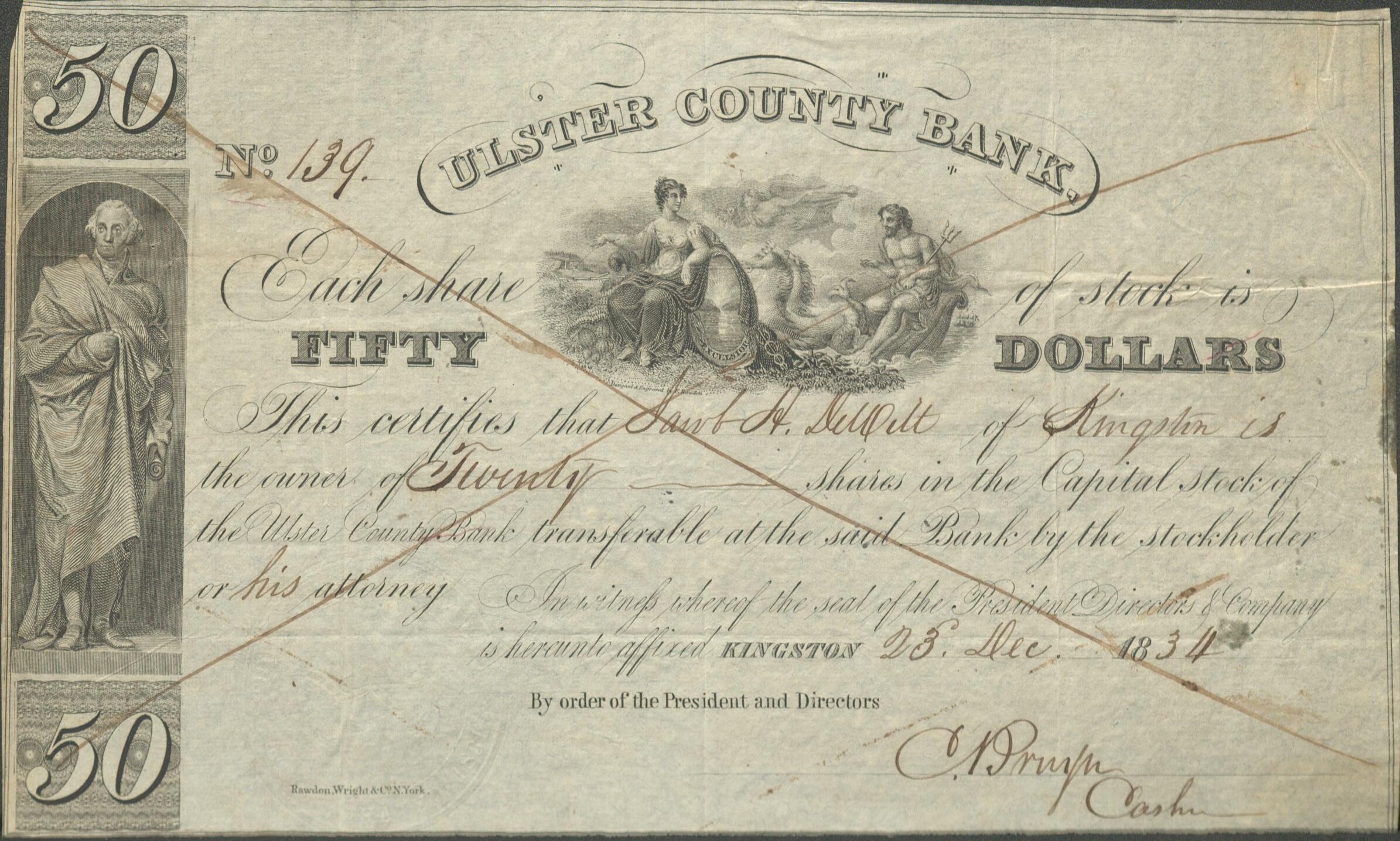
No. 151. Jacob H. DeWitt. He made an additional investment in the bank on May 20, 1838, after the Panic of 1838. In effect, it was a public statement of support after the national panic.
No. 153. Louis. Bevier of Rochester. A surveyor and scholar, highly educated at the Kingston Academy. He was also a captain in the War of 1812. His investment in the bank was symbolic.
No. 173. Solomon Shears of Hurley. He was a prosperous merchant-farmer.
No. 184. Jon D. Ostrander of Kingston. He was the Surrogate of Ulster County for many years. His investment in the bank was a sign of confidence in the bank and the local economy.
No. 192. George W. Stanton. A member of the Albany financial elite and was a director of many institutions.
No. 199. Cornelius Bruyn of Kingston. He was the President of the bank. With his purchase of bank stock, he also became a bank owner.
No. 224. Abraham Elmendorf of Hurley. A successful merchant.
No. 231. Augustus A. Romyn. He was an investor in both the Ulster County Bank and its successor institution, the Ulster County Savings Institution.
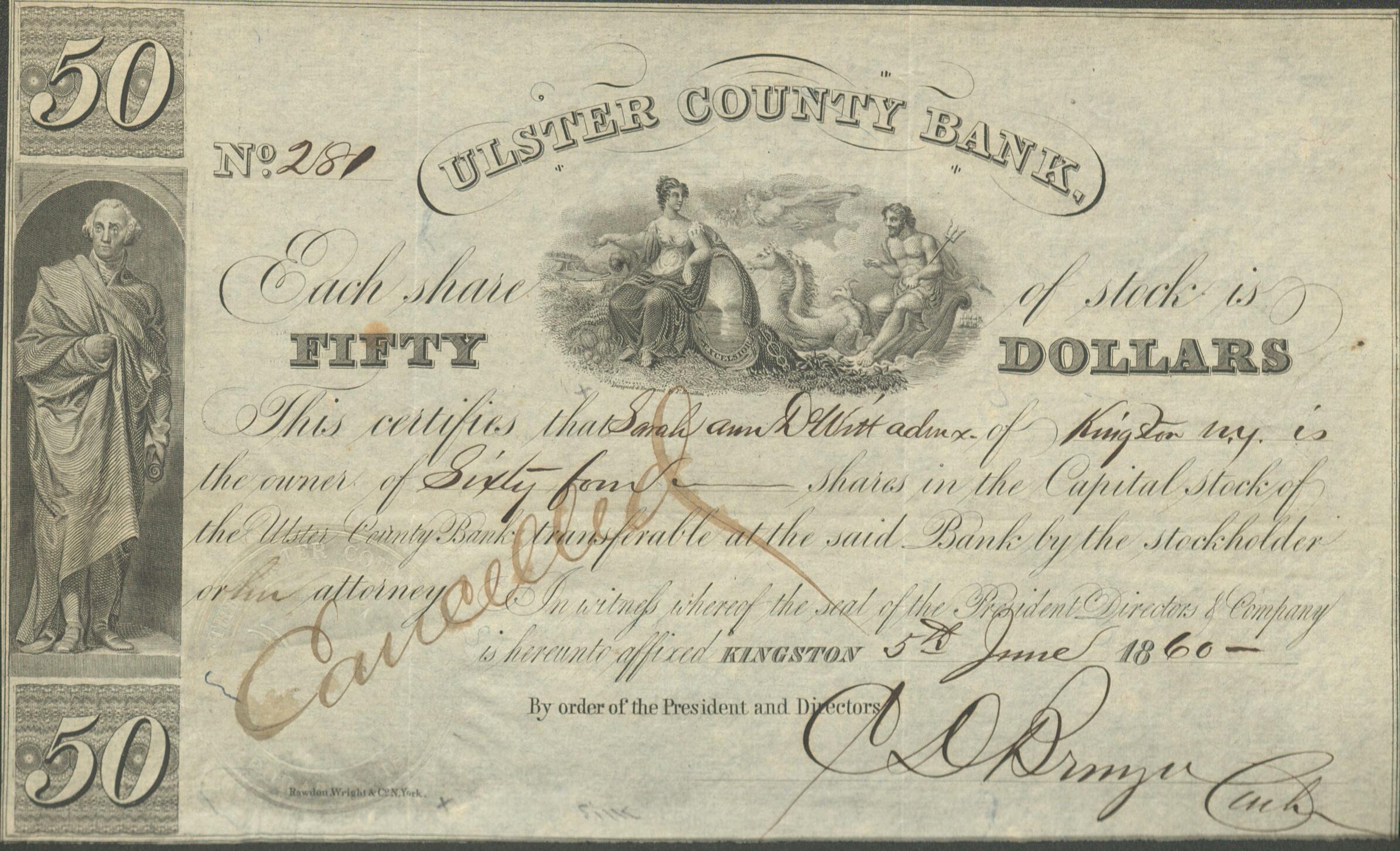
No. 273. Cornelius Bruyn. He was the President of the bank at its peak. Both the D & H Canal and Rosendale Cement were relying on the Ulster County Bank.
No. 281. Sarah B. Dewitt, Administratrix. She was Jacob H. DeWitt’s widow and was managing his estate.
With ephemeral material you never know where it will lead. In this case it brought me home.