
Rare Book Monthly

Articles - March - 2026 Issue

Coffee and Wheat - Some Consume, Others Collect

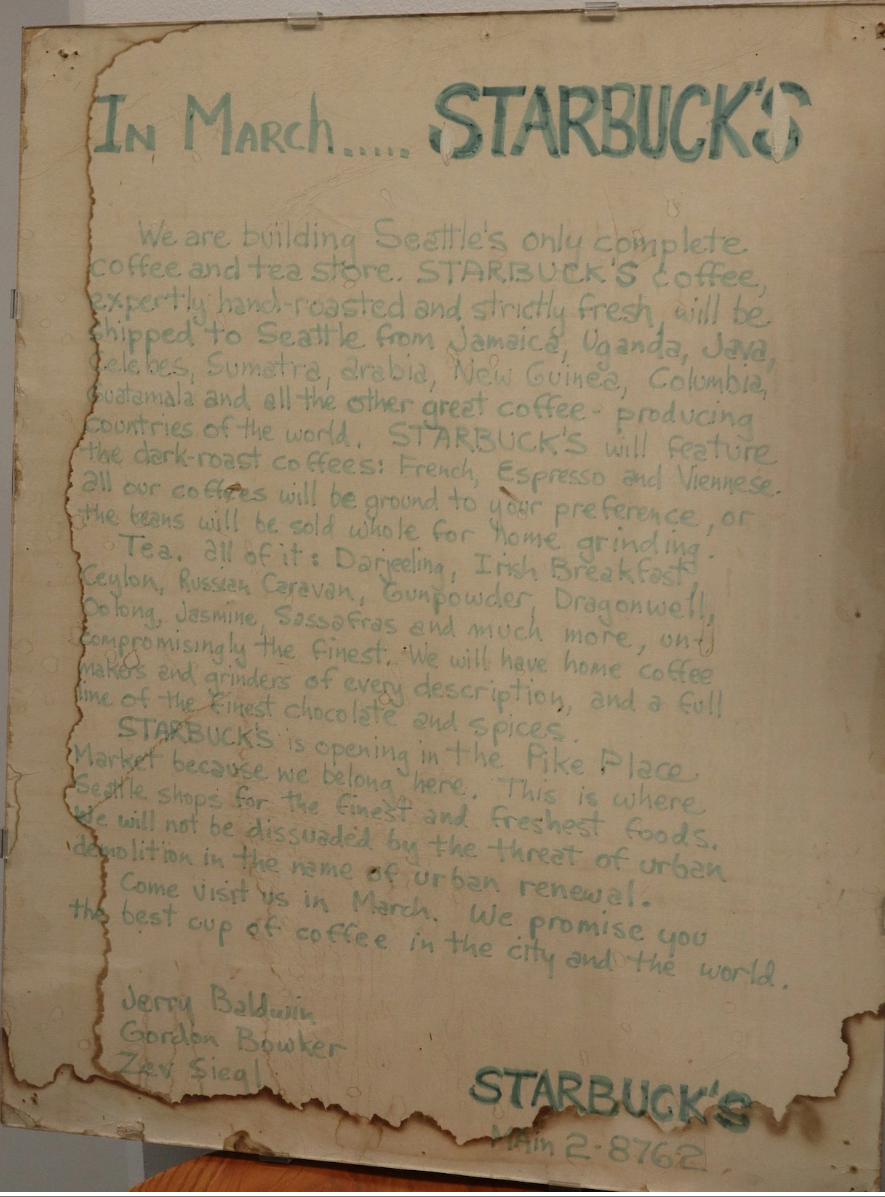
The original Starbucks Manifesto (UC Davis photo).

The original Starbucks Manifesto (UC Davis photo).

What is the first thing you do in the morning? For many of us, before going to work, recreation, or developing our book collection, it's to have a cup of coffee. However, it's unlikely you think much about it. You don't have a coffee-related collection and probably didn't know such a thing exists. It does, and it's not just someone's private collection. The University of California at Davis has a Coffee Center in its College of Engineering. It offers both undergraduate and graduate level courses. You can conduct experiments and learn all sorts of things about coffee. The Coffee Center describes itself as “the first academic research and teaching facility in the United States dedicated entirely to the study of coffee.”


Naturally, the UC Davis library has a coffee collection. Recently, they received three private coffee collections as gifts. One came from Gerald “Jerry” Baldwin, a co-founder of Starbucks and former President of Peet's Coffee. It includes material from the coffee seller's origins, including a manifesto displayed outside the original Starbucks, its first guest book signed by many of the founders, their family and friends, early financial records, early scrapbooks and photographs, and tasting score sheets. Other items show how Starbucks' three founders' quest for a great cup of coffee helped to shape the specialty coffee movement. Baldwin said, “My hope is people who are interested can turn to these documents as a reference and understand what it was truly like at the beginning.”


A second collection came from Russ Kramer, President of coffee importer Hacienda La Minita and veteran of Green Mountain Coffee. He worked with companies such as Dunkin' Donuts, McDonald's, Panera Bread and Safeway to develop coffee programs. His collection contains material covering sourcing, international trade, agricultural, economic and cultural dimensions of coffee and the trade. It includes Le bon usage du thé, du caffé, et du chocolat pour la preservation & pour la guerison des maladies, a 1687 French book about the curative powers of coffee, tea and chocolate.


The final collection comes from the Specialty Coffee Association, a group that brought professionalism and standards to the specialty coffee trade. It includes over a hundred boxes of documents, publications, and foundational texts that display the evolving standards in the then developing field. Bill Ristenpart, Director of the UC Davis Coffee Center said, “Coffee is one of the most widely consumed beverages in the world, yet there is still so much to learn about it. Having these collections available at the UC Davis Library will allow us, as researchers, to connect cutting-edge research with the people, practices and ideas that shaped the modern coffee landscape.” I'll drink to that.


I don't know whether Kansans drink a lot of coffee, but they do grow a lot of wheat. Also known as the “Wheat State,” it is the highest wheat producing state in the U.S., and considering how much wheat is grown in the Midwest, that is quite an accomplishment. It's no wonder Kansans would be interested in what are known as “wheat recipe books.” These, naturally, promote recipes using wheat. Eating more bread, pasta, and “the breakfast of champions,” Wheaties, keeps Kansas' farmers happy, and when they are happy, all (almost) of Kansas is happy.
 

Eager to encourage wheat consumption, the Kansas Wheat Commission began producing wheat recipe books in 1966. They have been doing them annually ever since. The main creator is Cindy Falk, who took over the responsibility in 1988 and has been producing them ever since. She promoted national circulation of the booklets and included information about nutrition and evolution of consumer taste, baking practices, and nutrition science.


Recently, the Kansas Wheat Commission decided to give their entire collection of wheat recipe books to Kansas State University. They wanted to preserve the history of the books, make them available to researchers, and keep a record of how information about wheat was shared over the decades. They are now housed in the Morse Department of Archives and Special Collections in the Hale Library at Kansas State University.


It is possible to collect anything that interests you, not just expensive classic books. You can collect whatever suits your tastes, and in these cases, quite literally.
Rare Book Monthly

  • Sotheby's Book Week
    2 June - 9 July
    Sotheby’s, June 25: Smith, Adam. The Wealth of Nations, on its 250th anniversary. $180,000 to $250,000.
    Sotheby’s, June 17: Fontana, Lucio. Concetto Spaziale. 1967. Leporello en papier doré. Bel exemplaire signé. €4,000 to $€,000.
    Sotheby’s, June 25: Fitzgerald, F. Scott. "So we beat on, boats against the current, borne back ceaselessly into the past”. $150,000 to $200,000.
    Sotheby’s, June 25: Washington, George (as First President). Washington decries “an ostentatious imitation, or mimickry of Royalty” in his Presidency. $250,000 to $500,000.
    Sotheby’s, June 17: Lope de Vega. Rare manuscrit autographe signé de la préface dédicatoire de "El Cardenal de Belen" (le cardinal de Bethléem), pièce composée en 1610. €40,000 to €60,000.
  • Leland Little, June 12: The First Illustrated Edition of Mary Shelley's Frankenstein.
    Leland Little, June 12: John Morton, Signer of the Declaration of Independence, Signed Pennsylvania Land Survey.
    Leland Little, June 12: The Scarce Jansson Edition of a Remarkable Early View of London.
    Leland Little, June 12: Signed Limited Edition of The Works of Sir Arthur Conan Doyle.
    Leland Little, June 12: Faden’s Important and Scarce Map of the Southern Campaign of the American Revolution.
    Leland Little, June 12: William J. Tate (NC, 1869-1953), Archive of the "Original host to the Wright brothers at Kitty Hawk.”
  • Aste Bolaffi, June 17-18: Galileo Galilei. Dialogo sopra i due massimi sistemi del mondo tolemaico, e copernicano. Firenze, 1632
    Aste Bolaffi, June 17-18: Saverio Manetti. Storia naturale degli uccelli. Firenze, 1771-76
    Aste Bolaffi, June 17-18: Fortunato Depero. Depero futurista. Rovereto, 1927
    Aste Bolaffi, June 17-18: Nicolas Visscher. Atlas minor sive totius orbis terrarum contracta delineat ex conatibus. Amsterdam, circa 1649-95
    Aste Bolaffi, June 17-18: Andreas Vesalius. Anatomia. Addita nunc. Antiquorum Anatome. Venezia, 1604
    Aste Bolaffi, June 17-18: Tristan Tzara and Salvador Dalì. Grains et Issues. Parigi, 1935
  • June 25, 2026
    Doyle, June 25: Houdini's biography, boldly signed. $3,000 to $5,000.
    Doyle, June 25: A volume from Abraham Lincoln's library, signed just before heading to Washington for his inauguration. $20,000 to $30,000.
    Doyle, June 25: A very early Confederate recruiting manual belonging to the chief commissary in Lee's Army. $600 to $800.
    Doyle, June 25: Rare hand-colored lithographs of the life of Napoleon. $20,000 to $30,000.
    Doyle, June 25: The "Holster Atlas" of the American Revolution. $5,000 to $8,000.
    Doyle, June 25: Jewish ceremonies in fine hand-colored engravings. $7,000 to $10,000.
    Doyle, June 25: A very rare work on Turkish military costume. $1,000 to $1,500.
    June 25, 2026
    Doyle, June 25: The most important illustrated work on the Mexican-American War. $10,000 to $15,000.
    Doyle, June 25: The finest illustrated book on Afghanistan. $10,000 to $15,000.
    Doyle, June 25: Henry Justice Ford St. George rescues the Princess from the horrible Dragon. $2,000 to $3,000.
    Doyle, June 25: A rare work of Prussian Army uniforms under Frederick William II, with exquisite hand-colored engravings. $800 to $1,200.
    Doyle, June 25: Lenny Bruce typed letter signed to a Village bohemian during his obscenity trials, with a manuscript note and drawing. $300 to $500.
    Doyle, June 25: Schiff's scarce Shanghai Sketchbook. $300 to $500.
    Doyle, June 25: The first accurate published representation of the American flag. $2,000 to $4,000.
  • Old World Auctions (June 17): Lot 123. Celebrate 250 Years of Independence with Original Stars and Stripes (1790) Est. $1,400 - $1,700
    Old World Auctions (June 17): Lot 20. Keulen's Spectacular Chart of the World Featuring California as an Island (1728) Est. $12,000 - $15,000
    Old World Auctions (June 17): Lot 42. Schedel's Ancient World Map with Fantastic Humanoid Creatures (1493) Est. $14,000 - $17,000
    Old World Auctions (June 17): Lot 591. Matching Set of 3 Stunning Globe Gores of Eastern Asia from Coronelli's 3.5 Foot Globe (1688) Est. $5,500 - $7,000
    Old World Auctions (June 17): Lot 9. Speed's Popular World Map with Allegorical Representations of the Elements (1651) Est. $14,000 - $17,000
    Old World Auctions (June 17): Lot 168. First Separate Map of Kansas & Nebraska Territories (1854) Est. $5,500 - $7,000
    Old World Auctions (June 17): Lot 43. Only Macrobius Map with Britain Attached to Europe (1515) Est. $800 - $950
    Old World Auctions (June 17): Lot 250. Rare Map of Boston and One of the Earliest Maps of the Revolutionary War (1775) Est. $2,000 - $2,300
    Old World Auctions (June 17): Lot 79. Schenk's Uncommon Map Featuring Two Figurative Title Cartouches (1696) Est. $1,200 - $1,500
    Old World Auctions (June 17): Lot 681. Hand-Colored Image of the Annunciation to the Shepherds (1502) Est. $800 - $950

Article Search

Archived Articles