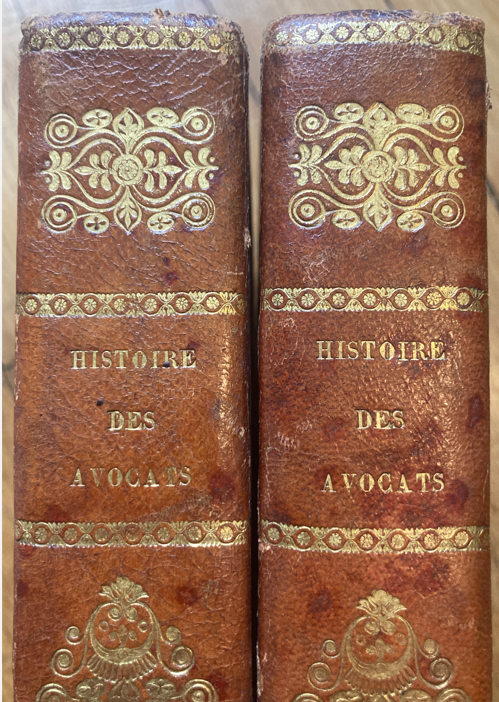
Silence in the court! All rise for a rare, peculiar and underrated book: Histoire des avocats au Parlement et du Barreau de Paris (Maradan, 1813). It goes back to the roots of the French legal system. And believe it or not, it’s fascinating!
Worthy to be remembered by the French
None but an attorney could write a history of the attorneys—Jean-François Fournel (1745-1820) was indeed called to the bar in Paris in 1771, where he remained until 1789. But “he was more of a scholar,” the CTHS* website underlines. As a matter of fact this 2 in-8° volume set is clearly the fruit of thousands of hours of research. “It covers the period going from Saint Louis, in 1250, to 1790,” Fournel writes in the preface. Although the profession more or less existed before that, “it’s only under Saint Louis’ reign that the order of the attorneys illustrated itself in a way that’s is worthy to be told and remembered by the French.” Their history, he adds, is to be considered collectively, as they’ve always being close to the Parliament, hence to the circle of power.
Swords and Words
King Saint Louis (1214-1270) is remembered for his crusades but also for “settling legal disputes under an oak tree in the forest of Vincennes, near Paris”—this fact is acknowledged by his biographer Sir de Joinville, but this legal dimension also derives from a crucial episode of his reign. “At one time, the Pope decreed that, being the vicar of Christ on Earth, he was therefore the only legitimate sovereign of all kingdoms and empires of the Earth,” Fournel writes, “and that all the kings were but his disposable vassals.” The matter was of importance. A genuinely pious king, Saint Louis had to stand against the Pope while trying not to be excommunicated. Swords were powerless in this matter. “It was a battle of opinion,” Fournel confirms. “The King’s council felt cornered until it resorted to call upon a particular set of men, the attorneys.” They came out with such an authoritative refutation of the Pope’s claims that “the Court Rome felt alarmed, suspended its attacks and forgot about France for a while.” Saint Louis couldn’t be more satisfied, and “from that day on, he offered his protection to such a valuable profession.” The foundation of the modern legal system had just been laid, and the rest is history—a history thoroughly explored in this book, filled with historical revolutions, portraits of incredible men of law and the evolution of the legal system. A must-read, indeed—and not only for attorneys.
I got my copy many years ago and I’ve never come across another one since. As a matter of fact, the Rare Book Transaction History only lists one occurrence of its being sold at auction—it was in 2020, in France, by Tessier & Sarrou. There’s no copy for sale on AbeBooks, or anywhere else on the Internet for the time being. It was published by Maradan, known for the first French translation of Matthew G. Lewis’ The Monk (1797) and many other surprising little books. This one was printed at Didot L’Aîné’s printing house—quality work. I thought that being rare and fascinating, it should be quite expensive. It happens that the copy listed above went for €114.00 only. I guess this book is underrated. Actually, all Fournel’s works are very hard to find. Indeed, he wrote other books with quite striking titles:
- Traité de l’Adultère/Treatise on Adultery (1779)
- Traité de la Séduction/Treatise on Seducing (1781)
- Dictionnaire des Transactions/Dictionary of Transactions (1797)
- Traité du Voisinage/Treatise on Neighbourhood (1800)
- Histoire des Avocats.../The History of Attorneys... (1813à
- Histoire du Barreau de Paris dans le cours de la Révolution/The History of the Bar of Paris during the Revolution (1816)
- Les Lois rurales de la France.../France Rural Laws (1819).
A dedicated freemason, Fournel had a prestigious career. “When he died,” the CTHS writes, “he was the dean of the bar association.” He left a few books, including this very rare and pretty good history of the attorneys—which doesn’t get the recognition it deserves. At least, he wasn’t denied an attorney as this little article intends but to plead its cause.
Thibault Ehrengardt
- Comité des Travaux Historiques et Scientifiques https://cths.fr/an/savant.php?id=130604