The World is Still Changing: Tradition and Technology in the Rare Book Trade
- by Bruce E. McKinney
Change is our constant
Book fairs have long played an important role in the rare book field. We date the beginning of printing with Gutenberg’s invention of the printing press circa 1450. Less known is the first book fair was the Frankfurt Book Fair in 1462. In 1564 the first book fair catalogue (Messkatalog) provided an organized listing of show material. In America Mathew Carey organized the first Literary Fair in New York in 1802.
With the emergence of literacy, the development of faster presses and pulped paper in the 19th century, collectable paper became a more widely followed field. Auctions and dealers made scale possible. After WWII, ILAB and soon after, the ABAA established standards. Soon after, their book fairs became significant events for both buyers and sellers.
From the early 19th century, auctions provided wholesale functionality for dealers. Late in the 20th century, auctions entered the retail market.
By 2000, the field was already transitioning to rely on aggregated listing sites that made it quickly obvious what was rare and valuable. Agreement as to fair value was left to sellers to post their prices. It encouraged higher prices, that encouraged more sellers to list. Soon it became apparent when the number of equal or better copies posted reached 6, it stalled sales, opening the door wide for auction houses to break the logjam. Overpriced online listings became the ticket to their success. Last year almost 4,000 collectible paper auctions sold more than $1.230 billion dollars of this material (all documented on Rare Book Hub).
Now the field is adjusting to a new reality. eCatalogues (for dealers, collectors and institutions) are starting to function like auction catalogues. If their material is described well, illustrated with images, and priced correctly, the material flies out the door. If inappropriately priced, well, they’ll continue to be available until their eCatalogues disappear. One way or the other the market learns. For Rare Book Hub’s paid subscribers it is a free additional service for them. Think of it as a quasi-auction format. The world is changing.
And how do shows fit in? Book fairs have always enjoyed a traditional book-oriented following. With the surge of interest in ephemera, person to person events is an ideal way to introduce and educate new and casual collectors. For those fresh to the scene, collectible paper is a surprisingly accessible game where their initially limited funds can be converted into many interesting examples. Equally important for dealers, these new client’s interest in ephemera will encourage their futures. The book field has long been a strong magnet for those who love history and paper. Ephemera will soon be the drug of choice.
For new collectors, book fairs that encourage ephemera deserve a much larger audience. For the fresh faces, it’s at the fairs they will see the players, and then go home thinking, I can be one of them. It’s the future of collectible paper.
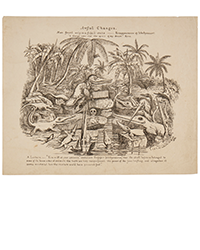
Sotheby’s, July 14: Henry De La Beche. "Awful Changes," 1830. $6,000 to $9,000.
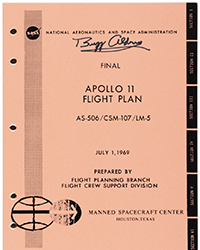
Sotheby’s, July 15: [Apollo 11]. Flight Plan, Complete Original Printing Signed by Buzz Aldrin. $5,000 to $8,000.
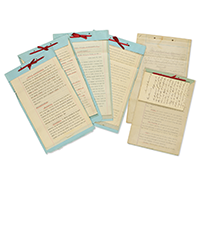
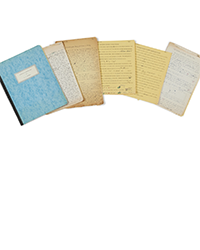
Sotheby’s, July 15: Thomas Alva Edison. Documents Establishing and Ending the Edison Electric Railway Company. $20,000 to $30,000.
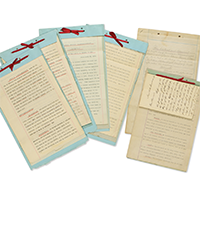
Sotheby’s, July 15: Richard P. Feynman. Feynman's Lectures on Gravitation 1-16, Including the Original Transcriptions of Lectures 12-16 by Morinigo and Wagner, With Richard Feynman's Manuscript Notations, 1971. $12,000 to $18,000.
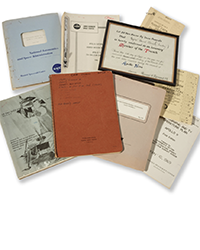
Sotheby’s, July 15: [Apollo 9]. A Group of Manuals and Mission Documents used by Stuart Roosa as a member of the Astronaut Support Crew. $5,000 to $8,000.
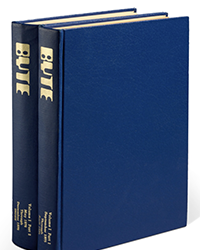
Sotheby’s, July 15: [BYTE: The Small Systems Journal]. A collection of early foundational issues of Byte: The Small Systems Journal, with rare hardcover editions. $5,000 to $8,000.
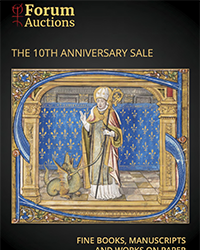
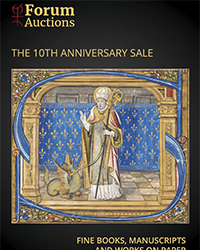
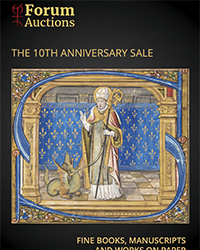
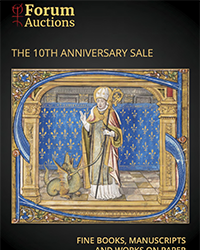
Forum Auctions The 10th Anniversary Sale Fine Books, Manuscripts and Works on Paper July 16, 2026
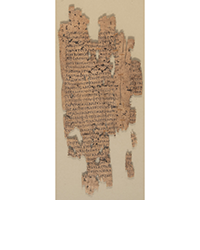
Forum, July 16: Inundation papyrus. P.Michael 4, the ‘Inundation papyrus’, a geographical account of the Nile near Canopus, in Greek, remains of two columns from a manuscript scroll on papyrus, Egypt, second century CE. £12,000-18,000
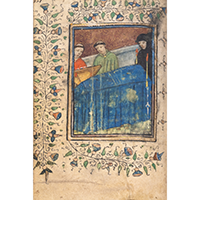
Forum, July 16: Book of Hours, use of Sarum, manuscript on vellum, 6 full-page miniatures, with famous Middle English inscriptions, Southern Netherlands for the English market, [c.1430]. £30,000-50,000
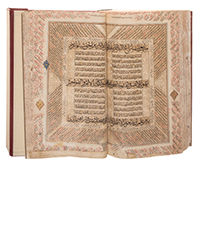
Forum, July 16: Qu'ran, Arabic manuscript on burnished, stencilled, and gold-flecked paper, 447ff., Sultanate Gujarat, Ahmadabad, [after 1411 but no later than 1442]. £15,000-20,000
Forum Auctions The 10th Anniversary Sale Fine Books, Manuscripts and Works on Paper July 16, 2026
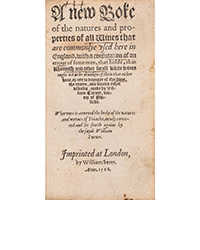
Forum, July 16: Turner (William). A New boke of the natures and properties of all wines that are commonly vsed here in England, rare first edition of the first English book on wine, By William Seres, 1568. £20,000-£30,000
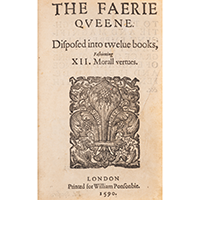
Forum, July 16: Spenser (Edmund). The Faerie Queene. first edition, Printed [by John Wolfe] for William Ponsonbie, 1590. £30,000-40,000
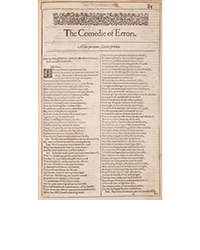
Forum, July 16: Shakespeare (William). The Comedie of Errors, extracted from the first folio, Isaac Jaggard and Edward Blount, 1623. £15,000-20,000
Forum Auctions The 10th Anniversary Sale Fine Books, Manuscripts and Works on Paper July 16, 2026
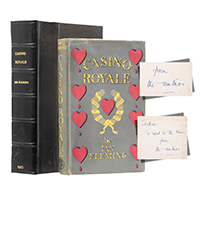
Forum, July 16: Fleming (Ian). Casino Royale, first edition, signed presentation inscription from the author, 1953. £40,000-60,000
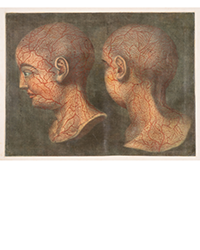
Forum, July 16: d'Agoty (Jacques-Fabien Gautier). Anatomie de la Tête, first edition, Paris, chez le Sieur Gautier, 1748. £10,000-15,000
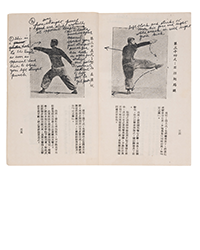
Forum, July 16: Martial Arts.- Lee (Bruce). 'Praying Mantis style' Kung Fu book, containing numerous annotations, diagrams and graphs in Bruce Lee's hand, c. 1960. £50,000-70,000
Forum Auctions The 10th Anniversary Sale Fine Books, Manuscripts and Works on Paper July 16, 2026
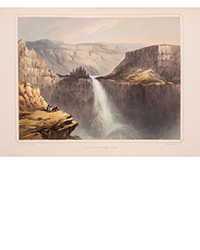
Forum, July 16: Warre (Capt. Henry James). Sketches in North America and the Oregon Territory, first edition, rare hand-coloured issue, 1848. £30,000-40,000
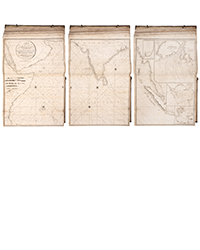
Forum, July 16: Norie (John William). The Marine Atlas, or Seaman's Complete Pilot for all the principal places in the known world..., 1826. £30,000-50,000
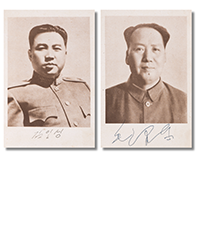
Forum, July 16: Mao Tse-tung.- Kim Il-sung.-[Note book for visitors from China to Korea], signed by Mao and Kim, [Beijing, 1954]. £10,000-15,000