Rare Book Monthly

Articles - February - 2026 Issue

Can “Patriotism” and “History” Co-exist? The Smithsonian Case In Point

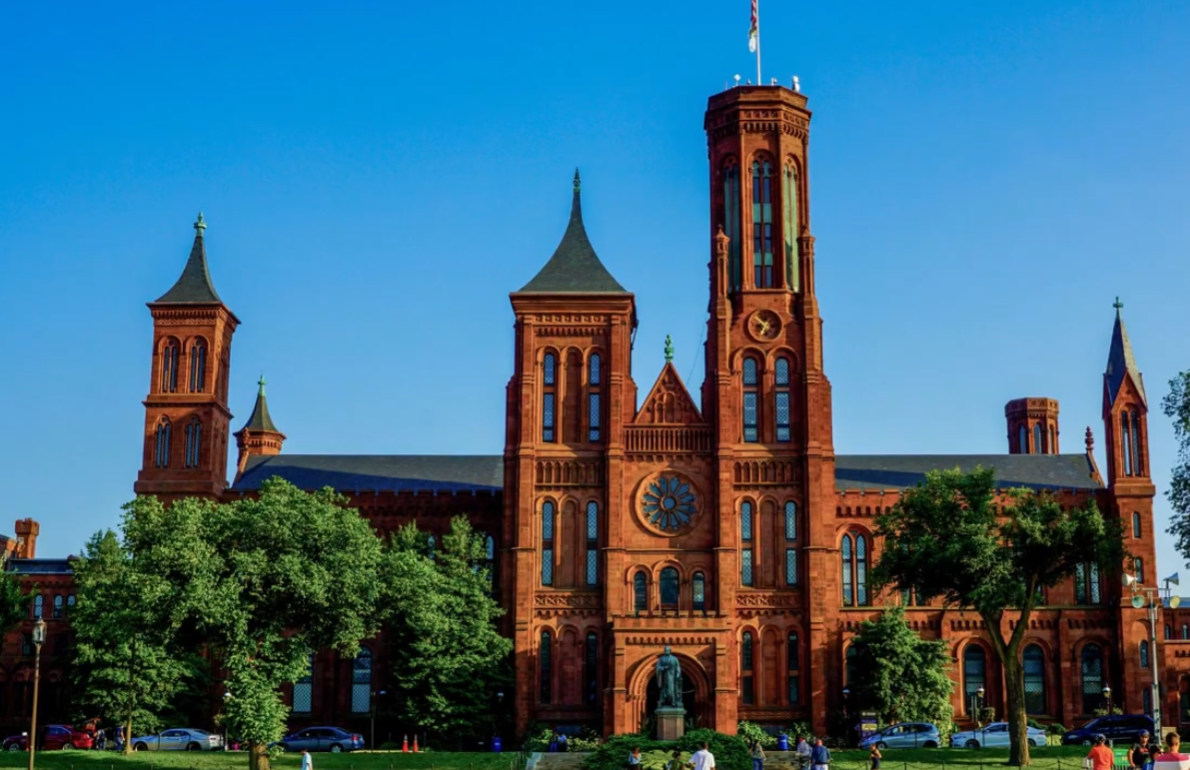
Smithsonian Institution Original Building.

Smithsonian Institution Original Building.

If you’re a history buff or a museum fan or anyone who thinks that the treasures of the past should be preserved and displayed you’ve no doubt read and heard about the current pressure on the Smithsonian. The story goes that the current administration would prefer to gloss over the less flattering episodes of the American past in favor of versions that are more flattering, uplifting, and patriotic. 

Don’t be a downer, goes the line, how can a little selective revision hurt. Wouldn’t that just be nicer for everybody all the way around?

The answer is “No,” not just a little No. Let’s hear a big NO, NO, NO!

When we are discussing the Smithsonian we are not just talking about one place:

According to their website: “The Smithsonian Institution—the world’s largest museum and research complex—includes 19 museums and galleries and the National Zoological Park. Currently, the total number of artifacts, works of art and natural science specimens in the Smithsonian’s collections is approximately 155 million. The bulk of this material—more than 145.8 million specimens and objects—is part of the National Museum of Natural History. In addition, Smithsonian collections include 162,000 cubic feet of archival material and 2.1 million library volumes.”

There are ones you know best like Natural History, Air & Space, African American and Native American located on the Mall in Washington, DC. But there are also other sites in NYC, and other parts of the country (link to list at the end), covering art, history, science, and culture for a diverse national collection.

It’s so big and it has so much, why would anyone object to a little tinkering with the content of the exhibits for political and ideological reasons? 

To put it bluntly: We teach our kids to tell the truth; we want our national museums to do the same.  

Let’s be clear on this - Smithsonian and all its parts is something we, as Americans, do well, really really well. This is our best stuff and these are our best people who put it together. It’s been around for awhile, and not just for a New York minute or two but since 1846. 

These are museums and exhibits we are proud of because they are interesting and accurate. They give a realistic informative look at our past and welcome all aspects of the American experience. 

When those same kids take their class trip to the nation’s capital, what do they want to see? I think you already know the answer.

So please, when it comes to fiddling around with the content, let’s get a grip.

To suggest that we do not love our country because we recognize there are parts of our past that have been less than glorious is, at the very least, intellectually lazy. 

Most Americans are indeed patriotic. We celebrate the 4th of July. We stand for the flag and fly it. Some of us even served in the US military. We actually know the words to the National Anthem and can recite the Pledge of Allegiance. Yes, there’s a place for “Stars and Stripes Forever,” there’s even a place for fireworks, banners, buntings, parades and Independence Day oratory. Most of us are 100% down for all of that. 

But there is no excuse for trying to steer the interpretation of our past so that only the shiny parts show. 

Being proud of our country and standing up for history as it really was are not mutually exclusive goals. And while we’re at it, let’s stand up for the people who have dedicated their lives to make it real and vivid for us, our children, family and visitors.

The traditional suggestions for what you can do to keep the Smithsonian great include writing to Congress, contributing financial support, rewarding professional expertise and promoting public awareness. Those are pretty boiler-plate suggestions.

But there’s nothing more American than word-of-mouth; so see if you can find a minute in the coming year to speak up to express your support for these great American museums and the great Americans who bring them to us. Talk to your neighbor, bring it up at coffee, mention it at scouts or after church. You’d be surprised how much good word-of-mouth can influence the outcome in situations like this one.

Do your part and be visible and vocal in your support, so when your kids get back from the class trip to DC and their eyes get all shiny talking about the Air and Space Museum, you can say, “Yeah, I know, I bet it’s even better than the last time I went.”

Here’s a list of all the parts of the Smithsonian and their holdings

https://www.si.edu/newsdesk/factsheets/smithsonian-collections

Read more about political pressure on the Smithsonian

New York Times (gift article) Jan. 8, 2026

https://www.nytimes.com/2026/01/08/arts/design/smithsonian-trump-pressure.html?unlocked_article_code=1.GVA.W03J.AZljbGockhEp&smid=url-share

Guardian Jan. 8, 2026

https://www.theguardian.com/us-news/2026/jan/08/donald-trump-smithsonian-reframe-entire-culture-united-states

Artnet News Jan. 13, 2026

https://news.artnet.com/art-world/smithsonian-funding-white-house-review-2735969


Posted On: 2026-02-01 03:07
User Name: midsomer

Where was your high horse when the statues came down?


Posted On: 2026-02-01 09:37
User Name: davereis

Good question, Midsomer., and this from a lifelong democrat. When so-called progressive dems (and many other dems) wanted to obliterate history by tearing down monuments, so many were right onboard. Most, but not all, were young democrats. The proposals somehow made them feel righteous. It was huge inexperience in life intersecting with cultural narcissism. But when the OTHER side (MAGA) wants to edit history to their liking, it is compared to fascism. By who? answer: By the same people who wanted to tear down the parts of history they disagreed with. So now, can any of us claim to be in the morally correct?


Posted On: 2026-02-01 22:30
User Name: jimmccue

Clearly the President should not be issuing executive orders to compel museums to do this that or the other, but the NYT story's phrasing is interesting: "The Trump administration’s campaign to pressure the Smithsonian into presenting a primarily positive view of America has been part of the president’s agenda since last March, when he issued Executive Order 14253, ’Restoring Truth and Sanity to American History.’ ” — for it doesn't seem unreasonable to ask the national museum to present "a primarily positive view" of the nation, and this is very different from saying that it must not present anything *other than* a positive view. Would the NYT prefer a primarily negative view?


Posted On: 2026-02-01 23:58
User Name: ae244155

Comparing museums and statues is a false comparison. Museums exist to tell us about history, statues and monuments are created to honor people. Americans should (and do) know about the Civil War and that should never be hidden, but we should not have statues in our town squares honoring traitors whose cause was to keep a part of the population (other than themselves, of course) in slavery, never to be free, in many cases beaten and brutalized, women raped by their masters. These people do not deserve to be honored, and the descendants of their victims should not have to see their statues, anymore than German Jews should be subjected to statues of Hitler. Fortunately, Germans don't do that. There is a good reason why there are no statues of Benedict Arnold, despite his great contributions to America before he turned traitor. The Confeds don't deserve better than he.


Rare Book Monthly

  • Sotheby’s
    Précieuses reliures d’une bibliophile
    Collection Georgette J. Salles
    Open for bidding 8-29 April
    Apr. 8-29: Delaunay, Sonia — Blaise Cendrars. La Prose du Transsibérien. 1913. €120,000 to €180,000.
    Apr. 8-29: Picasso, Pablo — Georges Hugnet. La Chèvre-feuille. 1943. €80,000 to €120,000.
    Apr. 8-29: Schmied, François-Louis ─ Joseph-Charles Mardrus. Cantique des cantiques. 1925. €30,000 to €50,000.
    Apr. 8-29: Bonnard, Pierre — Paul Verlaine. Parallèlement. 1900. €30,000 to €50,000.
    Apr. 8-29: Derain, André — Guillaume Apollinaire. L’Enchanteur pourrissant. 1909. €20,000 to €30,000.
  • Heritage, May 13: Isaac Asimov. I, Robot. The dedication copy, inscribed to John W. Campbell, Jr.
    Heritage, May 13: Aldous Huxley. Brave New World. A fine copy, in a brilliant dust jacket.
    Heritage, May 13: Ray Bradbury. Fahrenheit 451. Presentation copy, inscribed by the author.
    Heritage, May 13: Robert A. Heinlein. Stranger in a Strange Land. A fine copy, signed by the author.
    Heritage, May 13: Jules Verne. Twenty Thousand Leagues Under the Seas. Exceedingly rare true first American edition, first issue.
  • One of a Kind Auctions
    Tesla, Einstein & The American Presidency: Rare Historical Documents
    Ending April 30, 2026
    One of a Kind Auctions, Apr. 30: The Republican Court; Autographs of George Washington, (Signers) Thomas Jefferson, Benjamin Harrison, John Dickinson, Charles Carroll of Carrollton and More!
    One of a Kind Auctions, Apr. 30: Nikola Tesla Signed Holograph Manuscript Page from "Tidal Wave to Make War Impossible," Describing the World's First Conceived Remotely Operated Weapon of Mass Naval Destruction.
    One of a Kind Auctions, Apr. 30: Albert Einstein — Incredible possibly Unique Signed & Inscribed Einsteins hand “Relativitätstheorie / A. Einstein” Booklet: Relativitätstheorie, 10th Ed., 1920, Original Wrappers.
    One of a Kind Auctions
    Tesla, Einstein & The American Presidency: Rare Historical Documents
    Ending April 30, 2026
    One of a Kind Auctions, Apr. 30: James Joyce Personal Copy of Finnegan's Wake (With Signature).
    One of a Kind Auctions, Apr. 30: Buster Keaton Flamingo Films / Kennedy Productions Archive Group, 1933–1937.
    One of a Kind Auctions, Apr. 30: Extremely rare Josiah Henson (Uncle Tom) Signature & Harriet Beecher Stowe Cabinet Card.
    One of a Kind Auctions
    Tesla, Einstein & The American Presidency: Rare Historical Documents
    Ending April 30, 2026
    One of a Kind Auctions, Apr. 30: William Livingston (Signer of DOI), the New Jersey State Convention had unanimously ratified the Federal Constitution.
    One of a Kind Auctions, Apr. 30: Complete 1927 Tunney-Dempsey "Long Count" Fight Ticket Signed by George Getz, with 1923 Dempsey-Firpo Dinner Card and Jack Dempsey Signed Photograph.
    One of a Kind Auctions, Apr. 30: James Buchanan Cabinet Signed Autograph album
    One of a Kind Auctions, Apr. 30: CHARLES LINDBERGH SIGNS HIS NEW YORK CITY MAYORAL BANQUET INVITATION, JUNE 14, 1927 — THREE WEEKS AFTER THE TRANSATLANTIC FLIGHT
  • Jeschke Jádi
    Rare Book Auction 159
    Saturday April 25
    Jeschke Jádi, Apr. 25: Lot 1153 Gerhard Mercator u. Jodocus Hondius. Atlas sive cosmographicae. Amsterdam, Hondius, 1606.
    Jeschke Jádi, Apr. 25: Lot 1378 Martin Höhlig, Collection of 100 photographs Berlin im Licht, 1928.
    Jeschke Jádi, Apr. 25: Lot 192. Fragment of a late medieval liturgical music manuscript. 14th century
    Jeschke Jádi
    Rare Book Auction 159
    Saturday April 25
    Jeschke Jádi, Apr. 25: Lot 1394 Auguste Salzmann. Jérusalem. 40 salt paper prints. Paris, Baudry, 1856.
    Jeschke Jádi, Apr. 25: Lot 1143 Deluxe edition of Prince Waldemar of Prussia's travelogue about Sri Lanka, India and Nepal. Berlin, 1853.
    Jeschke Jádi, Apr. 25: Lot 1225. Koch-Gruenberg. Indianertypen (Indiantypesin the Amazon). Berlin 1906.
    Jeschke Jádi
    Rare Book Auction 159
    Saturday April 25
    Jeschke Jádi, Apr. 25: Lot 862. Cornelis Ploos van Amstel. Viro Amplissimo Nobilissimo. Amsterdam 1765.
    Jeschke Jádi, Apr. 25: Lot 549. Francisco de Goya. Los desastres de la guerra. 80 Etchings. Madrid, 1923.
    Jeschke Jádi, Apr. 25: Lot 1033. Rösel von Rosenhof. Natural History of Frogs. Nuremberg, 1815.
    Jeschke Jádi
    Rare Book Auction 159
    Saturday April 25
    Jeschke Jádi, Apr. 25: Lot 13 Pomponius Mela. Cosmographi. Venice, Renner 1478.
    Jeschke Jádi, Apr. 25: Lot 526 William Shakespeare. Hamlet. Cranach Press, 1928.
    Jeschke Jádi, Apr. 25: Lot 1022. Eugen Johann Christoph Esper. Butterflies Leipzig, 1829-1839.
  • Gros & Delettrez, May 5: APRÈS de MANNEVILLETTE, Jean-Baptiste d’- Le Neptune Oriental.
    Gros & Delettrez, May 5: DELISLE, Guillaume – Atlas françois,1725.
    Gros & Delettrez, May 5: HONTER. SOPHOCLE - Recueil composite réunissant deux ouvrages.
    Gros & Delettrez, May 5: PHÉROTÉE DE LA CROIX, A. - Algemeene weereld-beschryving.
    Gros & Delettrez, May 5: LA PÉROUSE, Jean-François de Galaup de - Voyage autour du monde.
    Gros & Delettrez, May 5: BLAEU, Guillaume & Jean -Septième volume de la Géographie Blaviane.
    Gros & Delettrez, May 5: TATIKIAN, Boğos - Figures et costumes du Levant.
    Gros & Delettrez, May 5: GIRAULT DE PRANGEY, Joseph-Philibert -Monument arabes et moresques de Cordoue, Séville et Grenade.
    Gros & Delettrez, May 5: CHAMPOLLION le jeune. Monuments de l’Egypte et de la Nubie.
    Gros & Delettrez, May 5: CASSAS, Louis-François. - Voyage pittoresque de la Syrie, de la Phénicie, de la Palestine et de la Basse Egypte.
    Gros & Delettrez, May 5: SONNERAT, Pierre. Voyage aux Indes orientales et à la Chine.
    Gros & Delettrez, May 5: GARNIER, Francis. Voyage d'exploration en Indo-Chine.
    Gros & Delettrez, May 5: SUBERBIE, Alix (E. SMITH). Dessins et aquarelles de Madagascar.
    Gros & Delettrez, May 5: BYRON -Viage del comandante Byron.

Article Search

Archived Articles