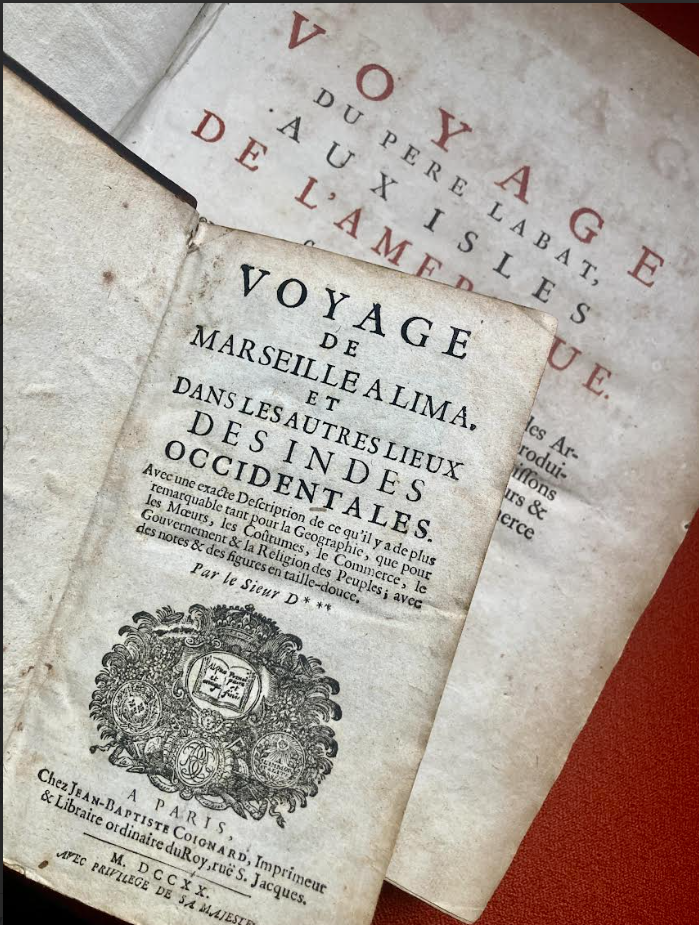
In 1702, Mr. Durret offered to take his readers around the world. He’d sail with them, he promised, from Marseille, France, to Lima, Peru. An exciting prospect, indeed! Mr. Durret kept his word, except for one thing: he never left his room to write this relation.
Legit Fake
Durret’s relation is entitled Voyage de Marseille à Lima... (Paris, 1720), and it kicks off as follows: “We left Marseille for the West Indies, on December 14, 1702.” Do not take it literally, though—Durret never went to the West Indies. “The core of this relation,” he notes in his preface, “is from the relation of the Bachelor Surgeon of Bourg-en-Bresse (...). But the changes I’ve made to polish his style, and the notes I’ve added, must lead you to consider it as an original piece of work (...). Those changes do not concern the facts reported by the original author; I’d would never touch this part.” It was nothing surprising for a printer to call upon the skills of an author to “polish” the work of a traveller—and this one was printed by Jean-Baptiste Coignard, a King’s printer, with the due Privilege of His Majesty. Everything seemed legitimate. Yet, when Father Labat published his own Voyage Aux Ises de l’Amérique the same year, he wrote a preface to castigate the “fake travellers”, who never left their room—contrary to him, of course. Then he adds: “M. Durret (...) will recognize himself in this portrait.”
Apocryphal
We call them “apocryphal”, because they’re made-up, or at least suspicious relations that pretend to be genuine. Some travel books collectors look down on them, as worthless works of imagination although most of them were carefully put together from official sources—sometimes partly, like Lesage’s Les Aventures de Robert Chevalier (Paris, 1732); sometimes fully, like Coreal’s voyage (Paris, 1722), or Prevost’s Voyage de Robert Lade (Paris, 1744). Durret’s relation would fall in the last category. Most booksellers who offer a copy for sale quote the authoritative Sabin in their description: “Father Labat thought it was a fake relation.” This is usually the sole source they quote. Labat’s relation is one of the most authoritative sources on the French West Indies at the turn of the 18th century—he lived there, for several years, this is established beyond doubt. Yet, being not such a great admirer of him, I decided to check it out by myself.
Destroying Durret
I re-read Labat’s preface. Not only does he question Durret’s relation—but he destroys it. Durret was too famous to pretend he’d been to the New World—“that’s why he hides behind this Bachelor Surgeon (...),” Labat giggles. Then he adds that Durret simply plagiarized the relation of Father Feuillée, “a famous astronomer who went from Marseille to Lima the same year.” Durret should have “given an abridged version of Feuillée’s voyage instead, minus the astronomic details—that not so many people could give without wasting their relation, like Feuillée did (...). But Durret wanted to write, and to put out a thick volume loaded with everything he’s read in Herrera, d’Acosta, la Vega, Les Casas...” Labat then lists several factual mistakes in Durret’s relation to prove he knew not what he was writing about. For my part, I went on Googlebooks to leaf through Feuillée’s relation. Here are two examples of comparison, taken from the very first pages of Feuillée’s book—but it goes on and on. Each passage is actually identical in both books:
-
“We realized, as we were sailing, that one of our officers was missing; our Captain had to stop our ship sideways to wait for him.”
-
“A few moments later, our foremast could stand the violence of the tempest no more and broke in three different places, and without prompt help, we were bound to lose all our masts.”
Durret was clever enough to note in his relation that “Father Louis Feuillée, a Minime religious and famous mathematician, embarked with us on King’s order to go to the Indies and America.” It was a way to justify relating the exact same events. There’s actually no doubt left—this is not a “fake relation”, this a stolen one! Durret’s did add descriptions of all the places mentioned in this travel—they are interesting at first, but soon get tedious. A travel book shouldn’t be a geographical and historical catalogue—but the tribulation of a traveller.
This book comes with a handful of plates, but plagiarism is also present here as the one showing the ceremony of the Inquisition in Goa is “borrowed” from Dellon’s Relation of the Inquisition in Goa (Leyde, 1687). This being said, Durret’s relation remains a sought-after book among travel books fanatics. It’s well printed, well written, well illustrated and quite readable—a nice copy is still worth a few hundred euros, notwithstanding its dubious sincerity. People forgive a liar, when his lie is worth reading...
Thibault Ehrengardt