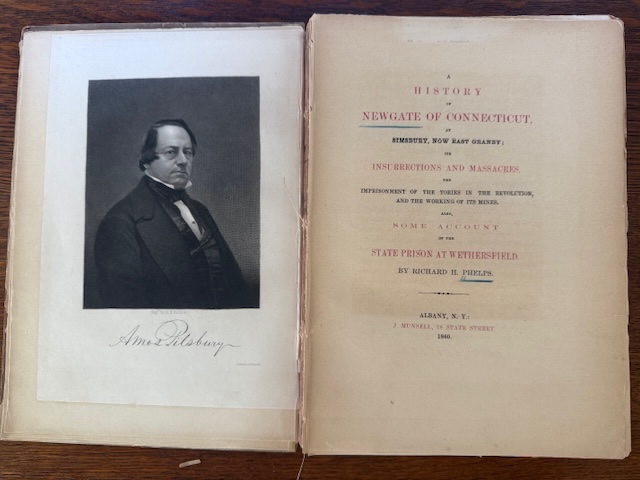
An 1860 Munsell printing that still looks pretty good
For years I have searched for imprints associated with Joel Munsell, the 19th century Albany, New York printer who recorded his printing history in a book titled: Munselliana 1834-1871. His volume mentions 2,268 examples of his printed production. One of the more important books he printed was:
“A
History
Of
Newgate of Connecticut,
At
Simsbury, Now East Granby;
it’s
Insurrections and Massacres,
The
Imprisonment of the Tories in the Revolution,
and the Working of its Mines.
Also,
Some Account
of the
State Prison at Wethersfield.
By Richard H. Phelps
_ _ _ _ _ _
Albany, N. Y.
J Munsell, 78 State Street
1860
In 1860, Munsell & Rowland of Albany, New York were printers in their prime. Joel Munsell, the senior man, initially a commonplace printer, had become a newspaper publisher and was running a busy print shop that would be immortalized 11 years later, with the publication of his printing records from 1834 to March 1871. His book, called Bibliotheca Munselliana, printed in 30 copies, listed 2,278 items, with details and quantities shown for about half of them. Such records have been rarely known.
In the fullness of time, it became clear, 1860 +/- 5 years was Mr. Munsell’s golden moment. Among the books he published during that decade was A History of Newgate of Connecticut authored by Richard H. Phelps. Mr. Phelps’s account of the history of the Newgate Mine has become its accepted history about its outsized role in the history of early Connecticut coinage, and forty years hence when it became a prison to confine Tories during the American Revolution.
The coinage I mention was illegally minted in the early 1730’s. Initially, it’s copper ore had to be transported from Newgate to England to be minted pursuant to English law. Opportunists thought it easier just to frank Connecticut money locally and its coins became a well-accepted medium of exchange by the local populace. Alas, these early coins (now known as Granby Coppers) were pure copper and didn’t wear well.
In the 1770’s during the Revolutionary War, the forgotten Newgate mine was repurposed as a prison to hold Tories. Once the war was ended, the Tories were released to their futures.
In time, memories slipped away, leaving a new generation of investors to find their futures somewhere down into the holes that were first dug 200 years ago at the Newgate Mine. Over the decades fresh attempts were made to reopen the copper mine. They all failed.
In time the State of Connecticut became the owners of Newgate’s field of dreams.
In 1860, Munsell & Rowland published the mine’s definitive account written by Richard H. Phelps ensuring the magic of Newgate would not be lost. Joel Munsell, during that period when he wasn’t wanting of money, he lent his presses, paper and ink to encourage advocates of the past to continue their revery. For his act, we acknowledge our thanks. Most of his printings were mundane. The story of the Newgate lives on.
For those who live or per chance come nearby, The Newgate continues to be open to those interested. For the lucky few that have good examples of those early Newgate coppers, they are worth $10,000 to $25,000.
As well, in my recently purchased copy of this rare book, a long 1877 clipping of a Hartford, Connecticut newspaper, was tucked in. This account is attached.
“Old Newgate” - The Ancient Copper Mine Prison in East Granby, Conn.
- How Convicts were immured in Rocky Caverns.
- Their Sufferings and Their Escapes
- (from our Regular Correspondent) (His name not known)
HARTFORD, Conn., April 13, 1877, the dungeons of Europe in the Middle Ages and up to the time when the public sentiment dictated a fairer treatment of prisoners were no doubt terribly destructive to health and life, but here in Connecticut there existed within half a century which was a blot upon the reputation of the state. Reference is made to the famous Couper Mine, or “old Newgate” prison in East Granby about twenty miles northwest from Hartford, which is an object of such interest to visitors that hundreds explore its caverns every year. Philanthropists who dilate upon the horrors of our best constructed prisons of the present day and demand of accommodations for convicts better than the homes of a large population of our laboring population, should visit this place and contrast even the worst of modern prisons with the horrors of the old Newgate of Connecticut. It must have been a hell upon earth. Originally am copper mine, reached by a shaft stretching down 50 feet through solid rock, it was adapted during the Revolutionary war to the safe keeping of the British soldiers, and afterward became the prison of the State.
The History of the Prison dates to 1707, when a company was formed to open a copper mine in “Copper Hill”, a high, rocky range, then in the town of Swisbury, but now, owing to changes in town divisions, in East Granby. Seven years later the use of the property was purchased by Jonathan Belcher of Boston (afterward Governor) and two others, and this company operated the mine for 23 years. The enterprise was not financially successful, however owing to restrictions by the British government. It was required that the ore be sent to England for smelting, and the expense of transportation was excessive, as it was necessary to wagon the ore to Hartford, whence it was shipped in sloops to New York and hence to England. However, considerable copper was surreptitiously smelted by German workmen in the vicinity, and about 1737 A Mr. Higby manufactured a large number of coins called “Granby coppers,” which were current throughout the State. Five different issues of were struck, and single specimens command from coin collectors at this time (1877) from $15 to $25, according to their perfection. The Connecticut Historical Society at Hartford is in possession of specimens in good condition.
Mining was abandoned in 1773, when the colony of Connecticut purchased the property and fortified it for use as a permanent prison. At this time there were two shafts leading down to the caverns, and escapes being frequent, a blockhouse was built over one, and the other was closed with stone and iron. During the Revolutionary war many British soldiers and Tories were confined to the prison, and in 1781 a desperate attack on the guard was successful and the entire party, then in custody escaped but were but were nearly all recaptured in the neighborhood. During this period. Of the prison’s history nail-making was carried on, and a rough sketch in the rooms of the Connecticut Historical Society shows the plan of the buildings. In 1799 the State established the name of a permanent prison. A palisade was built, enclosing half an acre, with the shafts of the mine near the center of the enclosure and in 1802 this was replaced by a strong stone wall. A brick guard house was then built in the center, and in the rear of this guard a stone apartment was constructed directly over the main shaft leading to the caverns beneath. Other buildings were erected from time to time for workshops, etc., and the place was continued as a state prison until the new prison at Wethersfield was completed and occupied in 1827.
Old Newgate in 1877.
Since its abandonment for prison purposes the place has gone to ruin, and its sole inhabitants at this time are a family occupying the old guard-house building, and who add to their scanty income by acting as guides for visitors to the caverns and the various buildings scattered throughout the enclosure. The place may be reached by carriage from Granby station on the Canal Railroad, or Tariffville on the Connecticut Western Railroad, one distant two and the other three miles. The enclosure is on the slope of Copper hill, approached by an easy roadway, and from a distance presents, with its towered buildings and dismantled walls and broken roofs, a picturesque appearance. The stone wall on the front of the enclosure adjoins the roadway, and entrance is gained through a massive gateway, above which is a stone with the inscription, “Newgate 1801.” Near the gateway the first shaft, 100 feet deep, is reached, and over it is the remains of a windless and rope used many years ago in hoisting up the ore. To the left hand is a long range of buildings formerly occupied as workshops. The roofs are warped and shrunken and are penetrated by every storm. Within, all is dust and confusion. The plastering has fallen from walls and ceilings, and the patches remaining are covered with the charcoal inscriptions of visitors. A noticeable feature is the solidarity of the construction of the walls and floors, the former of stone and the latter supported by heavy hewn beams and planked. At intervals iron rings are inserted in the upright beams, to which dangerous prisoners were chained, and the floor beneath is heavily worn by their impatient tread. At the further end of the enclosure is a large brick and stone building, whose roof supports a bell and lookout tower, from which the residents in the valley below, were warned of the escape of prisoners, and hastened to scour the woods and fields in pursuit. The interior of this building is of massive construction, and trap doors lead to an underground dungeon, with small, heavily barred windows, which was used at night by the more peaceable prisoners, whose good conduct won for them relief from the nightly confinement in the damp caverns of the mine. Another building on the left side of the enclosure at one time contained a treadmill, where the prisoners wearily tramped upon the boards of a 30-foot wheel, which gave motion to the machinery, the while stared at by the farmers who brought their corn to be ground at the low cost of prison labor.
The Caverns.
It will be understood that the convicts enjoyed the privilege ground in the workshops and buildings only during working hours. At all other times they were kept in the great caverns of the mine, from 50 to 100 feet below, and in darkness indescribable. At daylight they were summoned to labor and climbing up the ladder of the shaft opening into the guard-house building, were marched off, a squad at a time, to their respective shops. To allow all to ascend at once, even when surrounded by armed guards, meant insurrection, and the prison has had many such affairs. Men thus confined in dungeons, like brutes, were nerved to desperate acts, and every precaution was necessary. Labor ended at sundown, when the prisoners were again brought into the guard house and sent down the shaft, the heavy trap door was closed upon them and bolted, and armed guards watched beside it through the night. At the time of your correspondent’s visit, trap doors, ladder and all were still there. A little son of the present occupant of the guard house was secured as a guide, and the party after procuring candles and rough outer clothing, descended the shaft. At the bottom a gradually descends for a considerable distance, all the surroundings being solid rock. The silence, the seclusion and the deprivation of light other than the faint gleams of the tallow dips were all oppressive. A short distance from the foot of the shaft, the passageway widened, and in the contact with the dim light was seen the remains of a low rude platform, the boards rotted by time and water. This had been one of the sleeping places of the convicts. From the end of this passageway, smaller ones branched off in various directions, all with a downward slope, and some of them 200 or 300 feet in length, terminating, so far as the visitor could see, in cavities filled with water, the accumulation of the years since the mine had been pumped out. All of these passages were low, and the visitors stooped to avoid contact with the dripping roof above. Traces of copper were everywhere apparent – in the green slime upon the sides, and in the fragments of stone underfoot.
One of the passages terminated in a small egg-shaped cavern about ten feet across, in the floor of which was a thick iron ring. Here desperate prisoners were placed in solitary confinement, chained to the ring, not a sound to be heard, not a ray of light visible, nor a face seen excepting when the keeper brought the scanty allowance of food. At one side, adjoining the ring, a little cavity the size of a cup is scooped in the solid rock and filled with water which falls, drop by drop, from overhead. Thus, it fell 50 years ago, when some wretched being hammered day after day at the solid rock with fragments of stone he wore this cavity, and thereafter had fresh cool water always at hand. It is related that a prisoner once died in this horrible dungeon, his iron manacles having eaten into his legs, and mortification having resulted therefrom. The prison authorities always denied this, but convicts who were in prison at the time, told the story when released and persisted that it was true. What horrors these canyons have witnessed, in mental and physical suffering and in the gross brutalities of jailors, no one except he who see all things can ever tell.
Escapes of Prisoners.
From the bottom of the mine, a level runs through the rock to the open air, emerging on the slope of the hill below the prison, designed for drainage. At the inner end was protected by iron bars, when the mines were converted into a prison, but the convicts regarded it as one of the best means of escape, as it was at the farther extremity of the mine from the shafts. One of them, in the early days of the prison succeeded in removing the bars, and after nights of weary toil in enlarging the partially choked drain, found himself near the outer orifice. When at labor one night far within, he gave himself up for lost. A stone overhead which he had partially loosened, fell into the drain behind him, closing the passage to his return, while the way forward was impracticable. Starvation stared him in the face, but by some lucky impulse he kicked desperately at the stone and found it could be moved. By bracing himself, he gradually worked the great stone backward to a wider space in the level, and at daylight, after hours of agonized exertion, he reached his companions. A few nights later a dozen or more made their way to liberty through the same dangerous passage, and the pincky fellow who had cleared the road for them escaped recapture and reached England. Numerous other attempts were successful, and some failed only after desperate resistance by the guards. Several prisoners in a stone dungeon under the guard room removed a huge stone from the floor at night and tunneled their way thence through the soil under the wall, to the open air, but only one, the smallest could get through. In 1806 the prisoners rose on the guards, while at work in the nail shop, but abandoned their attempt after one prisoner had had his head blown to pieces by a shot from heavily charged musket. Another secreted himself in a coffin, after hiding the corpse, and on reaching the place of burial beyond the walls put the guards ting o flight by utter sepulchral groans. This ingenious chap was never retaken. In 1822 a desperate attempt was quelled only by the shooting of several of the convicts.
Present Condition of the Place (as of 1877)
In 1839, three years after the place was abandoned as a prison, the mines were reopened by a New York company, but after considerable money had been sunk the works were abandoned. Twenty years past, and the Connecticut Copper Company began operations, but continued only for a couple of years. The best ores yield 20 per cent of copper, averaging 14, and it is stated that, of Hartford, but that gentleman has taken no measures toward developing its resources, and it is questionable whether such an enterprise could be made to pay. The shafts and passages, some of which extend 300 feet under the mountain, are unobstructed, but the lower but the lower parts of the mine are filled with water, and the buildings, which were tenantable when mining was last carried on, are in a wretched condition. The chief value of the place appears to be its attractions to the seekers after the curious. It is a favorite resort for excursion parties from the surrounding country, but visitors from a distance are rarely seen, and it is evident that the famous old place, to which is attached such a singular history, is scarcely known, beyond the section in which it is located. The most complete history of the prison that has been printed in a book, ‘Newgate of Connecticut,” by R. H. Phelps of East Granby, who gives a mass of interesting facts and many reminiscences obtained from prison officials and others informed as to its history. As a curiosity it is well worth a visit, not so much because of its interest as a mine as its remarkable history as a Bastille from 1773 to 1827, a period of more than half a century.
The Hartford Sunday Herald
April 3, 1877
As to the Newgate Mine’s status I asked Gemini what has happened since 1877:
Since 1877, the Newgate Mine site in East Granby, Connecticut, transitioned from a defunct prison back to a tourist attraction, becoming the Old New-Gate Prison & Copper Mine, a National Historic Landmark and state museum, preserving its unique history as America’s first chartered copper. Ine and state prison, with modern-day exhibits and tours.
Key developments after 1877:
- Late 19th Century Tourism: After the prison closed in 1827, the site saw renewed interest; in the late 1800s, the Viets family bought it, adding picnic areas and observation decks for visitors exploring the mine tunnels and prison buildings.
- State Stewardship: The property eventually became a state-run historical site, preserving its dual legacy as a colonial copper mine (1707) and early state penitentiary (1773-1827).
- National Recognition: It was designated a National Historic Landmark in 1972, highlighting its significance in American history.
- Modern Museum: Today, it's known as the Old New-Gate Prison & Copper Mine, featuring a visitor center, outdoor exhibits, historic ruins, and underground mine tours, managed by the state's Department of Economic and Community Development.
In essence, the site evolved from a site of incarceration back to a place of historical education, offering a tangible glimpse into early American mining and penal systems.
Here’s the New-Gate Prison and Copper Mine, East Granby’s website:
https://portal.ct.gov/decd/content/historic-preservation/04_state_museums/old-newgate-prison-and-copper-mine