Books For The Living, or the Pedantic Habit of Wearing White Gloves
- by Thibault Ehrengardt
The New York Times made it clear in a recent article: “For Rare Book Librarians, It’s Gloves Off. Seriously.” This old debate whether librarians should handle old books with white gloves is coming back again. The article reads: “The glove thing,” Maria Fredericks, the director of conservation at the Morgan Library and Museum said when contacted about the matter, sounding slightly weary. “It just won’t die.” How many times have you watched a curator on TV, leafing through an old book with careful, almost slow motion gestures? The white gloves are sending a message: this is not ordinary stuff. This is almost a ritual, and only a happy few are entitled to it—please stay far, and admire us. Actually, most people wearing white gloves just do what they’ve been taught; and there’s no big deal. Yet, using white gloves can also be part of the bourgeois “entre soi” that surrounds old books. There’s a silent class war going on here. Old books are for the elite. Although many booksellers will introduce themselves as old books servitors “passing culture on to the next generation”, some are actually closer to old time courtesans, sniffing wealthy people’s pockets with servile smiles. For them, using white gloves is just a way to look more important.
I’ve seen people acting funny with books: a renowned librarian threw a rare $10,000 travel book from the 16th century on a table in front of me, as if it were a bag of chips—the horrid sound it made still haunts me at night! The next day, a bookseller brutally opened a book for me, cracking the back like you break someone’s neck—I stared at him in panic. He stared back, smiling casually. Old books must be handled with care, no doubt. But white gloves are just useless pedantic accessories. The article of the NY Times lists all the reasons why we shouldn’t wear them: they reduce your sense of touch, and might cause you to tear a page, smear pigments or even drop the book. They attract dirt, make you sweat and generate moisture (which is not good for books). At the end of the day, “the best way to handle a rare book,” said Mark Dimunation, the longtime head of the rare books and special collections division at the Library of Congress, “is with clean hands and caution.”
These are all the “good” reason. But there’s another one—the best one, in my humble opinion. Actually, I’ve never needed any other. We might have the duty to pass these books on to the future generations, but they are for the living. We are the ones who can smell, and touch them right now! The texture of their paper is a delight to the naked fingers; so are the almost imperceptible edges left by the press around the engravings for example. Weren’t these books designed on purpose? I mean as attractive as possible with smooth leather bindings and golden backs? No detail was spared to make you desire them. And we should touch them with gloves? Reading an old book is a sensorial experience. These books come from far, and they must be passed on, yes; but they must be kept alive in the process. By “alive”, I don’t mean in perfect condition, but surrounded with human care. Without us, the living, they are but bits of leather and paper. Loving them might damage them? But what’s life, even of an old book, without love? As insipid an experience as handling an old book with white gloves.
Sotheby’s Shelf Life: Books, Manuscripts and Works on Paper from the Library of Stanley J. Seeger and Christopher Cone 25 June – July 7
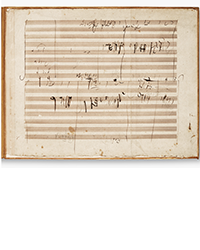
Sotheby’s, July 7: Ludwig van Beethoven. Autograph sketches for the overture "Die Weihe des Hauses", op.124, [1822], UNPUBLISHED. £150,000 to £200,000.
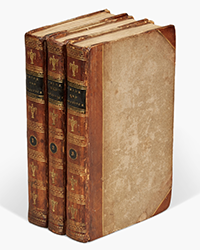
Sotheby’s, July 7: Jane Austen. Pride and Prejudice, 1813, first edition, 3 volumes, contemporary half calf. £50,000 to £70,000.
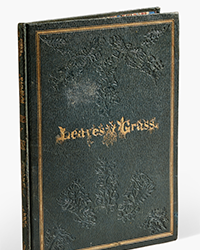
Sotheby’s, July 7: Walt Whitman. Leaves of Grass, Brooklyn, 1855, first edition, first issue, original green cloth, the Doheny copy. £50,000 to £70,000.
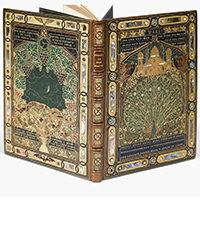
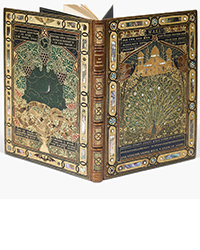
Sotheby’s, July 7: Binding—Sangorski & Sutcliffe—Omar Khayyam. Rubaiyat, London, 1872, third edition, in a magnificent jewelled Peacock binding. £15,000 to £20,000.
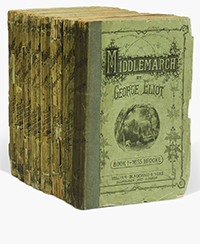
Sotheby’s, July 7: George Eliot. Middlemarch, Edinburgh and London, 1871, first edition in the original parts. £20,000 to £30,000.
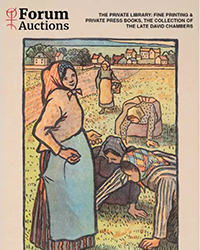
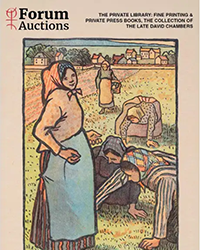
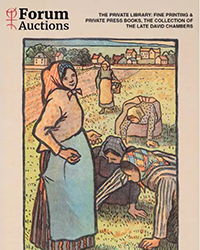
Forum Auctions The Private Library: Fine Printing & Private Press books, the collection of the late David Chambers July 9, 2026
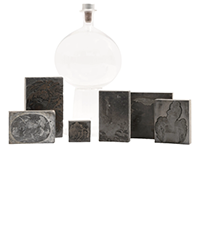
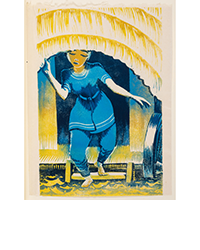
Forum, July 9: Hassall (Joan) A large collection of over 300 original woodblocks of engravings for various books, v.d., with Hassall's engraver's glass water-globe (Qty) - Est. £10,000-15,000
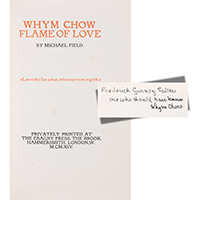
Forum, July 9: Eragny Press.- [Bradley (Katherine Harris) & Edith Emma Cooper], "Michael Field." Whym Chow, Flame of Love, one of only 27 copies, inscribed by Bradley, the rarest book from the press, 1914. - Est. £3,000-4,000
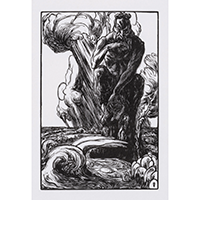
Forum, July 9: [Moore (Thomas Sturge)] [Wood Engravings], 71 wood-engravings printed by David Chambers from the original blocks, the only set on Japanese Hosho paper, from an edition of 5 sets, [1970]. - Est. £3,000-4,000
Forum Auctions The Private Library: Fine Printing & Private Press books, the collection of the late David Chambers July 9, 2026
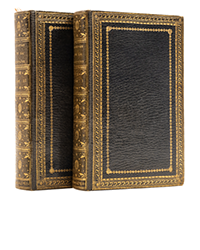
Forum, July 9: La Fontaine (Jean de) Contes et Nouvelles en vers, 2 vol., engraved plates after Eisen, fine early 19th century blue morocco, gilt, by Bradel l'ainé, Amsterdam [Paris], 1762. - Est. £2,000-3,000
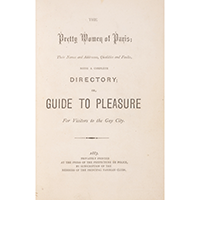
Forum, July 9: Erotica.- Prostitution.- Pretty Women of Paris (The); Their Names and Addresses, Qualities and Faults..., [Paris], privately printed at the Press of the Prefecture de Police, 1883. - Est. £3,000-4,000
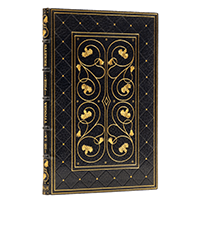
Forum, July 9: Vale Press.- Ricketts (Charles) & Lucien Pissarro. De la Typographie et de l'Harmonie de la Page Imprimée…, [one of 216 copies], bound in dark blue morocco tooled in gilt, by Sarah T.Prideaux, 1898. - Est. £1,000-1,500
Forum Auctions The Private Library: Fine Printing & Private Press books, the collection of the late David Chambers July 9, 2026
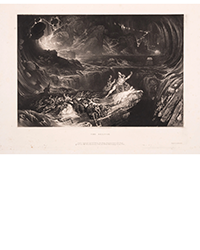
Forum, July 9: Martin (John) Illustrations of the Bible, complete set of 20 mezzotints, good impressions, rarely found in early states, [c.1831-1835]. - Est. £1,000-1,500
Forum, July 9: Golden Cockerel Press.- Four Gospels of the Lord Jesus Christ (The), one of 500 copies, Mary Gill's copy, Waltham St. Lawrence, 1931 with a signed proof of engraving on japon numbered 10/10 (2) - Est. £5,000-7,000
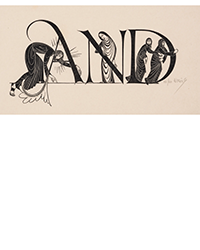
Forum, July 9: Boccaccio (Giovanni) The Decameron, 3 vol., vol.1 extra-illustrated by John Buckland Wright with c.150 erotic original drawings in pen & ink and pencil, 1886 [extra-illustrated c.1940]. - Est. £10,000-15,000
Forum Auctions The Private Library: Fine Printing & Private Press books, the collection of the late David Chambers July 9, 2026
Forum, July 9: Cox (Morris) Collection of Gogmagog Press Books, 35 vol., rare complete collection of printed books issued by the press, limited editions, most signed by Cox, 1957-83. - Est. £10,000-15,000
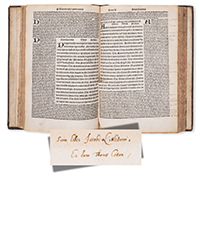
Forum, July 9: Wynkyn de Worde.- [Terentius Afer (Publius)] [Comedie...], [Paris, Josse Badius: sold in London by Wynkyn de Worde, & others], [15 July 1504]. - Est. £4,000-6,000
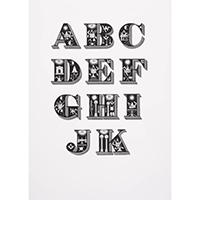
Forum, July 9: Mosley (James) Ornamented Types. Twenty-Three Alphabets from the Foundry of Louis John Pouchée, 2 vol., one of 10 copies for presentation, from an edition of 210, 1992-93. - Est. £1,000-2,000
Forum Auctions The 10th Anniversary Sale Fine Books, Manuscripts and Works on Paper July 16, 2026
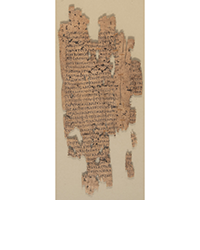
Forum, July 16: Inundation papyrus. P.Michael 4, the ‘Inundation papyrus’, a geographical account of the Nile near Canopus, in Greek, remains of two columns from a manuscript scroll on papyrus, Egypt, second century CE. £12,000-18,000
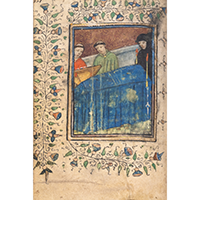
Forum, July 16: Book of Hours, use of Sarum, manuscript on vellum, 6 full-page miniatures, with famous Middle English inscriptions, Southern Netherlands for the English market, [c.1430]. £30,000-50,000
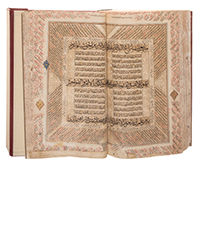
Forum, July 16: Qu'ran, Arabic manuscript on burnished, stencilled, and gold-flecked paper, 447ff., Sultanate Gujarat, Ahmadabad, [after 1411 but no later than 1442]. £15,000-20,000
Forum Auctions The 10th Anniversary Sale Fine Books, Manuscripts and Works on Paper July 16, 2026
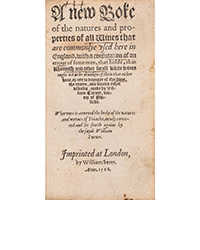
Forum, July 16: Turner (William). A New boke of the natures and properties of all wines that are commonly vsed here in England, rare first edition of the first English book on wine, By William Seres, 1568. £20,000-£30,000
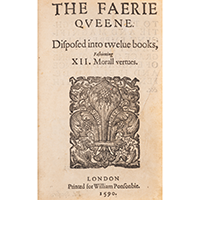
Forum, July 16: Spenser (Edmund). The Faerie Queene. first edition, Printed [by John Wolfe] for William Ponsonbie, 1590. £30,000-40,000
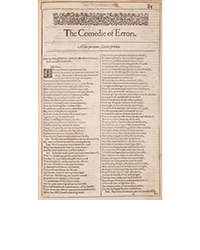
Forum, July 16: Shakespeare (William). The Comedie of Errors, extracted from the first folio, Isaac Jaggard and Edward Blount, 1623. £15,000-20,000
Forum Auctions The 10th Anniversary Sale Fine Books, Manuscripts and Works on Paper July 16, 2026
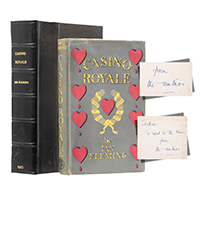
Forum, July 16: Fleming (Ian). Casino Royale, first edition, signed presentation inscription from the author, 1953. £40,000-60,000
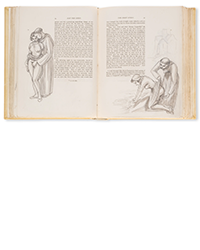
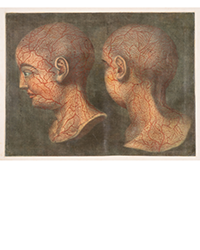
Forum, July 16: d'Agoty (Jacques-Fabien Gautier). Anatomie de la Tête, first edition, Paris, chez le Sieur Gautier, 1748. £10,000-15,000
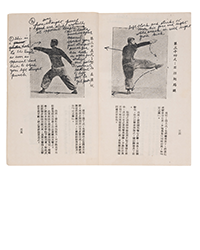
Forum, July 16: Martial Arts.- Lee (Bruce). 'Praying Mantis style' Kung Fu book, containing numerous annotations, diagrams and graphs in Bruce Lee's hand, c. 1960. £50,000-70,000
Forum Auctions The 10th Anniversary Sale Fine Books, Manuscripts and Works on Paper July 16, 2026
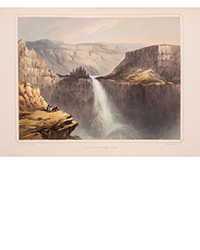
Forum, July 16: Warre (Capt. Henry James). Sketches in North America and the Oregon Territory, first edition, rare hand-coloured issue, 1848. £30,000-40,000
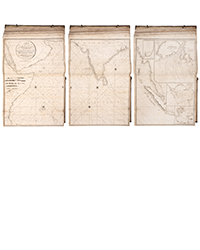
Forum, July 16: Norie (John William). The Marine Atlas, or Seaman's Complete Pilot for all the principal places in the known world..., 1826. £30,000-50,000
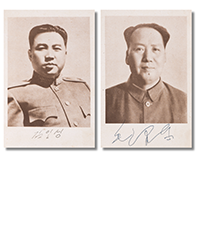
Forum, July 16: Mao Tse-tung.- Kim Il-sung.-[Note book for visitors from China to Korea], signed by Mao and Kim, [Beijing, 1954]. £10,000-15,000