
Rare Book Monthly

Articles - February - 2023 Issue

Martial In Rome, the Power And The Glory

The Colosseum: Not fun and games, games and slaughter.

The Colosseum: Not fun and games, games and slaughter.

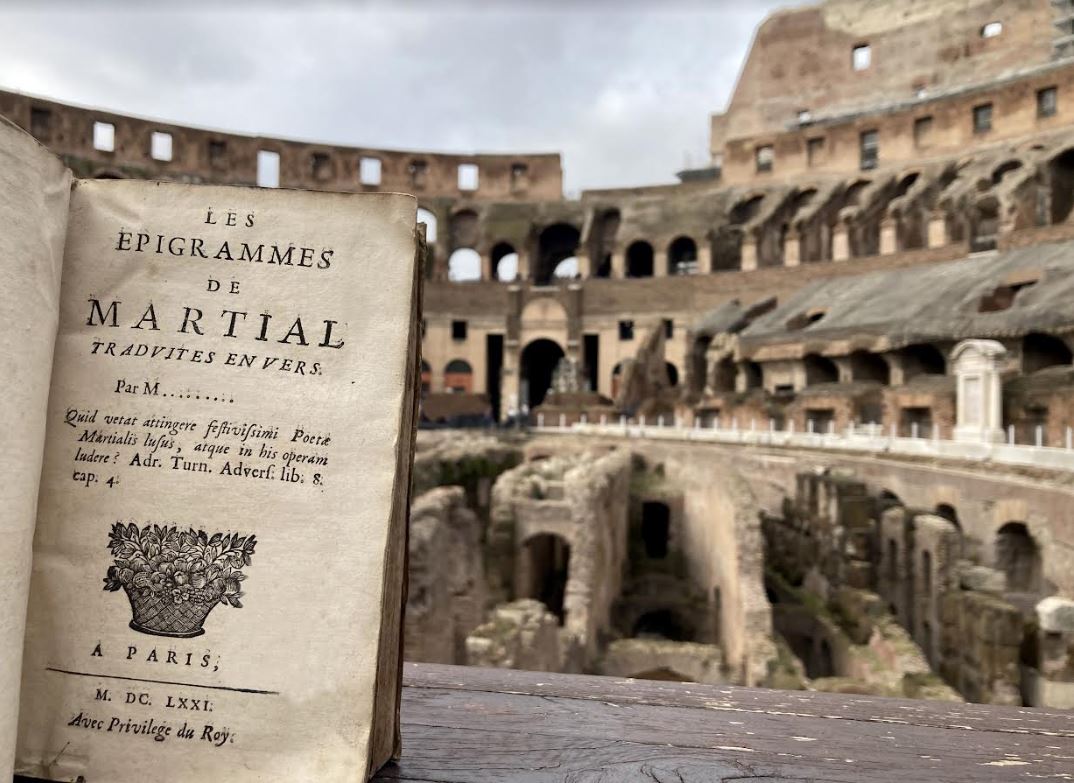
I went to Rome, Italy, and I took a picture of a 1671 edition of Martial’s epigrams inside the dreadful Colosseum. This place was once the showcase of the most powerful city on Earth; as you enter it in 2023, you’re almost deafened by the mute cries of 80,000 raging spectators. They were screaming with joy as people were murdered, raped or torn by wild beasts in front of their eyes. These circus games inspired several epigrams to Martial (40-104)—known as “the book of the circus games”. They are not recommended for soft readers.


Visiting the Colosseum is like visiting St Peter’s church in the Vatican. Those places are nothing but unapologetic displays of power. Everything there was designed to make you feel miserable. The cold breath of power blows on your neck as soon as you enter, as if to remind you how insignificant you are. Two thousands years or so later, notwithstanding technological or medical progress, or our travelling to the moon, the impact is still the same. It is a debauchery of means and money with a unique goal: showing who’s the master. “Let barbarian Memphis keep silence concerning the wonders of her pyramids,” Martial writes, “and let not Assyrian toil vaunt its Babylon. Let not the effeminate Ionians claim praise for their temple of the Trivian goddess (...). Every work of toil yields to Caesar's amphitheatre.1” It is the most visited site in Italy today. “What race is so distant from us, what race so barbarous, Caesar, as that from it no spectator is present in thy city? The cultivator of Rhodope is here (...): the Sarmatian nourished by the blood drawn from his steed, is here. (…) The Arabian has hastened hither, the Sabaeans have hastened (...). Though different the speech of the various races, there is but one utterance, when thou art hailed as the true father of thy country.” A pagan Tower of Babel, so to speak.


I had an “arena access” ticket, so I was permitted to step into the arena with a restricted amount of tourists. Here I was, walking in the footsteps of Carpophorus. He was Domitian’s protégé2, and a fearless hunter. “That which was the utmost glory of thy renown, Meleager, a boar put to flight, what is it? a mere portion of that of Carpophorus. He, in addition, planted his hunting-spear in a fierce rushing bear (...); he also laid low a lion (...); and with a wound from a distance, stretched lifeless a fleet leopard.” One day, a lion escaped its master’s grip and created panic among the patrons. Everybody ran away but Carpophorus, who jumped on it instead, and put it to death. What a spectacle indeed! I looked at the nearby seats behind me. They seem so close! The spectators could almost touch the many gladiators who died at their feet.


The circus games had a political dimension. Binging lions, rhinoceros (how powerful was that tusk to whom a bull was a mere ball!) or elephants from the ends of the empire was a way to display Caesar’s power. Even the wild beasts came to die for his glory. The floor of the arena is now gone, and we can see corridors underneath—the belly of the beast. Elevators would send the gladiators, the animals or their victims right in the middle of the battlefield. Representation was the key word of the games. “The pagan and cruel Romans,” our French translator warns before offering the poem entitled Pasiphae, “would often give inhuman and lewd spectacles in the Colosseum, to re-enact the Greek fables.” Pasiphae was Minos’ wife, and when the latter refused to sacrifice a white bull to Poseidon, the God retaliated. He made Minos’ wife fall in love with a bull. So passionate was Pasiphae that she hid inside a wooden cow covered with a cow skin. “The bull approached and started to copulate with it as if with a real cow,” Apollodorus writes. “The young woman then gave birth to the Minotaur.” Many questioned the truth of these fables, and re-enacting them in the Colosseum was a serious matter. “Believe that Pasiphae was enamoured of a Cretan bull: we have seen it,” Martial rejoices, “The old story has been confirmed,” meaning they had a woman publicly raped by a bull. Another wretch had the honour to re-enact the myth of Prometheus: “so has Laureolus, suspended on no feigned cross, offered his defenceless entrails to a Caledonian bear. His mangled limbs quivered, every part dripping with gore, and in his whole body no shape was to be round.” This Laureolus, Martial presumes, had “murdered his father, or assassinated his master, or maybe raped his mother.” Serves you right, you savage!


Man versus lions, leopards versus elephants, women versus beasts, or short-people fighting each other—it goes on and on. I was reading the epigram about those young men who were attacked by a loose lion. They were sweeping away the sand made thick with blood during an interlude. Then I noticed a modern Venus on my right. She was posing in the arena, holding her phone with a selfie-stick—looking for the best view on her body curves, the best pout. Not as much as a bull raping a woman, but this was a dreadful spectacle to behold. Unfortunately, there were thousands of Venuses in the Colosseum that day. Guess that when they post their best shots on social media, 80,000 spectators applauded. The ancient tyrants are gone, but the circus games go on, and the spectators are always asking for more.


Thibault Ehrengardt


1. The English translations are from a 1897 edition available online (www.tertullian.org).

2. The translator of our 1671 edition indicates that Martial is referring to the circus games given by Domitian. Yet, in his article Domitien, spectacles, supplices et cruauté, Cinzia Vismara writes (persee.fr): “The chronology of Martial’s Book of the Circus Games has only been confirmed recently (...). And these poems exclusively depict the games given by Titus to inaugurate the Colosseum.”

Posted On: 2023-02-02 12:41
User Name: chr.edwards

This all seems to me a bit oversensitive: it's getting on for 2000 years since people and animals were slaughtered in the Colosseum (not the Coliseum, by the way). And to compare it with St Peter's in the Vatican, which is certainly not intended to make the visitor miserable, is ridiculous. I suggest you save your indignation for modern atrocities, about which something can be done.


Posted On: 2023-02-02 20:41
User Name: ehrengardt

You're right. A woman raped by a bull in front of a delighted audience? Come on, man! A man ripped by a fierce beast while chained on a rock? Don't be a sissy. That was long ago, this is inaccurate, just like old dusty books I guess.

If you can't see the link between the Colosseum (pardon my English, will ask the editor to correct it) and St Peter's Church, never mind - they do. That's why they did all they could to put their name all over the place. And if I remember correctly, they tried to erect a church inside the place at one point.

Anyway, thanks for sharing your thoughts. Means a lot to me, you now how sensitive I can be. :D


Posted On: 2023-02-06 23:52
User Name: bukowski

The Colosseum is not terrible. It is majestic and magnificent, regardless of how and for what it was used. Woke poseur!


Posted On: 2023-02-09 17:58
User Name: ehrengardt

"Regardless?" Guess, I'll have to keep on thinking without you that 2+2=4.
Have a majestic and magnificent day. ;)


Rare Book Monthly

  • Aste Bolaffi, June 17-18: Galileo Galilei. Dialogo sopra i due massimi sistemi del mondo tolemaico, e copernicano. Firenze, 1632
    Aste Bolaffi, June 17-18: Saverio Manetti. Storia naturale degli uccelli. Firenze, 1771-76
    Aste Bolaffi, June 17-18: Fortunato Depero. Depero futurista. Rovereto, 1927
    Aste Bolaffi, June 17-18: Nicolas Visscher. Atlas minor sive totius orbis terrarum contracta delineat ex conatibus. Amsterdam, circa 1649-95
    Aste Bolaffi, June 17-18: Andreas Vesalius. Anatomia. Addita nunc. Antiquorum Anatome. Venezia, 1604
    Aste Bolaffi, June 17-18: Tristan Tzara and Salvador Dalì. Grains et Issues. Parigi, 1935
  • June 25, 2026
    Doyle, June 25: Houdini's biography, boldly signed. $3,000 to $5,000.
    Doyle, June 25: A volume from Abraham Lincoln's library, signed just before heading to Washington for his inauguration. $20,000 to $30,000.
    Doyle, June 25: A very early Confederate recruiting manual belonging to the chief commissary in Lee's Army. $600 to $800.
    Doyle, June 25: Rare hand-colored lithographs of the life of Napoleon. $20,000 to $30,000.
    Doyle, June 25: The "Holster Atlas" of the American Revolution. $5,000 to $8,000.
    Doyle, June 25: Jewish ceremonies in fine hand-colored engravings. $7,000 to $10,000.
    Doyle, June 25: A very rare work on Turkish military costume. $1,000 to $1,500.
    June 25, 2026
    Doyle, June 25: The most important illustrated work on the Mexican-American War. $10,000 to $15,000.
    Doyle, June 25: The finest illustrated book on Afghanistan. $10,000 to $15,000.
    Doyle, June 25: Henry Justice Ford St. George rescues the Princess from the horrible Dragon. $2,000 to $3,000.
    Doyle, June 25: A rare work of Prussian Army uniforms under Frederick William II, with exquisite hand-colored engravings. $800 to $1,200.
    Doyle, June 25: Lenny Bruce typed letter signed to a Village bohemian during his obscenity trials, with a manuscript note and drawing. $300 to $500.
    Doyle, June 25: Schiff's scarce Shanghai Sketchbook. $300 to $500.
    Doyle, June 25: The first accurate published representation of the American flag. $2,000 to $4,000.
  • Old World Auctions (June 17): Lot 123. Celebrate 250 Years of Independence with Original Stars and Stripes (1790) Est. $1,400 - $1,700
    Old World Auctions (June 17): Lot 20. Keulen's Spectacular Chart of the World Featuring California as an Island (1728) Est. $12,000 - $15,000
    Old World Auctions (June 17): Lot 42. Schedel's Ancient World Map with Fantastic Humanoid Creatures (1493) Est. $14,000 - $17,000
    Old World Auctions (June 17): Lot 591. Matching Set of 3 Stunning Globe Gores of Eastern Asia from Coronelli's 3.5 Foot Globe (1688) Est. $5,500 - $7,000
    Old World Auctions (June 17): Lot 9. Speed's Popular World Map with Allegorical Representations of the Elements (1651) Est. $14,000 - $17,000
    Old World Auctions (June 17): Lot 168. First Separate Map of Kansas & Nebraska Territories (1854) Est. $5,500 - $7,000
    Old World Auctions (June 17): Lot 43. Only Macrobius Map with Britain Attached to Europe (1515) Est. $800 - $950
    Old World Auctions (June 17): Lot 250. Rare Map of Boston and One of the Earliest Maps of the Revolutionary War (1775) Est. $2,000 - $2,300
    Old World Auctions (June 17): Lot 79. Schenk's Uncommon Map Featuring Two Figurative Title Cartouches (1696) Est. $1,200 - $1,500
    Old World Auctions (June 17): Lot 681. Hand-Colored Image of the Annunciation to the Shepherds (1502) Est. $800 - $950
  • Sotheby's Book Week
    2 June - 9 July
    Sotheby’s, June 25: Smith, Adam. The Wealth of Nations, on its 250th anniversary. $180,000 to $250,000.
    Sotheby’s, June 17: Fontana, Lucio. Concetto Spaziale. 1967. Leporello en papier doré. Bel exemplaire signé. €4,000 to $€,000.
    Sotheby’s, June 25: Fitzgerald, F. Scott. "So we beat on, boats against the current, borne back ceaselessly into the past”. $150,000 to $200,000.
    Sotheby’s, June 25: Washington, George (as First President). Washington decries “an ostentatious imitation, or mimickry of Royalty” in his Presidency. $250,000 to $500,000.
    Sotheby’s, June 17: Lope de Vega. Rare manuscrit autographe signé de la préface dédicatoire de "El Cardenal de Belen" (le cardinal de Bethléem), pièce composée en 1610. €40,000 to €60,000.

Article Search

Archived Articles