Collins Dictionary has named its Word of the Year, and it's one that collectors of all stripes will need to know in the years ahead. The “word,” though it isn't really a word, is “NFT.” It's an abbreviation for two words and one prefix, “non-fungible token.” That's a mouthful and probably half the people who are familiar with NFTs don't know what it stands for, even if they understand the concept. For many others, they don't understand the concept even if they have read the definition. It is not easy for people who grew up in a physical world to understand the digital one. I know.
NFTs, which have only been around a few short years and were unknown to most a year ago, broke into the public consciousness last spring when a digital NFT artwork sold for $69.3 million. Say what? An artwork with no canvas, no physical being, just an electronic memory converted to a digital image by computer chips sold for $69.3 million. Nice job “Beeple,” aka Mike Winkelmann, the artist. You aren't going to hang that on your wall unless its via an electronic computer monitor attached to a computer.
Before we get to describing the relationship between NFTs and collectible paper, here is a brief explanation from someone who actually has no idea what an NFT is. First, “non-fungible.” “Fungible” means there are many like items that can replace each other. For example, a dollar bill is fungible. They are interchangeable. It doesn't matter which one you have. So, non-fungible means unique, such as an original painting, or the first handwritten manuscript of a book.
“Token” here means something that is “attached” to a digital copy. Like an inscription written in a book, the token is “attached” to the digital image. It stays with the image forever. Since it is non-fungible, the token is unique, one of a kind. Attach this unique token to an artwork or anything else in digital form, it now becomes unique, the only one with this token. Therefore, if your digital copy of an artwork has this first token “attached” to it, it means you have the first. It's as if you had the painting and everyone else had prints or photographs of it. So, while others may have digital images of your artwork that look the same on their computers, you have the only one that has been established as the first, the original artwork. Naturally, that is worth a whole lot more.
An associated word you have probably heard, particularly with regard to digital (or crypto) currencies like bitcoin, is “blockchain.” Like me, you may have no understanding of this either. Rather than NFTs and their digital works being stored in a database, in one place, controlled by one entity, it is stored on a “blockchain.” That consists of “blocks” of sealed, unchangeable data in private computers all over the world. They are attached to each other, so to speak, to create a chain of blocks. Since these blocks are sealed and cannot be changed, no one can ever change or remove the token. It is like that inscription in the writer's unique handwriting. It guarantees authenticity. Your ownership becomes guaranteed in the blockchain (though you can sell it to another who registers their ownership, sort of like a chain of property ownership documents at the county courthouse). This is how your ownership of cryptocurrencies like bitcoin is guaranteed until you transfer it to another.
Now you may still be wondering what all this has to do with collectible books and paper. If artwork can be converted to NFTs, why not other forms of paper? We are already seeing it with baseball and other sports trading cards. Tampa Bay (and formerly New England Patriot) wide receiver Rob Gronkowski sold a collection of 349 of his digital NFT trading cards for $1.2 million. Just imagine how much his long-time buddy and teammate, Tom Brady, will be able to get for his. Topps, long the maker of tradition paper baseball cards, is now offering NFT versions.
Jack Dorsey, the founder to Twitter, sold an NFT of his first “tweet” for $2.9 million. What is a “tweet” but a digital version of a paper memo? An NFT of an original email could replace collectible old handwritten letters. And books? How about an NFT marked original manuscript of a book? Most authors are writing digitally on computers these days rather than creating paper manuscripts. This may be the only way to get an original manuscript in the future.
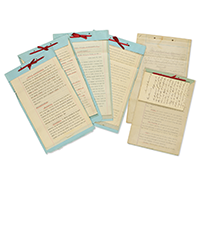
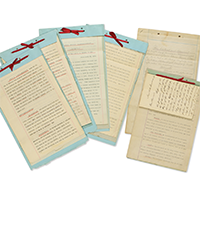
Michael Cohen, Donald Trump's one-time attorney and fixer, has offered a one-page manuscript as an NFT. He wrote it in prison and it looks like it may have been a draft of the opening statement for his tell-all book. It begins, “The President of the United States wanted me dead, or, let me say it the way Donald Trump would: he wouldn't mind if I was dead. That was the way Trump talked. Like a mob boss...” In case you're concerned you'll be bumped off if you buy it, it is priced in etherium, an untraceable digital currency like bitcoin. The price is 2.17 Eth, which as of a few days ago was worth $8,500 (by now, that could be worth twice as much or half as much the way those values fluctuate).
So long as there is money to be made, these things will be created. While no one can say this will be a lasting passion rather than a fad, the prices indicate the seriousness of interest so far. Could this be the future of collecting?
Two of the other words that made it to Collins' top 10 were “crypto” and “Metaverse.” “Crypto” is short for cryptocurrency, the digital currency. “Metaverse” is that land combining reality and fantasy, a land where real people can live and converse in a digital world, where their avatars have virtual experiences, and what they display and trade are not their physical possessions. No, they will be digital ones, their NFTs. If you want to be a big man or woman in the Metaverse, you will need to have important and valuable NFTs. Just like the rich person today shows off his Picasso hanging on the wall, the rich one of tomorrow will have a Picasso NFT to show off in the Metaverse.
Sounds exciting? A lot of people think so. Facebook didn't change its name to “Meta” for no reason. Apple and others aren't devising AR (augmented reality) and VR (virtual reality) glasses for people who want to live only in the “real” world. Young people, so we hear, can only afford to live in tiny apartments that have no room for physical objects anyway. And Covid has taught us how to live in confined settings where our only connections to others is in the digital world. Is this sufficient? I don't know. To me, there seems to be something missing. The physical world can be experienced through five senses, sight, sound, touch, smell and taste, the digital world but two, sight and sound. Does this matter? I need a hug.