Those of you who entered the world of bookselling in the digital age mostly followed the path laid down by Interloc or Amazon. For you 1998 is a long time ago. But there are some of us who go farther back. Come with me now to a time when the internet did not yet exist. In those bygone times specialty booksellers in America read the AB (Antiquarian Bookman) and corresponded with each other on postcards quoting what they had to offer and what they hoped to buy.
Forget about little bloops and bleeps your phone made as your antique device attempted to dial-up, we are talking pre-fax machine when all business was done in person, on the phone or mainly by mail. Think of a long day cranking the mimeograph (then state-of-the-art publishing tool for catalogs) ending with your hands covered with a particularly vile purple ink and you’ll be right back in my childhood.
I was born in 1943 in Detroit into a home that was still in its pre-bookstore incubation period. That meant my parents were well on the way to accumulating so many books that they would of necessity begin to sell some of them. As a young child it did not occur to me that not everyone lived surrounded by stacks and piles of books.
In our home that meant books in every room (including the bathrooms), books on the stair landings, next to the beds, books with little slips of pink and yellow and green paper sticking out of them, and books awaiting the mailman (“Brown paper packages tied up with string….”). We were his least favorite stop because there was always a lot to pick up and deliver and it was all heavy. This proved even more disagreeable to the USPS in the later years when the business got too big for the house and all the parcels had to be carried up and down two flights of stairs in our expanded commercial location.
In the beginning the books came in courtesy of my father who loved to scout the bookish haunts of Southern Michigan. Those included the sub-basements of Goodwill Industries, and Claes down by the old Tiger Stadium (both now defunct). In the very beginning I remember being a little girl bundled up in a snow suit holding his hand and stepping up very high to board the streetcar headed downtown. We came home tired, covered with grime, dust and spider webs and toting as many packages as the two of us could carry.
In the first Detroit years my folks, Morton (Jock) and Petra (Pete) Netzorg, weren't dealers yet, but by the 1950s - when we’d moved to Massapequa, Long Island - then a rapidly growing suburb of NYC, it was apparent that the only way to support my father's enthusiasm for book buying would be my mother’s insistence on bookselling (By the end of the 1950s we’d uprooted the whole shebang again and moved back to Detroit when my dad got a promotion at his day job with the US Rubber Company. We got a bigger house, with a bigger basement and a bigger bookstore.)
But during the Long Island years book scouting was all done in our bulbous aging powder blue Chrysler and it usually involved hitting a series of rickety old quonset huts and similar barn-like structures on Sunrise Highway. These were salvage places where anything made of paper was thrown willy nilly into unsorted heaps. While my father dug through the piles, my brother David and I burrowed into equally vast mountains of mostly left over war comic books featuring blood and gore with here and there an issue of “Little Lulu” sticking out. It all smelled of ink and cheap, often damp paper, mold and mildew.
The book buying expeditions with my Dad were the fun part of the old days. The less fun parts were the conscription of the children into semi-involuntary labor. Did you want an allowance? Well that meant you would learn how to run that mimeograph, and also how to pack those outgoing packages to my mother’s very exacting standards. It also meant early-on (as soon as I could hold a pencil) being introduced to the art and science of cataloging.
Once I learned how to print (but hadn’t learned cursive yet), I was taught how to write a basic catalog card: Title, author, publisher, date, condition all written (or in my case printed) neatly on a little 3x5” piece of paper of various colors that were called “slips”.
There was a slip for every book that came in and once a slip was made it stayed in our long library style files drawers forever, recording the times that title came and went through our hands and at what prices. I remember coming home from college one year and rummaging through the files and seeing some of my early hand printed efforts were still in use, with many entries on the back.
It also meant learning how to type, also to my mother’s even higher standards, the better to type her invoices, labels, packing insertions and post office forms. Let me point out that the acquisition of these skills was not optional, and the classic line definitely applied: “Resistance is futile.”
When they did go into business as the Cellar Book Shop (ABAA) their specialty was the Philippines and that required a pretty demanding vocabulary for a youngster. I remember learning how to spell words like Ifugao and Mindanao, Tagalog, Iocano and other words not normally in the vocabulary of a nine year old girl who liked to roller skate and ride her bike to look at Simplicity patterns down at the fabric store.
Along with the ability to work in most areas of the shop (which was by appointment only as my mother did not let just anyone in the door) I picked up a lot of my father’s habits.
My father had two things he liked to do in his spare time. Because our clientele was international we got a lot of mail with neat stamps from all over the world (no barcode labels back then) and he would soak them in the sink and we’d come home from playing to find every available surface in the kitchen covered with these little pieces of paper from far away places drying on blotting paper.
Another thing he did was break bound magazines for literary and historical content. The ones I remember best from big heavy copies of Harper’s, Scribner’s, Appleton’s Journal and Century and sometimes St. Nicholas, thrown in with lesser known bookish specialty publications like The Bookman and literally pounds and pounds of old American and UK auction catalogs. The old Maggs catalogs lived in the downstairs bathroom (mostly from the 1920s) which is how I grew up believing that a Rembrandt or a Goya etching could be had for under five pounds.
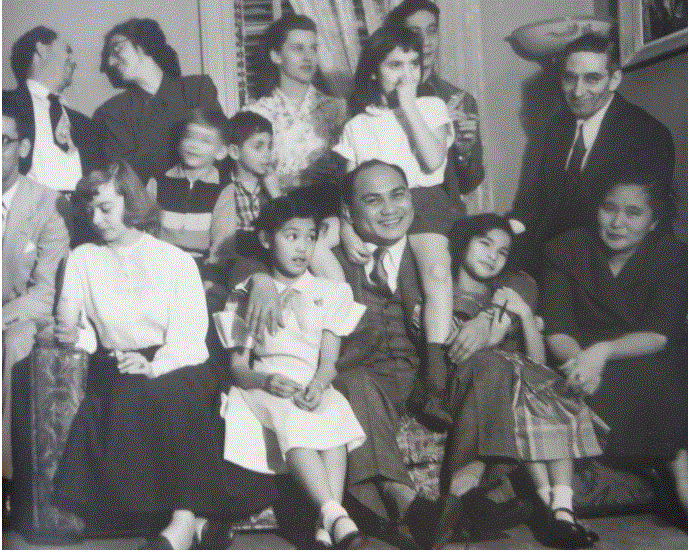
HANGING OUT IN THE TRADE- OLD STYLE: That’s me about the age of 8 sitting on the shoulders of S.P. Lopez, then Philippine ambassador to the UN in NYC. Also in the photo are my mom and dad (upper left) and my little brother David, (finger in his mouth). The date must have been the early 1950s when the grown-ups were planning a Philippine art exhibit and book show.
When he wasn’t soaking his stamps my dad would break the magazines for articles and fiction by well known authors and illustrators of the day. He’d extract writers like Mark Twain, Bret Harte, Joseph Conrad, and also color plates by artists like Howard Pyle, NC Wyeth, Jessie Wilcox Smith and Elizabeth Shippen Green. He’d rebind them in simple brown paper wraps he made and titled himself and glue the whole thing together with some early cousin of Elmer’s aka “gunk” aka “booksaver.” There was always a jar of that sticky fluid on his desk and when things got slow in stamp soaking he would turn his energy to winnowing the wheat from chaff in the old bound magazine department. He never broke his almost complete run of the Bureau of American Ethnology (BAE), so those volumes were eventually part of my own stock.
I think in those days we called that kind of breaking and clipping “vertical file” material. Today we call it ephemera. When he died it all came to me and he turned out to have very good taste. It all sold; I don’t have any left. Though I don’t soak stamps (because nobody uses stamps anymore) I still do keep a big clip file (minus the glue) but sad to say the quality of fiction and non-fiction first appearances of the 20th century was not as good (IMHO) as what was published in the mid-and late 19th century, or perhaps it is just that those volumes have become scarcer.
The other thing that was a standard feature of my childhood was the ceremonial visits of traveling PI countrymen. My folks had picked the Philippines as their specialty because my dad had been born there (Naga City) in 1912, one of three children of American school teachers. Though he had a US passport, he never really considered himself an “American” and I don’t think in more than a half century he ever got used to North American winters. He had a closet full of barong tagalog shirts (thin almost transparent long sleeved men’s shirts worn for dressy occasions). He liked nothing better than to get all duded up in this attire and hang out with the crowd that remembered “Manila before the war.”
I guess it shouldn’t have surprised me that there wasn’t a Filipino academic who passed within 500 miles of Detroit or Long Island who didn’t end up at our house for dinner and then went downstairs to spend more hours poking around the basement oohing and ahhing over our books. By the time America became involved with Vietnam the Filipino contingent was augmented by the foreign correspondents covering the war and the South East Asian graduate students looking to get the inside track on material that was becoming scarcer and more expensive.
My very favorite of all our Filipino friends from the early days was the SP Lopez family. SP was then a visiting diplomat and the head of the Philippine delegation to the United Nations. He, his associates from the legation and what few Filipino artists were living in NYC in the 1950s were always trying to cook up art exhibits and patronage for artists like Romeo Tabuena. My parents were always included. Us kids were just dragged along. We didn’t understand most of the conversation, but when SP’s family sat down for a meal, my God it was good! It’s 70 years later and I can still remember the first taste of pancit with calamansi.
Though I found my dad’s side of bookselling more appealing, I must say it was my mother who really came through for me when I went into business for myself in 1979. Though the men might have ruled the dealer’s world, it was the women who called the shots in special collections, libraries, archives and museums, and institutional purchases. By golly my mother seemed to know them all on a first name basis.
When I was just starting out as a Hawaiiana specialist my mother hooked me up with two of the best known women librarians in that field who, as a favor to her, would often ask me to quietly dispose of their duplicates, or would kindly help me authenticate some of my early acquisitions. It was my mother who introduced me to a Yorkshire dealer who had original 18th century Pacific watercolors which sold for fancy prices almost before the emulsions dried on the photos. It was also my mother who set me up with an appointment to meet Isador Berkelouw, the noted Australian dealer living in Santa Monica, whose succinct advice I have never forgotten: “Don’t fall in love with the merchandise.”
All things considered it was more fun to be in the trade before the internet. We had 4th Avenue. Bookselling was a clubby little world and everybody knew each other. The mania for the flawless dust jacket or the signed, limited, numbered edition bound in red morocco stamped in gilt had not yet emerged. It was simpler and it was more innocent. The things you could want seemed infinitely more possible to attain (For example I always wanted to be Walter Schaztski and have glass fronted fine wood bookshelves filled with deluxe early 20th illustrated books by Rackham and Dulac, and turn the pages sitting cross legged on his red Persian rug). I must have been about 10 when my dad first took me to his shop on East 57th St.
Here’s a quote from the NY Times written in 1976 when Schaztski’s shop closed that pretty well sums up what was better about him and the past in general.
Announcing the store’s closing, the Times wrote: “ Some of (the customers) are big-time collectors who can write a check for $550,000 and not think twice about it. But most of them are people who go to the store because they know that even if they have only 50 cents to spend they can come away with something they like and be treated exactly as if they were Paul Melion himself.”
I must confess I’m looking for that vibe to come again.
If by chance there are a few kids of booksellers who read this article, fear not, you might hate it, but in the fullness of time it turns out to be a pretty worthwhile experience, so hang in there. And just remember, it could be worse, you could have to crank the mimeograph.
Reach Susan Netzorg Halas at [email protected]