Rare Book Monthly

Articles - July - 2021 Issue

Mungo Park in Africa: A Classic, I Presume

Mungo Park’s Travels in the Interior Districts of Africa (London, 1799) is one of the most iconic travel books ever. It is the testimony of one of the very first white men to travel this part of the world, and to come back alive—and the very beginning of the true exploration of Africa by the Westerners.


Mungo’s travel was an official one, sponsored by the prestigious African Association based in London. The Association had sent a first explorer a few years earlier, Major Houghton—but he went missing, and the Association decided to send someone after him in 1795. “Supported by Sir Joseph Banks (who was part of the prestigious Association), Park was selected,” Wikipedia states. Mungo eventually did what no other European had done before, and when he came back two years and seven months later, the Association hastily published an abridged relation of his travel. A few months later, the full version, a genuine and fascinating relation, became a best seller.


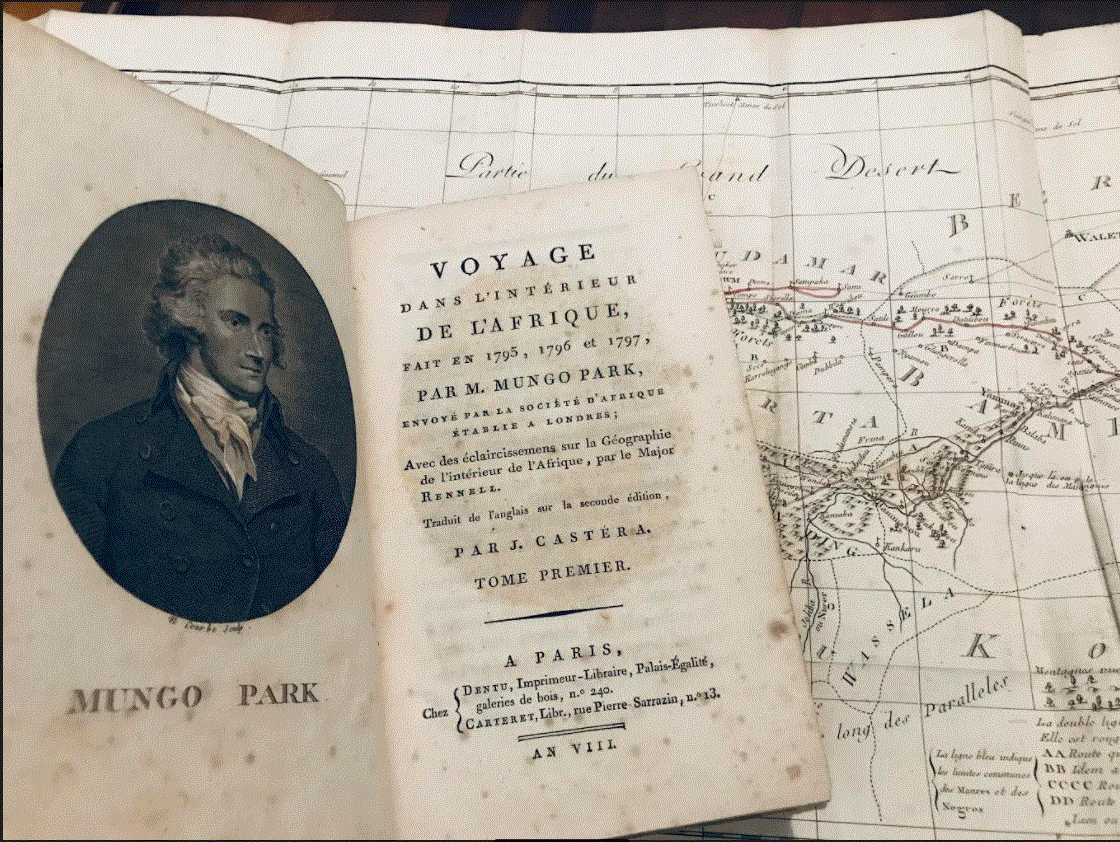
It was actually a game-changing book that opened the doors of Africa to European explorers. Mungo’s work quickly crossed the Channel, as Dentu and Carteret published it in French in 1799—the abridged version was also translated (Pougend, 1800). The success was immediate and a second French edition saw the light of day a few months later (Year VIII—1800). I was fortunate enough to recently grab a copy of this second edition. It is a typical post-Révolution (1789) book, a two in-8° volume set bound in half-leather. Times were rough in France, as everything was missing and expensive. Consequently, most books of the period were bound in the cheapest way—not to mention that external signs of wealth weren’t really fashionable.


My copy is also incomplete, as most copies. Indeed, two maps out of three are missing and the copper plates mentioned in the text were not bound with the book either. One bookseller, listing another copy of the same edition on the Internet, writes: “One map is missing, handwritten mention of the printer underlining that this map is out of print. No engraving in our copy. They are not even mentioned in the instructions to the binder, probably for the same reason.” That’s interesting—and it raises the question of what really makes a book complete or not? Indeed, those missing parts tell us a lot about the story of this book, and about the period it was printed—isn’t it a sort of supplementary information compared to a complete copy? Anyway, as long as complete copies sell for more, I guess this question will remain rhetorical.


Mungo found the remains of his “brave but unfortunate” Major Houghton, who had been robbed by the Moors, and left to die. “Whether he actually perished of hunger, or was murdered outright by the savage Mahomedans, is not certainly known; his body was dragged into the woods, and I was shewn at a distance, the spot where his remains were left to perish.


Mungo almost met the same tragic fate, as the interior districts of Africa were not safe for a lone white man. Especially when he was travelling through the regions controlled by the Moors. “They have something unpleasant in their aspect (...),” he writes, “a disposition towards cruelty and low cunning. (...) The treachery and malevolence are manifested in their plundering excursions against the Negro village.” The Negroes lived under the permanent threat of the Moors, who considered them as inferior. “When a boy has committed to memory a few of their prayers, and can read and write certain parts of the Koran he is reckoned sufficiently instructed. (...) Proud of his acquirements, he surveys with contempt the unlettered Negro.”


The more Mungo progressed in the interior of Africa, the more he had to deal with the Moors. In Deena, they “assembled around (my) hut, and treated me with the greatest insolence: they hissed, shouted, and abused me; they even spit in my face.” Mungo stoically endured their torments—he had no choice, as that they enjoyed plaguing the Christian, waiting for a good reason to kill him, as he presumes. At the end of the day, they kept him prisoner for months, starving him, mistreating him, and almost leading him to death—his eventually escaping them was a sort of miracle.


Mungo’s geographical discoveries, especially those regarding the Niger River, were historical—they are detailed in an appendix of the book. But most of all, he describes an unexpected Africa: a rich soil, abundant rains, organized cities and trades, as well as various languages. He met many slave traders, the Slatees, who procured him “safety and company” along the way. Most of them carried their dull “goods” to the coast, to trade with the European ships. One day, Mungo met a “coffle of seventy slaves” near Sego: “They were tied together by their necks with thongs of a bullock’s hide, twisted like a rope; seven slaves upon a thong; and a man with a musket between every seven. Many of the slaves were ill-conditioned.” Most slaves were war prisoners, others were born slaves. The Moors were deeply involved in the trade, selling their slaves to some Negro Slatees who would sell them back, whether to their compatriots—as a lot of Moors and Negro chiefs owned slaves—or to the Europeans.


Fierce lions preventing entire cities to get outside at night, deserts lying next to luxuriant fields, magnificent and mysterious rivers infested with crocodiles... Mungo Park unveiled an exciting and promising Africa to his readers, who rushed in his wake. He went back there himself, but only to meet his ultimate death in 1806. But that’s another story, and another book.
 

TE.

Rare Book Monthly

  • Forum Auctions
    Fine Books, Manuscripts and Works on Paper
    29th January 2026
    Forum, Jan. 29: Plato. [Apanta ta tou Platonos. Omnia Platonis opera], 2 parts in 2 vol., editio princeps of Plato's works in the original Greek, Venice, House of Aldus, 1513. £8,000-12,000
    Forum, Jan. 29: Book of Hours, Use of Rome, In Latin, illuminated manuscript on vellum, [Southern Netherlands (probably Bruges), c.1460]. £6,000-8,000
    Forum, Jan. 29: Correspondence and documents by or addressed to the first four Viscounts Molesworth and members of their families, letters and manuscripts, 1690-1783. £10,000-15,000
    Forum Auctions
    Fine Books, Manuscripts and Works on Paper
    29th January 2026
    Forum, Jan. 29: Shakespeare (William). The Dramatic Works, 9 vol., John and Josiah Boydell, 1802. £5,000-7,000
    Forum, Jan. 29: Joyce (James). Ulysses, first edition, one of 750 copies on handmade paper, Paris, Shakespeare and Company, 1922 £8,000-12,000
    Forum, Jan. 29: Powell (Anthony). [A Dance to the Music of Time], 12 vol., first editions, each with a signed presentation inscription from the author to Osbert Lancaster, 1951-75. £6,000-8,000
    Forum Auctions
    Fine Books, Manuscripts and Works on Paper
    29th January 2026
    Forum, Jan. 29: Chaucer (Geoffrey). Troilus and Criseyde, one of 225 copies on handmade paper, wood-engravings by Eric Gill, Waltham St.Lawrence, 1927. £3,000-4,000
    Forum, Jan. 29: Borges (Jorge Luis). Luna de Enfrente, first edition, one of 300 copies, presentation copy signed by the author to Leopoldo Marechal, Buenos Aires, Editorial Proa, 1925. £3,000-4,000
    Forum, Jan. 29: Nolli (Giovanni Battista). Nuova Pianta di Roma, Rome, 1748. £6,000-8,000
    Forum Auctions
    Fine Books, Manuscripts and Works on Paper
    29th January 2026
    Forum, Jan. 29: Roberts (David). The Holy Land, Syria, Idumea, Arabia, Egypt, & Nubia, 3 vol., first edition, 1842-49. £15,000-20,000
    Forum, Jan. 29: Blacker (William). Catechism of Fly Making, Angling and Dyeing, Published by the author, 1843. £3,000-4,000
    Forum, Jan. 29: Herschel (Sir John F. W.) Collection of 69 offprints, extracts and separate publications by Herschel, bound for his son, William James Herschel, 3 vol., [1813-50]. £15,000-20,000
  • Dominic Winter
    Books, Maps, Documents & Autographs
    Ornithology, Music, Bookplates
    28th January 2026
    Dominic Winter, Jan. 28: Lot 26. Company School. An album of 85 Indian mica paintings, Madras, c. 1852. £700-1,000
    Dominic Winter, Jan. 28: Lot 28. Ross & Hooker. Notes on the Botany of the Antarctic Voyage, 1st edition, 1843. £4,000-6,000
    Dominic Winter, Jan. 28: Lot 44. Gould (John). The Birds of Great Britain, 5 volumes, 1st edition, 1862-73. £30,000-40,000
    Dominic Winter
    Books, Maps, Documents & Autographs
    Ornithology, Music, Bookplates
    28th January 2026
    Dominic Winter, Jan. 28: Lot 72. Edwards (George). A Natural History of Uncommon Birds… [and] Gleanings of Natural History, 7 volumes, 1st edition, 1743-64. £7,000-10,000
    Dominic Winter, Jan. 28: Lot 87. Walcott (Charles D. et al.). Geologic Atlas of the United States, 227-volume set, U.S. Geological Survey, 1894-1945. £500-800
    Dominic Winter, Jan. 28: Lot 236. A New Dictionary of the Terms Ancient and Modern of the Canting Crew…, By B. E. Gent., 1st edition, [1699]. £3,000-4,000
    Dominic Winter
    Books, Maps, Documents & Autographs
    Ornithology, Music, Bookplates
    28th January 2026
    Dominic Winter, Jan. 28: Lot 245. Frost Fair Broadside. Upon the Frost in the Year 1739-40, Printed on the Ice upon the Thames at Queen-Hithe, 1739/40. £1,500-2,000
    Dominic Winter, Jan. 28: Lot 270. Micheli (Antonino di). La Nuova Chitarra di Regole…, 1st edition, Palermo, 1680. £10,000-15,000
    Dominic Winter, Jan. 28: Lot 280. Elgar (Edward). Concerto for Violin and Orchestra, [1910], signed presentation copy. £500-800
    Dominic Winter
    Books, Maps, Documents & Autographs
    Ornithology, Music, Bookplates
    28th January 2026
    Dominic Winter, Jan. 28: Lot 282 - Griffes (Charles). Autograph Manuscript Score for Overture to Hänsel und Gretel, c. 1910. £2,000-3,000
    Dominic Winter, Jan. 28: Lot 304. Churchill (Winston). A terracotta maquette of Churchill by Oscar Nemon, c. 1955. £1,500-2,000
    Dominic Winter, Jan. 28: Lot 364 - Russian Imperial Archaeological Commission. Mecheti Samarkanda..., Fascicule I Gour-Emir, St. Petersburg, 1905. £2,000-3,000
  • Sotheby’s
    Fine Manuscript and Printed Americana
    27 January 2026
    Sotheby’s, Jan. 27: An extraordinary pair of books from George Washington’s field library, marking the conjunction of Robert Rogers, George Washington, and Henry Knox. $1,200,000 to $1,800,000.
    Sotheby’s, Jan. 27: An extraordinary letter marking the conjunction of George Washington, the Marquis de Lafayette, and Benjamin Franklin. $1,000,000 to $1,500,000.
    Sotheby’s, Jan. 27: Virginia House of Delegates. The genesis of the Declaration of Independence and the Bill of Rights. $350,000 to $500,000.
    Sotheby’s
    Fine Manuscript and Printed Americana
    27 January 2026
    Sotheby’s, Jan. 27: (Gettysburg). “Genl. Doubleday has taken charge of the battle”: Autograph witness to the first day of the Battle of Gettysburg, illustrated by fourteen maps and plans. $200,000 to $300,000.
    Sotheby’s, Jan. 27: President Lincoln thanks a schoolboy on behalf of "all the children of the nation for his efforts to ensure "that this war shall be successful, and the Union be maintained and perpetuated." $200,000 to $300,000.
    Sotheby’s, Jan. 27: [World War II]. An archive of maps and files documenting the allied campaign in Europe, from the early stages of planning for D-Day and Operation Overlord, to Germany’s surrender. $200,000 to $300,000.

Article Search

Archived Articles