Twenty Years After They Went Missing, Cambridge University Library Concludes Its Darwin Notebooks Were Stolen
- by Michael Stillman
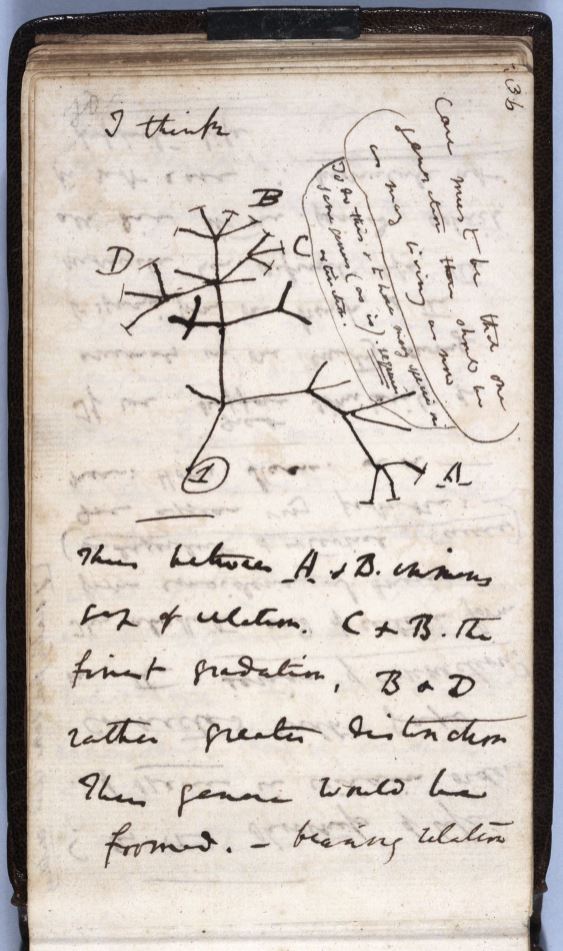
Darwin's Tree of Life (from Cambridge University Libraries website).
Two decades after they disappeared, the Cambridge University Library has concluded that two missing Charles Darwin notebooks have been stolen. That seems like a long time, but for the past 20 years the library has believed the notebooks were misplaced. If that sounds improbable, the Cambridge Special Collections rooms have millions of documents in countless boxes, occupying 28 miles of shelving. The entire library contains 130 miles of shelves. It's not that hard to imagine why librarians thought they were misfiled despite an inability to find them.
The missing notebooks were created by Darwin not long after his return home from his voyage on the ship the Beagle. That ship had spent much time surveying around the southern part of South America. Darwin was the ship's naturalist. He noted similarities yet differences between species in different areas and wondered how this happened. It would be the starting point for the development of his revolutionary theory of evolution.
Back home in 1837, Darwin wrote some of his thoughts in these notebooks. They are now known as the Transmutation Notebooks as Darwin began to theorize how one species could transmute to another. One of these notebooks contains his famous Tree of Life sketch, where he connects variant species to common ancestors. Darwin believed that as new species developed, older ones would be doomed to extinction, explaining why there are fossils of extinct plants and animals that are similar to living ones. In the months following, Darwin developed his theory of how some variants in species would be better adapted to their environment and would outcompete their ancestors, thus leading to the latter's extinction. Survival of the fittest.
By the early 1840s, Darwin had mostly figured out how species evolved, but he sat on it for years because he understood how controversial it would be. Most people believed new species were separate creations of God, and many would consider Darwin's theory to be sacrilege. It was only when Alfred Russel Wallace independently reached a similar conclusion about evolution that Darwin revealed his theory, the two publishing a joint paper in 1858.
The last known whereabouts of Darwin's notebooks goes all the way back to the summer of 2000. They were removed from the Special Collections strong room for photography. During a routine check in January 2001, it was discovered that the small box (size of a paperback book) containing the notebooks was missing from its proper location. That led to a search, and many others over the past 20 years, none of which was able to locate the notebooks. Librarians believed they were misshelved in the vast storerooms of the library, containing around 10 million items. They were never found.
At the beginning of 2020, Director of Library Services Dr. Jessica Gardner organized a new search. Various specialist staff were assigned to search different areas of the library, while a thorough search was conducted of the large Darwin collection. Again, nothing was found. In consultation with experts in the field of theft of cultural artifacts, the library has concluded that the most likely explanation is theft. Dr. Gardner noted that security 20 years ago was not the same as it is today. Something of this importance missing would be recognized immediately, and there is surveillance and other security measures in place today that did not exist back then.
This does not mean that the library has given up all hope that the notebooks are still somewhere in the library. Searches will continue, and it is estimated that a complete search will take another five years. Nonetheless, they will move forward under the belief that theft is the most likely explanation. Local law enforcement and Interpol have been notified. The missing notebooks have been entered in databases of missing items and the ABA (Antiquarian Booksellers Association) has been called on to keep their eyes open for someone attempting to sell them. The library is also calling on all private individuals who may know something about the notebooks, about how they disappeared 20 years ago or where they are today, to contact the Cambridge University Library or law enforcement.
If the Darwin notebooks were stolen, the question is who and why. Their value would be immense. The library said, “Given their unique nature, the value of the notebooks is difficult to estimate, but would probably run into millions of pounds.” We would only add to that “many” millions of pounds. However, their uniqueness and enormous importance makes them essentially unsaleable. Whoever might possess the notebooks would have to always be quiet about them, tell no one, never share with anyone that they have these notebooks. There will also be the fear that at some point someone will discover they have them and the penalty will be great. What is the point of stealing the notebooks for this?
Forum Auctions The 10th Anniversary Sale Fine Books, Manuscripts and Works on Paper July 16, 2026
Forum, July 16: Inundation papyrus. P.Michael 4, the ‘Inundation papyrus’, a geographical account of the Nile near Canopus, in Greek, remains of two columns from a manuscript scroll on papyrus, Egypt, second century CE. £12,000-18,000
Forum, July 16: Book of Hours, use of Sarum, manuscript on vellum, 6 full-page miniatures, with famous Middle English inscriptions, Southern Netherlands for the English market, [c.1430]. £30,000-50,000
Forum, July 16: Qu'ran, Arabic manuscript on burnished, stencilled, and gold-flecked paper, 447ff., Sultanate Gujarat, Ahmadabad, [after 1411 but no later than 1442]. £15,000-20,000
Forum Auctions The 10th Anniversary Sale Fine Books, Manuscripts and Works on Paper July 16, 2026
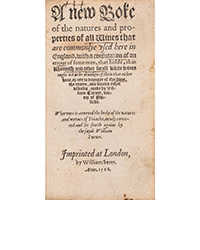
Forum, July 16: Turner (William). A New boke of the natures and properties of all wines that are commonly vsed here in England, rare first edition of the first English book on wine, By William Seres, 1568. £20,000-£30,000
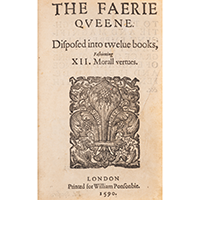
Forum, July 16: Spenser (Edmund). The Faerie Queene. first edition, Printed [by John Wolfe] for William Ponsonbie, 1590. £30,000-40,000
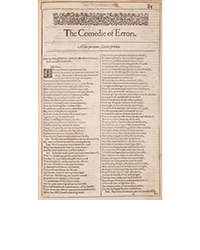
Forum, July 16: Shakespeare (William). The Comedie of Errors, extracted from the first folio, Isaac Jaggard and Edward Blount, 1623. £15,000-20,000
Forum Auctions The 10th Anniversary Sale Fine Books, Manuscripts and Works on Paper July 16, 2026
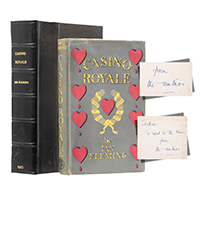
Forum, July 16: Fleming (Ian). Casino Royale, first edition, signed presentation inscription from the author, 1953. £40,000-60,000
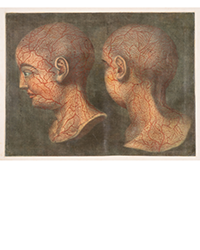
Forum, July 16: d'Agoty (Jacques-Fabien Gautier). Anatomie de la Tête, first edition, Paris, chez le Sieur Gautier, 1748. £10,000-15,000
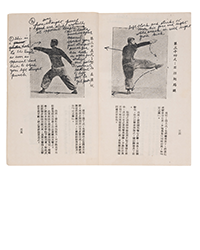
Forum, July 16: Martial Arts.- Lee (Bruce). 'Praying Mantis style' Kung Fu book, containing numerous annotations, diagrams and graphs in Bruce Lee's hand, c. 1960. £50,000-70,000
Forum Auctions The 10th Anniversary Sale Fine Books, Manuscripts and Works on Paper July 16, 2026
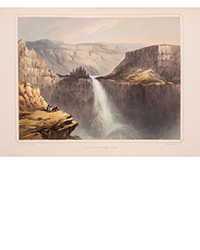
Forum, July 16: Warre (Capt. Henry James). Sketches in North America and the Oregon Territory, first edition, rare hand-coloured issue, 1848. £30,000-40,000
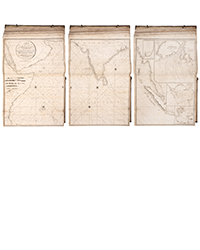
Forum, July 16: Norie (John William). The Marine Atlas, or Seaman's Complete Pilot for all the principal places in the known world..., 1826. £30,000-50,000
Forum, July 16: Mao Tse-tung.- Kim Il-sung.-[Note book for visitors from China to Korea], signed by Mao and Kim, [Beijing, 1954]. £10,000-15,000
Sotheby’s Shelf Life: Books, Manuscripts and Works on Paper from the Library of Stanley J. Seeger and Christopher Cone 25 June – July 7
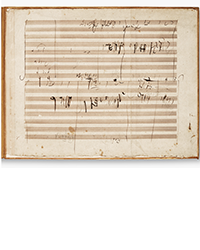
Sotheby’s, July 7: Ludwig van Beethoven. Autograph sketches for the overture "Die Weihe des Hauses", op.124, [1822], UNPUBLISHED. £150,000 to £200,000.
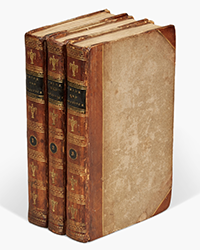
Sotheby’s, July 7: Jane Austen. Pride and Prejudice, 1813, first edition, 3 volumes, contemporary half calf. £50,000 to £70,000.
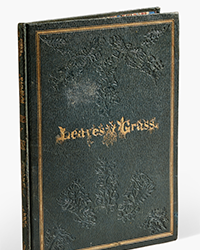
Sotheby’s, July 7: Walt Whitman. Leaves of Grass, Brooklyn, 1855, first edition, first issue, original green cloth, the Doheny copy. £50,000 to £70,000.
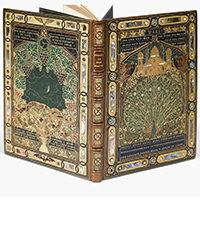
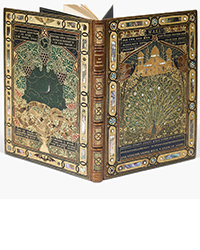
Sotheby’s, July 7: Binding—Sangorski & Sutcliffe—Omar Khayyam. Rubaiyat, London, 1872, third edition, in a magnificent jewelled Peacock binding. £15,000 to £20,000.
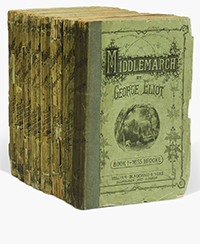
Sotheby’s, July 7: George Eliot. Middlemarch, Edinburgh and London, 1871, first edition in the original parts. £20,000 to £30,000.
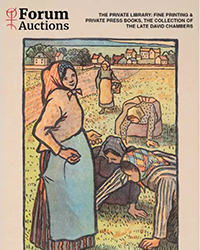
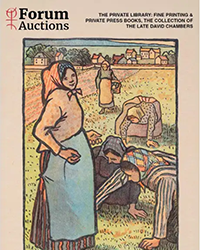
Forum Auctions The Private Library: Fine Printing & Private Press books, the collection of the late David Chambers July 9, 2026
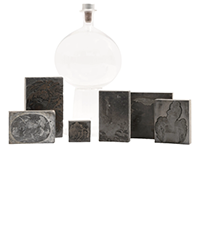
Forum, July 9: Hassall (Joan) A large collection of over 300 original woodblocks of engravings for various books, v.d., with Hassall's engraver's glass water-globe (Qty) - Est. £10,000-15,000
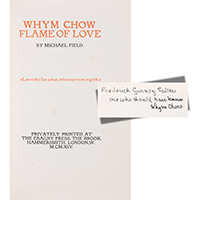
Forum, July 9: Eragny Press.- [Bradley (Katherine Harris) & Edith Emma Cooper], "Michael Field." Whym Chow, Flame of Love, one of only 27 copies, inscribed by Bradley, the rarest book from the press, 1914. - Est. £3,000-4,000
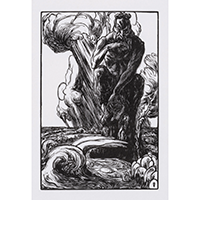
Forum, July 9: [Moore (Thomas Sturge)] [Wood Engravings], 71 wood-engravings printed by David Chambers from the original blocks, the only set on Japanese Hosho paper, from an edition of 5 sets, [1970]. - Est. £3,000-4,000
Forum Auctions The Private Library: Fine Printing & Private Press books, the collection of the late David Chambers July 9, 2026
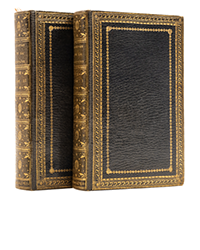
Forum, July 9: La Fontaine (Jean de) Contes et Nouvelles en vers, 2 vol., engraved plates after Eisen, fine early 19th century blue morocco, gilt, by Bradel l'ainé, Amsterdam [Paris], 1762. - Est. £2,000-3,000
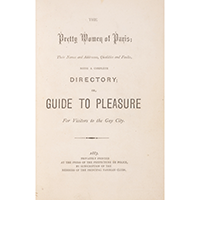
Forum, July 9: Erotica.- Prostitution.- Pretty Women of Paris (The); Their Names and Addresses, Qualities and Faults..., [Paris], privately printed at the Press of the Prefecture de Police, 1883. - Est. £3,000-4,000
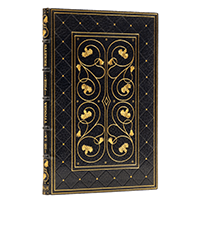
Forum, July 9: Vale Press.- Ricketts (Charles) & Lucien Pissarro. De la Typographie et de l'Harmonie de la Page Imprimée…, [one of 216 copies], bound in dark blue morocco tooled in gilt, by Sarah T.Prideaux, 1898. - Est. £1,000-1,500
Forum Auctions The Private Library: Fine Printing & Private Press books, the collection of the late David Chambers July 9, 2026
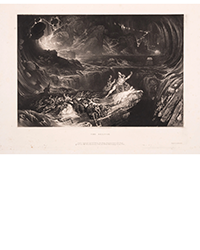
Forum, July 9: Martin (John) Illustrations of the Bible, complete set of 20 mezzotints, good impressions, rarely found in early states, [c.1831-1835]. - Est. £1,000-1,500
Forum, July 9: Golden Cockerel Press.- Four Gospels of the Lord Jesus Christ (The), one of 500 copies, Mary Gill's copy, Waltham St. Lawrence, 1931 with a signed proof of engraving on japon numbered 10/10 (2) - Est. £5,000-7,000
Forum, July 9: Boccaccio (Giovanni) The Decameron, 3 vol., vol.1 extra-illustrated by John Buckland Wright with c.150 erotic original drawings in pen & ink and pencil, 1886 [extra-illustrated c.1940]. - Est. £10,000-15,000
Forum Auctions The Private Library: Fine Printing & Private Press books, the collection of the late David Chambers July 9, 2026
Forum, July 9: Cox (Morris) Collection of Gogmagog Press Books, 35 vol., rare complete collection of printed books issued by the press, limited editions, most signed by Cox, 1957-83. - Est. £10,000-15,000
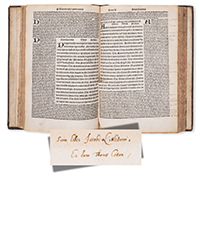
Forum, July 9: Wynkyn de Worde.- [Terentius Afer (Publius)] [Comedie...], [Paris, Josse Badius: sold in London by Wynkyn de Worde, & others], [15 July 1504]. - Est. £4,000-6,000
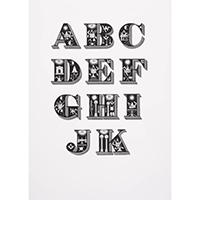
Forum, July 9: Mosley (James) Ornamented Types. Twenty-Three Alphabets from the Foundry of Louis John Pouchée, 2 vol., one of 10 copies for presentation, from an edition of 210, 1992-93. - Est. £1,000-2,000