This is the story of bookseller Clarence Wolf. He’s possesses the spirit of the great booksellers, exemplifying why the field is so compelling.
I have been a bookseller for over fifty years. It’s the only thing I’ve ever done, and for that matter ever really seriously considered. Books have always been a constant throughout my life. Both of my parents were bookish; my father was an artist and writer, and my mother was an editor. There were famous bookmen in my family, one of whom was Edwin Wolf II. Edwin was my cousin and mentor. He began his career working for A.S.W. Rosenbach in the late 1920’s, and was his cataloger for over 20 years, before becoming the librarian of the Library Company of Philadelphia. The Rosenbachs were cousins as well. The Doctor’s uncle, Moses Polock was also related to the Wolf family. Uncle Moses went to work as a teenager in the 1830’s for the Philadelphia bookselling firm of M’Carty & Davis. When Davis died in 1851 Moses bought the business. At the time of his death in 1903 he was one of the most knowledgeable and oldest bookmen in the country. Perhaps it’s in my blood.
In the late 1930’s my father had an art gallery in Philadelphia in the same building where George MacManus had his bookshop. They became friends, and soon began exchanging books and paintings. After a while they decided to go into business together, which they did sometime before 1940. Although my father owned half of the business, his involvement was punctuated with long absences. After George MacManus’ death in 1967 my parents decided to take over the MacManus Company. At that time my father was teaching at the Pennsylvania Academy of Fine Arts, and essentially had been absent from bookselling for many years. Although my father was extremely intelligent, and quite bookish, he was arguably one of the world’s worst businessmen, and was ill-suited to run a book business, or for that matter, any business. My mother might have won second prize in that contest. I came on board the following year. Although I had spent summers working for “Uncle George”, it wasn’t until I joined my parents that I felt that this was my destiny. Nothing ever felt as right as this did, nor did I ever feel as energized. After a couple of years my parents tired of being tethered to the shop and I took control of the MacManus Co.
In 1971, at the age of 23, I was now running the MacManus Co. It was a very different time, and the book business was quite different as well. Looking back, I think I was very fortunate to have started when I did. In those days the majority of our customers were institutions. And then the emphasis was more on scholarship than rarity. We issued a number of catalogs a year and sold vast quantities of scholarly books to colleges and universities. The gradual shift to selling rare books took place over a period of about ten years. I worked very hard, but I must admit that the supply of books and the number of people selling them made acquisitions so much easier than it is today. Once a month I would go to Boston as well as Baltimore and buy from Goodspeed’s, Morrill, Harris Auction, John Gach, and numerous others. Additionally, Philadelphia and the surrounding suburbs supplied me with lots of good books. There were monthly auctions at Freeman’s, not to mention the numerous calls we would get in those days when houses were being sold in Chestnut Hill, or on the Main Line. It was less competitive, and in many respects I think easier.
The people who really taught me the most, and were to varying degrees encouraging, were Edwin Wolf, Manny Kean, of the Kean Archives, and Norman Kane. Edwin was not given to hand-holding, and didn’t suffer fools gladly. I would visit him on a regular basis and allow him his pound of flesh in exchange for knowledge and a perspective few, if any could offer. After a few years this changed and I won his respect. Manny Kean on the other hand was the antithesis of Edwin. He was warm and encouraging, and had a very different teaching style. Norman Kane was a distinct presence in the first ten years of my career. He had worked for George MacManus from 1949 until 1960, so I knew him when I was growing up. Prior to Norman’s arrival, the MacManus Co. had always specialized in Americana, with a pronounced emphasis on local history. Norman established the literature department at MacManus, focusing mainly on 19th century American writers. He was brilliant, and really knew books. More importantly he knew the book business and how to run it. About a year after George MacManus’ death Norman sold my father his inventory. A couple of years later we made another large purchase. Since I really learned little or nothing from my parents, and my time working for George during the summers consisted mainly of performing menial tasks, I now had someone that I really could learn from. I visited Norman every month for years, and in addition we went on numerous buying trips together. Norman and I, along with George Allen went to the Lowdermilk sale in 1970. I remember we bought two truck- loads of books, some of which I still have. Another person from whom I learned a lot was David Holmes. Dave Holmes and I worked together for a little over eight years. He had his own book business in Boston which he left in order to come and join forces with me. He ran the literature department and I ran the Americana department. Our knowledge complemented one another. He greatly expanded our literature holdings and introduced 19th century British writers to our inventory. During those years the MacManus Company really grew. By the time Dave left and went back on his own we had become a force in the world of rare books. We stayed on the best of terms and continued to do business together until his untimely death a few years ago. I will forever be grateful for our time together. Dave was as kind and gracious a person as could be imagined.
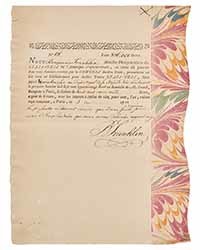
David Holmes’ arrival in 1975 marked the beginning of a period of real growth. Since I now had someone dealing with literature it enabled me to concentrate exclusively on Americana. It also was when we picked up some serious collectors. This was partially due to the fact that Mabel Zahn of Sessler’s died that year. Miss Zahn as she was known to most, was the doyenne of Philadelphia booksellers, and had a lock on old Philadelphia. She instilled loyalty in her customers, and was as old school as they came. Sessler’s simply was where one bought books. I can remember watching her bid at auction. She would always sit in the front row, and if you saw her raise her little finger to bid you knew that you were going home empty handed. The strangle hold that Sessler’s once had ended, and we benefited from it. One of the most memorable collectors that came to us after Miss Zahn died was Laird Park. Laird Park, and his mother before him were both serious collectors, and were both from the Sessler camp. Mr. Park was an imposing figure and extremely cautious as well. He owned Troemner and Co. of Philadelphia, a manufactory of precision balances and weights that was founded in 1840, by Henry Troemner, a German emigrant. Suffice it to say that his were exacting standards. I think he visited the shop a dozen times over a two or three year period before he made his first substantial purchase. At that point something clicked, and over the next twenty plus years we assembled a truly great collection of Americana. Shortly before his death Sotheby’s sold his collection. It was described as a mini-Streeter sale. It along with the Siebert and Snider sales were among three of the most important Americana sales of the second half of the 20th century. Frank Siebert, the great collector of Americana and rare Indian books was an old MacManus customer. He was a non-practicing pathologist, who, after an acrimonious divorce decamped from Pennsylvania and moved to Old Town, Maine. He lived like a hermit, subsisted on canned foods, wore the same clothes until they almost disintegrated. He was irascible, eccentric, had no time for most dealers and their “high priced junk”, the government, taxes and was as politically incorrect as could be imagined. Despite all that he had a brilliant mind, and as Edwin Wolf put, had a card catalog memory. Dr. Siebert spent some forty years compiling a Penobscot-English dictionary, and was one of the last people to speak it as well. When he would show up at our old shop in Philadelphia it was always in the late afternoon. He would then proceed to hold court until I finally(usually by fabricating some excuse) told him I had to leave. We had dealings and corresponded until his death in 1999. Bailey Bishop and I attended his funeral, where we were conscripted into pall-bearing service. It was one of the more surreal days of my career. During that same period I met Robert L. McNeil Jr. Bob McNeil was one of Philadelphia’s truly great collectors, as well as one of its great benefactors. He was my first mega-customer and whose collection of books and manuscripts was remarkable. A couple of years later I met Stuart Karu, with whom I built one of the best collections of books by, as well as ones printed by Benjamin Franklin. When his collection sold at Sotheby’s in 1992 it was arguably the best assemblage of Frankliniana offered at auction since the Pennypacker sale in 1905.I have always had a great interest in Franklin, and I have been fortunate enough to help build several other meaningful collections. I am currently working with Jay Snider, who is assembling a collection of Franklin materials that in all likelihood will be if not the greatest anyone has put together, close to it. His other two collections were both world class. The second Snider sale, sold by Bloomsbury in 2008 was the hands-down the best and most significant collection of Philadelphia and Pennsylvania materials ever offered at auction.
By the mid 1970’s I had begun to hit my stride and was dealing in rarer and more expensive books. I had business dealings with the colorful and controversial John H. Jenkins III, of Austin, whom I had first met at the Lowdermilk sale five years earlier. I always got along with Johnny, so when he purchased the Eberstadt collection in 1975 I was invited to go to Austin and have an early look at this treasure trove of Americana. I went with Steve Weissman, of Ximenes about a week after Jenkins had installed the collection. Seeing and handling rarity after rarity, and in some cases multiple copies of books that had vanished years earlier was somewhat of a jaw-dropping experience. The two generations of Eberstadts had dominated the field of Western Americana and their inventory was without equal. After staying up looking at books until I was cross-eyed and then repeating the process the next day, Johnny, along with his entourage took us out to dinner. One member of the group who stands out in my memory was Ray Walton, a larger than life Texan, whose appetite must have seriously depleted the shrimp population of the Gulf. Those were heady times, and Johnny was in his glory. I was very pleased with my purchases, and as a result made regular visits to Austin over the next ten years.
On one of my trips to Austin I met a young Bill Reese. At that time, while still at Yale, Bill was already in the book business. He and Fred White owned Frontier America Corp that was based in Bryan Texas, and specialized in Western Americana. I had first met Bill several years earlier when he accompanied his parents on a trip to Philadelphia, and visited my shop. At 14 he was a force to be reckoned with. He succeeded in putting me through my paces, and left me feeling somewhat incredulous in the wake of a remarkable display of knowledge and erudition. In 1979, Bill dissolved his partnership with Fred and moved to New Haven. From the time Bill established himself in New Haven until his death in June, 2018 we were in constant contact. We owned and sold untold numbers of books together, and became the closest of friends. He was the brightest star in our book universe. My association and friendship with Bill was hands down the most important one that I have ever made. He has left a void that will never be filled. Happily his wife Dorothy Hurt has kept the business going, and Nick Aretakis is continuing the good work.
Another association that played an important role in my development was my relationship with John C. Dann, the former director of the Clements Library. Although we had several encounters in the years prior to 1977, when John became director, it wasn’t until the following year that we connected. I remember that shortly after issuing a rare Americana catalog John called and ordered a number of books that were in my wheelhouse. Something clicked, we recognized our similar tastes, and a wonderful friendship developed. I started bidding for the Clements at auction and helped them acquire books and manuscripts for their collection. Eventually I was asked to join the board of the library, where I have had the honor to serve for over 20 years. John is one of the last great Americanists , and is another person to whom I owe a great deal.
As I have stated earlier, we started by selling mostly scholarly books, and that our focus in Americana was primarily local history. This has changed. Among the reasons for the changes are the internet and a general lack of interest in local history. It would seem as if local histories were prized because of their informational value. They, along with other reference books have essentially been made superfluous because all that they offer may be viewed in cyber space. There are still some collectors of antiquarian local histories, but they are in a distinct minority. We, along with businesses like Goodspeed’s and Tuttle sold untold numbers of local histories and genealogies. Today they sell slowly. The same can be said of standard rarities. It’s a great time for a beginning collector because in many cases when you go on line it’s a race to the bottom, and prizes may be had for considerably less than would have been the case pre-internet. The other big change in our business is the disappearance of a lot of institutional business. So many colleges and universities have had their budgets cut, or their special collections discontinued. Now, during the current pandemic it’s even more pronounced. Fortunately there seems to be enough individual participation to sustain us.
Things change. There has never been a time when dealers didn’t lament the fact that things were becoming less and less plentiful and that in essence the glass was half full. In 1891 William Brotherhead , the acerbic author of “Forty Years Among the Old Booksellers of Philadelphia” goes on and on about how, after the Brinley sales it was all over. I’m much more of an optimist. I believe that that if you look hard enough you will make discoveries. I believe that despite a lot of the current desire to bury or destroy our history, good or bad, it’s still relevant. The secret to my success is simple: hard work. I worked very hard, and continue to do so. In addition, my advice is not to depend on any one thing. Keep several balls in the air. I work because I love it, and am energized by it. Retirement is not an option. After turning 90, George Goodspeed said apropos of retirement that if he went to Florida in January he’d be dead by February. I concur.