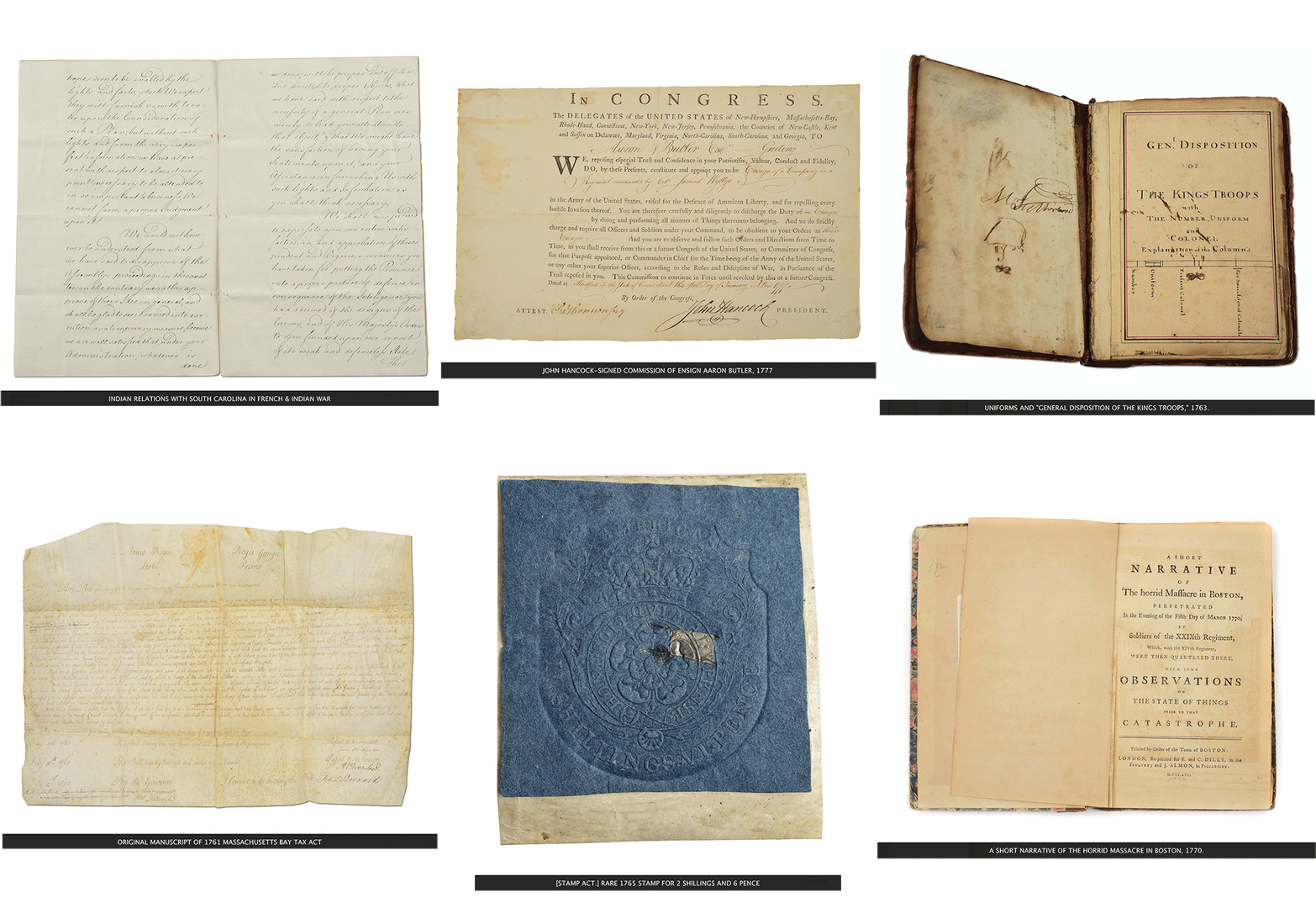
The personal collection of Al Benting, comprising 210 lots of Revolutionary and War of 1812 material, is to be sold at Morphy’s in Denver, Pennsylvania on May 27th. Winning bidders will be ecstatic and losing bidders grief stricken. It’s just one of those sales, that with one glance you realize you rarely see so much exceptionally unusual and important material. Bon Chance!
A sumptuous catalogued presentation is available in both digital and traditional printed forms [links below].
Mr. Benting has provided a letter explaining why the material is unusually good. It was born of attitude and is expressed in the collection’s name: “For Liberty, I Live.” From there are links to the catalogue, to the slide show on RBH along with links providing access to additional images and contacts to Morphy’s curators.
Make bidding arrangements early. The auction will be widely subscribed.
This book illustrates my collection amassed over the last quarter of a century with God’s help, luck, perseverance, networking, research, debt, and quite a bit of love and understanding from my wife, Jane, without whom, the collection and this book never would have come into being.
It seems to me that a good collection is built depending simply upon which finger God points at you when he says, “Your turn,” but usually, the best items come along when you have the least amount of money to spend.
Well before my time in the early days of collections, informationon eighteenth-century militaria was scarce, and many collector-accumulators amassed great piles of stuff based upon price, with one piece or another, except by luck, having very little relevance to the others in the “collection”. The really old-time collector might have had a closet full of Brown Bess muskets, most could hardly distinguish an early one from a late model until around the third quarter of the twentieth century when scholars had written enough to begin a rudimentary understanding of what many items really are.
One of the first collector scholars of the old generation whom I am proud to have known is George Neumann, who passionately wrote with great common sense but with little research material available beyond dug artifacts, old information, and great instinct. In the beginning, without scholars like George, I doubt that a great deal of today’s knowledge would exist because research builds upon prior research, just as knowledge builds upon itself. I confess that even though we sometimes disagreed on what some things are and were, I consider George, in his boundless passion and patriotism, to be the father of modern Revolutionary War collecting. When he passed away, so did his great knowledge understanding, and kindness.
By no means were George’s works, Swords and Blades of the American Revolution and Battle Weapons of the American Revolution, the only references of importance at the time; there are many other excellent writers who did great research in the same time frame, just as many of today’s writers are constantly publishing new discoveries based upon old information and a new tidbit or two.
I count myself fortunate to have known and been somewhat educated by many of the “old generation” collectors and dealers who knew some of the really old-timers. These men, like Bill Guthman, who sold me several items herein illustrated – to whom I am greatly indebted – went on to uncover a great deal of information about early military artifacts.
Many of these collectors have contributed greatly to my life, and, of course, to this book. Dealers like Neumann, Guthman, and Al Thompson – who was not very happy when Bill Coakley sold me my first musket marked to the 17th Massachusetts – have passed away. Since I began my quest, every item in the collection has left memories, mostly good, which I store in heart and mind. Coakley, for instance, was a stickler on condition and the relevance of one piece to another. He would annually drop by to seemingly “ruthlessly” evaluate my collection. I used to tease that because Bill was a banker, he had no heart; but under his great guidance, many romantic notions I used to have rapidly became irrelevant! Some good things left the collection because they were not pertinent to it, but the proceeds from these items and the many blunders I made along the way – some of them horrific- paid for other more pertinent things. These mistakes certainly sharpened my eye.
I honestly believe that if a collector never makes a mistake, he is not working hard enough in his endeavors. Years ago, for a lot of money, I bought a Committee of Safety musket made up of a French musket with spurious maker’s marks on the lock in an auction. There’s no better way to learn about an item than by taking a hit on something that should have been but isn’t. Lose money once, and you never forget!
On another bad day, I bought a pair of pistols with an outstanding holster from a Cape Cod dealer who swore it had come from inside the wall of an old house in Boston and had been used at the outbreak of the Revolution. The author, friend, and voracious collector, Bob Brooker, with his gargantuan laugh and infinite knowledge shortly thereafter straightened me out (hopefully forever) about a collector’s wishful thinking. I remember his scathing words: “Al, those are pretty good, but what do Persian pistols have to do with the Siege of Boston?” Being either hardheaded or a dumb collector, I hope I have now learned that every item I buy must stand on its own, regardless of the “sizzle” offered by the seller. Yes, the pistols were used during the turbulent years in Boston but hallway around the world.
It seems pertinent to understand that a little bit of knowledge may be worse than none; however, like the occasion
I went on a call to buy a gun that “had been at Concord Bridge,” only to discover that the musket was an early nineteenth-century model Springfield. I was told that the family had sold the “beat-up old fowler” because it “was not military so was not used in the revolution.”
On the other hand, the musket herein illustrated and believed carried by Captain Joseph Robins at Concord Bridge
is from the original Robbins estate in Acton, Massachusetts, which was inherited by my father in the late 1960s. He knew the gun, the great family historian, my ancient uncle Fred Robbins knew the gun, and I knew it was a kid while visiting the family home in Acton. One can be reasonably sure that because each part on the musket dates to before the revolution, that because the musket came from historic circumstances from a family that never bought but only inherited antiques, there’s an excellent chance that this is indeed, Joseph Robin’s musket. Unfortunately, my dad sold the engraved powder horn belonging to Robins. It’s a cut-down horn that later showed up in Bill Guthman’s collection and is now, to my knowledge, displayed at the museum in Deerfield, Massachusetts.
Today’s collecting process demands constant alteration to one’s thinking not only because of new research, but also because many items have become insanely expensive. I tell beginning collectors that these days, even just one item might well comprise a great “collection”. Perhaps a few items grouped together, in which every item enhances the value and interest of the entire lot, makes the best collection.
Knowledge, even more important than money, is paramount to building a great collection. Every item must stand on its own and enhance interest in the whole, regardless of the romantic story offered by the seller, who always seems to be your newest best friend. History fall into place in a much more logical fashion when you know as much or more than the seller does, and good items are best illustrated in one’s collection by the items surrounding it.
I was casually asked one Sunday afternoon at a Mass Arms Collector’s meeting, “What do you collect?” I said, “Lexington, Concord, Bunker Hill, and the Siege of Boston prior to March of 1776, inside the Route 128 beltway except for Concord, which bumps out a little bit to the West,” but tis is not to say that my collection has not and could not be somehow convoluted to include other cool items I just could not live another day without!
I don’t think my collection will ever be finished, except, well, perhaps when I’m dead, when all my “pals” will be Jane’s pals lined up like buzzards on a split rail fence, ready to pounce on the carrion of my collection before my dead body is even a bit cool. My goal, however, is to take my last ride in a very heavy coffin clanking down the church’s aisle, supported by my four nephews and two sons-in-law, with all my stuff and me inside.
Al Benting
2000 North Reading Road
Denver, PA 17517
Phone: 717-335-3435 | Fax: 717-336-7115
Email: [email protected].
Links: Morphy Auctions Website: https://www.morphyauctions.com/
Links: Morphy Auctions: Upcoming Auctions https://www.morphyauctions.com/auctions/
Links: Morphy Auctions: Bidding Options: https://www.morphyauctions.com/bidding/