Editor's Note: Christie's sale on December 5th of Fine Printed Books and Manuscripts Including Americana contains a beautiful selection of manuscripts from the Jay T. Snider Collection. This is Books & Manuscripts specialist at Christie's Rhiannon Knol's take on the significance of manuscripts in the field.
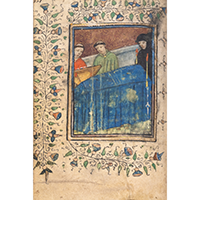
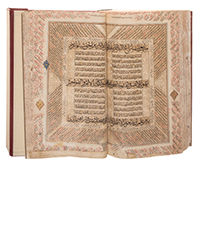
After over 500 years of the Gutenberg Galaxy, what explains the lingering allure of the manuscript? This question finds a ready answer in the diverse and lucid collection of Jay T. Snider, which spans centuries and continents yet broadcasts—in both its whole and its every part—what the artist Ben Shahn described as “an immediate sense of the hand that made the letters… the joy of workmanship that no time or weathering can erase.” While the category ‘illuminated manuscript’ is usually associated with medieval Europe, none here predate the invention of printing in the West. Gutenberg’s printing press may have industrialized book production, but it could never totally displace the role of the written word and the painted image.
While print means copies, a manuscript signifies an original, not mechanically produced, but handmade. Manuscripts bring us into the realm of the private diary, the personal sketchbook, and the draft—the places where human imagination, artistry, and knowledge germinate. Take, for example, a notebook in the Snider collection kept by several generations of nuns at the convent of Saint Godelieve (lot 145). Inside, numerous neat hands in French and Flemish record the collective knowledge of the convent on dyeing, paper making, embroidery, and other textile crafts. Inside its covers (themselves a manuscript salvaged from a Medieval antiphonal) scraps of inspiration have been lovingly preserved: illuminated borders from books of hours, a prayer card, cut-out paintings of fruit. On the other side of the Atlantic in the same century, Bethlemite monks in Mexico were crafting a large illuminated missal (lot 159). Although the Spanish had been printing in the New World for nearly two centuries, the manuscript tradition was alive and well—producing Baroque masterpieces which combined European and Native traditions of art and book production to honor the glory of God.
The heightened possibilities offered by words interplaying with images in handwritten and painted works also make these ideal vehicles for communicating scientific knowledge. A nineteenth-century illustrated manuscript recension of an ancient Indian veterinary text reveals this accretion of knowledge over time, with recipes added in several hands (lot 163). At the same time, a handsome manuscript document of the butterflies of Estonia underscores the importance of the scientific eye working in concert with the hand to capture the splendor of nature (lot 162). In 19th-century China, artists painted watercolors for the export market, producing astonishing renderings of native flora for discerning foreign scholars who did not trust engravings done by artists who had never seen their subjects (lot 155), as well as luminous gem-like miniatures to meet the tastes of collectors from London to Moscow (lot 156).
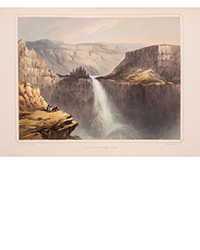
Across Europe and America, artists and travelers recorded their views of the world on a human scale. The American folk artist Lewis Miller captured the bustling cities of Germany in his “Reise Journal” (lot 150) while British engineer and draftsman Henry Drayson did the same for the dramatic landscapes of the American Northeast (lot 152). Princess Maria Anna of Prussia and Elisa D’Angleville both kept albums of their work as artists, tracing not only the development of their skills and the settings of their daily lives, but the landscapes of their interior life as well (lots 148 and 149).
Edo Japan’s manuscript tradition thrived alongside print, as scholars recorded ancient knowledge in elaborately folded books, calligraphers vaunted their art, and scribes copied secret or censored material for private circulation (lots 164-168). Manuscripts are also, of course, the province of secret knowledge. The Russian Old Believers, an often-persecuted breakaway sect from the Orthodox church, preserved centuries of ancient tradition in their manuscripts (lots 157 and 158). Cut off from the structures of the church, their sect spurred a growth in literacy as members took interpretive control into their own hands—their visionary theological manuscripts revealing a non-systematic knowledge infused with natural rationalism and creative imagination.
Handwriting is one of the tracks of the body, a leaving behind of the traces of human identity. Communities are recorded, sometimes created, in the pages of books. During the Medieval period, the operation of the memory itself was figured as a form of writing, with the writing of the scribe on vellum (made from animal skin) likened to experiences and emotions inscribing themselves onto the living flesh of the mind. Still today this metaphor has longevity, not lost to old technologies but resurrected for the language of computers and the digital, which write memory in bits and bytes onto the hard drive. The manuscript as an object offers a rare intimacy with the human mind of the long dead past.
Thus, when Marco Verricci presented his album of fantastical cities to Doge Marino Grimani in 1595, he was not giving a gift of paper and ink but of the imagination itself, pressed into the service of the glory of Venice (lot 169). In the age of print—and the era of the email—the manuscript is not less relevant at all, but only more precious and imbued with human meaning.