Rare Book Monthly

Articles - April - 2017 Issue

A Study of Old Book Smell Is Being Conducted at the Morgan Library

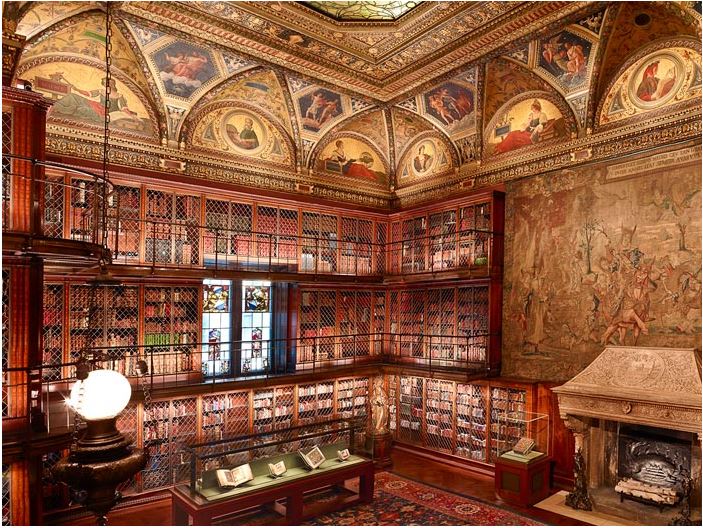
Pierpont Morgan's personal library (from the Morgan Library website).

Pierpont Morgan's personal library (from the Morgan Library website).

An unusual study of old books and smells is taking place at the Morgan Library in New York, combining the library, students from the Columbia Graduate School of Architecture Planning and Preservation, and the company International Flavors and Fragrances. The students are placing a clear, bell-shaped device, with sensors at the top and an air hose running to the side, on top of old books and whatever else they want to sample. The samples are then taken to IFF where they will be analyzed in the months ahead.


They aren't sampling just any old books, or any location in the building. The work is being done in the personal library of J. Pierpont Morgan, the turn of the century extraordinarily wealthy banker, industrialist and philanthropist, who used some of that wealth to collect rare books. He left his library to the public when he died. That was over a century ago, but his personal library hasn't changed all that much since he left.


This study was recently reported in the art blog Hyperalleric with a follow-up from the New York Times. I must admit that after reading both articles, I'm not quite sure why they are doing this. It is certainly an esoteric study. The Times came closest to understanding the intent, noting that maybe it could be used to recreate the smells of the old library for an exhibit, to "experience the library in a different way." They quoted Christine Nelson, a curator at the library, with the mystical explanation, "When we started this, we didn’t really know where this would go, and we still don’t, quite; it’s still an experiment." Whatever the purpose, the smell of old books is distinctive and a magnet to book collectors. It is not a pleasant aroma on its own, but an associative one, like "new car" smell, mainly a byproduct of glue, vinyl, plastics, and lubricants, people love only because they associate it with new cars.


We should note that this is not the first study done on the smell of old books. A study was conducted and posted to Analytical Chemistry in 2009 entitled Material Degradomics: On the Smell of Old Books. This one had more of a specific purpose – to help conservators preserve the old books under their care. Different books give off different odors depending on their paper and other elements of composition. These differences may not be easily recognizable to humans, who probably lump them all together as being the smell of old books. However, when instruments designed to calculate the chemical compositions of the VOC's (volatile organic compounds) are used to determine their precise make up, the composition of each book can be determined. This, in turn, allows conservators to determine the best course of action to preserve each particular book based on its precise composition.


The authors of the study, Matija Strlic, Jacob Thomas, Tanja Trafela, Linda Cséfalvayova´, Irena Kralj Cigic´, Jana Kolar, and May Cassar, described the smell as, "a combination of grassy notes with a tang of acids and a hint of vanilla over an underlying mustiness." This sounds like wine-tasters language. The most important compounds and factors, they determined, are rosin, lignin and carbonyl group content, degree of polymerization of cellulose, and paper acidity. Around 1850, rosin replaced gelatin to make ink adhere to the paper. Aluminum sulfate was used to get the rosin to precipitate to the fibers. Aluminum sulfate is acidic, explaining the more rapid deterioration of paper common to post-1850 books.


For chemists seeking more detail about the literally hundreds of volatile and semi-volatile gasses given off by the old books, those most commonly found were acetic acid, benzaldehyde, 2,3-butanedione, butanol, decanal, 2,3-dihydrofuran, 2-ethylhexanol, furfural, hexadecane, hexanal, methoxyphenyloxime, nonanal, octanal, pentanal, and undecane.
Rare Book Monthly

  • Forum Auctions
    Online: India
    Ends 19th February 2026
    Forum, Feb. 19: Lot 40
    Ramasvami (Kavali Venkata). A Digest of the Different Castes of India, 83 charming hand-coloured lithographed plates, Madras, 1837. £5,000-7,000
    Forum, Feb. 19: Lot 50
    Watson (John Forbes) & John William Kaye. The People of India: A Series of Photographic Illustrations...of the Races and Tribes of Hindustan, 8 vol., 480 mounted albumen prints, 1868-75. £4,000-6,000
    Forum, Feb. 19: Lot 53
    Afghanistan.- Elphinstone (Hon. Mountstuart). An Account of the Kingdom of Caubul, first edition, hand-coloured aquatint plates, a fine copy, 1815. £2,000-3,000
    Forum, Feb. 19: Lot 57
    [Album and Treatise on Hinduism], manuscript treatise on Hinduism in French, 31 watercolours of Hindu deities, Pondicherry, 1865. £3,000-4,000
    Forum, Feb. 19: Lot 62 Allan (Capt. Alexander). Views in the Mysore Country, [1794]. £2,000-3,000
    Forum Auctions
    Online: India
    Ends 19th February 2026
    Forum, Feb. 19: Lot 76
    Bird (James). Historical Researches on the Origin and Principles of the Bauddha and Jaina Religions..., first edition, lithographed plates, Bombay, American Mission Press, 1847. £3,000-4,000
    Forum, Feb. 19: Lot 100
    Ceylon.- Daniell (Samuel). A Picturesque Illustration of the scenery, animals, and native inhabitants, of the Island of Ceylon: in twelve plates, 1808. £5,000-7,000
    Forum, Feb. 19: Lot 123
    D'Oyly (Charles). Behar Amateur Lithographic Scrap Book, lithographed throughout with title and 55 plates mounted on 43 paper leaves, [Patna], [1828]. £3,000-5,000
    Forum, Feb. 19: Lot 139
    Gandhi (known as Mahatma Gandhi,) Fine Autograph Letter signed to Jawaharlal Nehru, Sevagram, Wardha, 1942, emphasising the importance of education in rural communities. £10,000-15,000
    Forum Auctions
    Online: India
    Ends 19th February 2026
    Forum, Feb. 19: Lot 140
    Gantz (John). Indian Microcosm, first edition, Madras, John Gantz & Son, 1827. £10,000-15,000
    Forum, Feb. 19: Lot 146
    Grierson (Sir George Abraham). Linguistic Survey of India, 11 vol. in 20, folding maps, original cloth, Calcutta, Superintendent Government Printing, 1903-28. £2,000-3,000
    Forum, Feb. 19: Lot 195
    Madras.- Fort St. George Gazette (The), No.276-331, pp.493-936 and Index to all of 1834 at end, modern half calf, Madras, 2nd July - 31st December 1834. £2,000-3,000
    Forum, Feb. 19: Lot 205
    Marshall (Sir John) and Alfred Foucher. The Monuments of Sanchi, 3 vol., first edition, 141 plates, most photogravure, [Calcutta], [1940]. £3,000-4,000
  • Il Ponte, Feb. 25-26: HAMILTON, Sir William (1730-1803) - Campi Phlegraei. Napoli: [Pietro Fabris], 1776, 1779. € 30.000 - 50.000
    Il Ponte, Feb. 25-26: [MORTIER] - BLAEU, Joannes (1596-1673) - Het Nieuw Stede Boek van Italie. Amsterdam: Pieter Mortier, 1704-1705. € 15.000 - 25.000
    Il Ponte, Feb. 25-26: TULLIO D'ALBISOLA (1899-1971) - Bruno MUNARI (1907-1998) - L'Anguria lirica (lungo poema passionale). Roma e Savona: Edizioni Futuriste di Poesia, senza data [ma 1933?]. € 20.000 - 30.000
    Il Ponte, Feb. 25-26: IL MANOSCRITTO RITROVATO DI IPPOLITA MARIA SFORZA. TITO LIVIO - Ab Urbe Condita. Prima Decade. Manoscritto miniato su pergamena, metà XV secolo. € 280.000 - 350.000
  • Sotheby's Fine Books & Manuscripts
    Available for Immediate Purchase
    Sotheby’s: Balthus, Emily Brontë. Wuthering Heights, New York: The Limited Editions Club, 1993. 6,600 USD.
    Sotheby’s: Charles Dickens. Complete Works, Philadelphia & London: J.B. Lippincott Company & Chapman & Hall, LD, 1850. Limited Edition set of 30 volumes. 7,500 USD.
    Sotheby’s: John Lennon, Yoko Ono. Handwritten Letter from John Lennon and Yoko Ono to their Chauffer. 1971. 32,500 USD.
    Sotheby’s: Winston Churchill. First edition of War Speeches, Cassell and Company, Ltd., 1941. Set of 7 volumes. 5,500 USD.
    Sotheby’s: Andy Warhol, Julia Warhola. Holy Cats First Edition, Signed by Andy Warhol. 1954. 30,000 USD.

Article Search

Archived Articles