The Last of the Reversed Ones.
Whitesell tells about the first frontispiece only. But we learnt about the three next ones thanks to another bibliophilist, who happily popped in our discussion with Florian Balduc: “I know of another ‘inversed set’ copy,” he rejoiced. “My own!” Then, he posted some pictures. And guess what, he had never noticed this detail before! So, just as we thought that there was no more copies of this surprising set on the French soil, we were proven wrong! A closer examination of this miraculous edition showed that, although it was indeed published in Year V (1797), it is totally different from the so-called “second edition” with the regular engravings: fewer pages (185 for the second volume of the regular edition, only 170 for the inversed one), different drop caps, different alignments of letters, and different printing defects. So Maradan printed a third edition in 1797, and illustrated it with these ‘inversed’ frontispieces—or was it the real second edition? It is obvious, anyway, that there were three editions of Le Moine in the course of the Year V (1797). On his website, Florian Balduc states: “This last set is different but contrary to the one used for the Year VI (1798) edition—where the engraving is more ‘raw’—, this one, though less ‘detailed’, is ‘richer’, and features some details absent from the others. Could it be, in fact, the very first set of these engravings?” That’s a possibility, indeed.
There are many other obscure facts about the French editions of The Monk. Let’s mention the Favre edition of 1797, to start with; which came out under the title Le Jacobin espagnol / The Spanish Jacobin. It is a set of 4 in-16° volumes, and it comes with 4 engravings too—but they have nothing in common with the Maradan’s. This is a redacted version, with not a supernatural manifestation left. The book even ends up well, with a marriage! Furthermore, Ambrosio meets his death in a very conventional way—exit the most terrible scene of the book, when the devil comes to fetch him in his cell to buy his soul! Apparently, this edition was successful as well, and it was reprinted the following year—it has become very rare. It was never a problem for booksellers to rework a book, adding, removing or rewriting entire passages. Translation was no art, and there was nothing sacred with writing novels. As a matter of fact, Lewis was the first one to censor his work. When the book was first published, “the committees of morality were outraged,” reads the notes of a modern edition of Le Moine (Gallimard Folio, 1966). “Lewis and his publisher were sued and Lewis condemned to expunge the third edition of The Monk. (...) We may wonder if his homosexuality was not responsible for his very complying submission. He probably didn’t want the police to enquire about his morality, fearing he might face public dishonour.”
In France, Maradan decided to change a few details. The monk is not a Capuchin anymore but a Dominican, for example, etc. That’s why Antonin Artaud, who gave a translation of the book in the early 20th century, thought that the only reliable translation was Léon de Wailly’s, published in 1840 (Paris, chez Dellaye). He could not praise it less, he who, as confessed to a friend in April 1933, could “hardly read English at all. ” (Gallimard, 1966). In fact, he more or less reworked Wailly’s version to come up with something, which, he says in his forewords, “is neither a translation nor an adaptation (...) but some sort of French copy of the original text.”
This book was so powerful that it somewhat ate up its own author. First, Lewis became known as “Monk” Lewis. Then, in 1808, after several mediocre publications, he wrote in the forewords of Venoni: “The act of composing has ceased to amuse me; I feel like I am not likely to write better than I have done already.” Later on, “Monk” Lewis inherited two sugar plantations in Jamaica from his deceased father, and he went twice there, dying at sea on his way back from his second voyage. The journal of his residence in Jamaica, The Journal of a West India Proprietor (London, 1834), remains his most interesting work after The Monk.
Thibault Ehrengardt

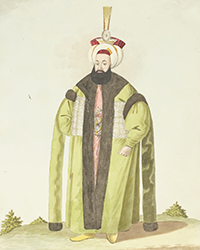
![<b>Gros & Delettrez, Feb. 11:</b> DALVIMART, Octavien ou d’ALVIMAR(T)]. CLARK. The Military Costume of Turkey](https://ae-files.s3.amazonaws.com/AdvertisementPhotos/ca2d66a9-721d-4878-a2eb-51a7bb9a3889.jpg "<b>Gros & Delettrez, Feb. 11:</b> DALVIMART, Octavien ou d’ALVIMAR(T)]. CLARK. The Military Costume of Turkey")