An archive representing the creative genius of a man who was the voice of a generation has come out of the shadows, to be accessible to scholars in an institutional setting. That voice of the baby boom generation is the freewheelin' Bob Dylan; the institution the University of Tulsa. Huh?
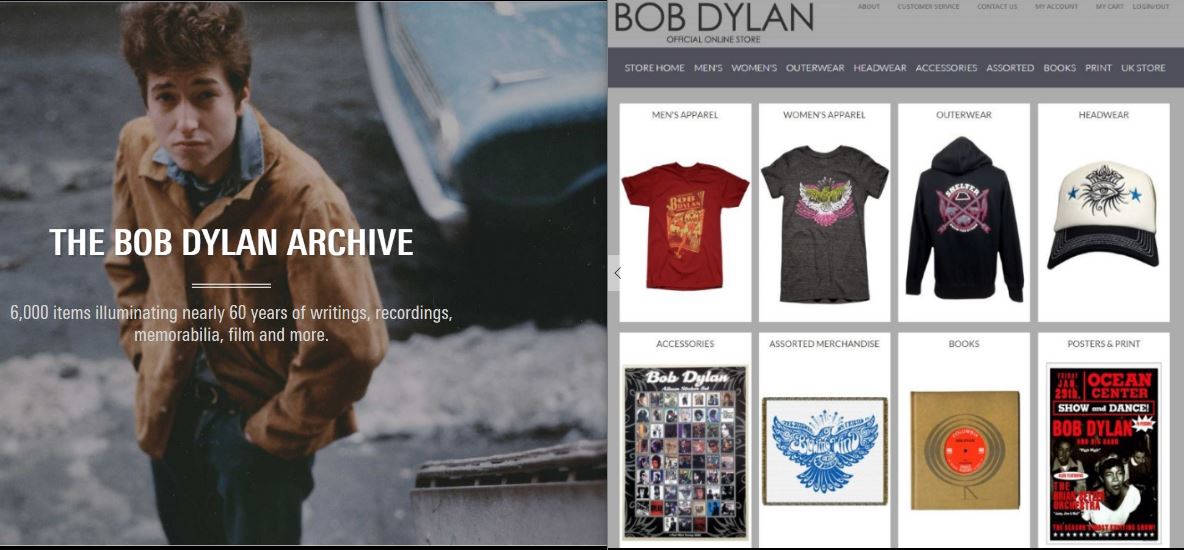
The archive consists of over 6,000 items, spanning Dylan's career. They go back as far as the 1950's, when no one outside of his hometown in Minnesota had ever heard of him. The high points of his career are generously represented. From the unplugged folk troubadour of the early 1960's, to the controversial electrified Dylan of the late '60's, to the Blood on the Tracks time in the 1970's, it's all here. After that, a new generation and new spokesmen took over as the voice of youth. Dylan's role was supplanted by the Bee Gees. :'-(
The most notable item in the archive appears to be a notebook from 1974 with handwritten lyrics for songs from the Blood on the Tracks album, including Tangled Up in Blue and Idiot Wind. It was his biggest selling album. There are sketches and written notes for Tarantula, Dylan's shot at poetry without musical accompaniment. Naturally, there is much more, including his earliest recordings from 1959.
While it has long been surmised that Bob Dylan must have a collection of his personal memorabilia, the extent of this archive came as something of a surprise. With Dylan about to reach his 75th birthday in a few weeks, his seeking a permanent home for it should not be surprising. However, it was not a gift. Rolling Stone magazine said that it was sold for an estimated $15-$20 million. They also said it had been estimated to be worth $60 million, so perhaps Dylan sold it at a discount so that it would end up at a library associated with the University of Tulsa.
Nevertheless, that is a lot of money. If Dylan was once the voice of a generation that eschewed material wealth for peace, love and freedom, his orientation since the days he bunked with friends while introducing his songs to the beat community of New York has changed over the years. He is believed to own 11 homes, some of which are quite luxurious. Dylan is quite secretive about his personal life, almost never giving interviews. He is known to have had two wives and three children, but rumors persist that he has had more of each. His secretiveness is such that it is conceivable that this could be true despite his being such a major public figure. Certainly, there have been numerous other women with whom he has been involved. It also should be noted Dylan has not been accused of being ungenerous to those in his life, at least not financially, even if he has not always been the perfect family man. All of this requires a substantial amount of money.
Dylan, whose appearances were limited as he quickly rose to great renown in the 1960's, today tours constantly. Two reasons have been given for it. One is financial – that he needs the money to support his lifestyle, in particular, maintaining his many homes. That is ironic since, being constantly on the road, he has little time to spend in them. The official Bob Dylan website is essentially a commercial venture, selling everything Bob Dylan, from music to t-shirts. The other reason given for his constant touring is that he truly is a rolling stone, unable to settle down anywhere, a man who must keep moving to survive.
But why Tulsa? The money? Something else? Perhaps this is like asking why Dylan chose to record an album of Frank Sinatra songs. Mysterious. Thankfully, as best I know, Sinatra never returned the favor.
As to the new location for his archive, Dylan has no particular connection to Tulsa. He grew up in Minnesota. He lived in a couple of places, but all within that state. When he had perfected his craft well enough to try taking it on the road, he headed to New York City. That is even farther, both measurably and spiritually, from Oklahoma. He hung around Manhattan, befriending the beats and their culture, singing his folk songs, and developing a following that would soon explode as he reached people's souls in a way few, if any others, of his generation did.
University of Tulsa President Steadman Upham issued a statement that attempted to explain their good fortune. "Because of the level of scholarship available through the university and its partners," he explained, "TU is the perfect keeper of the Bob Dylan Archive." That kind of begs the question. Aren't there comparably good keepers in New York, or Minnesota? Aren't the kind of scholars likely to want to study Dylan's work in depth more likely to be found in New York City than Tulsa?
Perhaps Dylan's comment, part of a PR release, explains his motivation: "I’m glad that my archives, which have been collected all these years, have finally found a home and are to be included with the works of Woody Guthrie and especially alongside all the valuable artifacts from the Native American Nations. To me it makes a lot of sense and it’s a great honor." Whether the money or Woody Guthrie was the primary motivation only Dylan knows, and one can be sure he will not tell us. There is no question Guthrie's music had a major impact on Dylan. It is likely no one else was as influential on him, and Dylan has long acknowledged that debt. When he made it to New York, he made a point of often visiting his idol. Unfortunately, by then Guthrie had been institutionalized for Huntington's disease, which not only ravishes your body, but also your mind. He was not in a position to mentor his disciple.
For Guthrie's archive to be housed in Tulsa makes perfect sense. He was born and raised in Oklahoma. He sang about the hard times of the Depression, and few people were as badly impacted by those times as the people of Oklahoma. At one point he took off for California, like so many fellow "Okies" in Grapes of Wrath times, though he got into the music rather than the agricultural business in California, later migrating to New York. However, even there, Guthrie maintained his Okie identity. His archives belong in Oklahoma. As for Dylan, well, I guess if you are a troubadour, you live your life like a rolling stone, Tulsa makes as much sense as anyplace.